
Each term links to the guide or tool that explains it, where one is built. Palmistry is a tradition for reflection, not a science: the definitions say what the books read, never what will happen. Hindi names marked * are less settled and still wait for a check by our Hindi reviewer.
Palmistry and its traditions
Palmistry हस्तरेखा शास्त्र
Palmistry (palm reading, Hast Rekha Shastra) is the old tradition of reading the lines, mounts and shape of the hand for character. It is a tradition for reflection, not a science.
Read more: How to read palm lines
Chiromancy काइरोमैंसी
Chiromancy is the older word for reading the lines of the palm; the classical books use it for the line-reading half of palmistry.
Read more: How to read palm lines
Chirognomy काइरोग्नोमी
Chirognomy is the older word for reading the shape of the hand and fingers, the other half of palmistry beside the lines.
Read more: How to read palm lines
Samudrika Shastra सामुद्रिक शास्त्र
Samudrika Shastra is the Indian tradition of reading the body’s features, of which hand reading (Hast Rekha) is one part.
Hindu astrology भारतीय ज्योतिष
Hindu astrology (Jyotisha) is the Indian astrological tradition; Indian palmistry names the mounts after the same planets.
Astrology फलित ज्योतिष
Astrology reads the positions of the sun, moon and planets for meaning. Like palmistry, it is a tradition, not a science.
Read more: Is palmistry true?
Divination भविष्य-कथन
Divination is any practice that claims to see the future or hidden things; palmistry was long counted among them.
Palmist हस्तरेखा विशेषज्ञ
A palmist (palm reader) is a person who reads hands by the rules of palmistry.
The hand and which hand to read
Hand हाथ
The hand is the end of the arm: the palm, four fingers and the thumb. Palmistry reads its shape, lines and mounts.
Read more: How to read palm lines
Palm हथेली
The palm is the inner, central part of the hand between the wrist and the fingers, where the lines are.
Read more: Lines on your palm
Fingerprint अंगुलि छाप
A fingerprint is the ridge pattern on a fingertip, studied by science as dermatoglyphics. Palm lines are creases, not ridges.
Read more: Is palmistry true?
Thenar eminence अंगूठे के नीचे का उभार
The thenar eminence is the fleshy pad at the base of the thumb; palmistry calls roughly this area the mount of Venus.
Hypothenar eminence छोटी उंगली की ओर का उभार
The hypothenar eminence is the fleshy edge of the palm below the little finger; palmistry calls roughly its lower part the mount of the Moon.
Handedness हाथ की प्रधानता
Handedness is a person’s preference for using one hand more than the other: right-handed, left-handed or both.
Read more: Which hand to read
Dominant hand प्रमुख हाथ
Your dominant hand is the one you use most, usually the hand you write with. Palmistry reads it as the life you are making.
Read more: Which hand to read
The major lines
Palm lines हाथ की रेखाएं
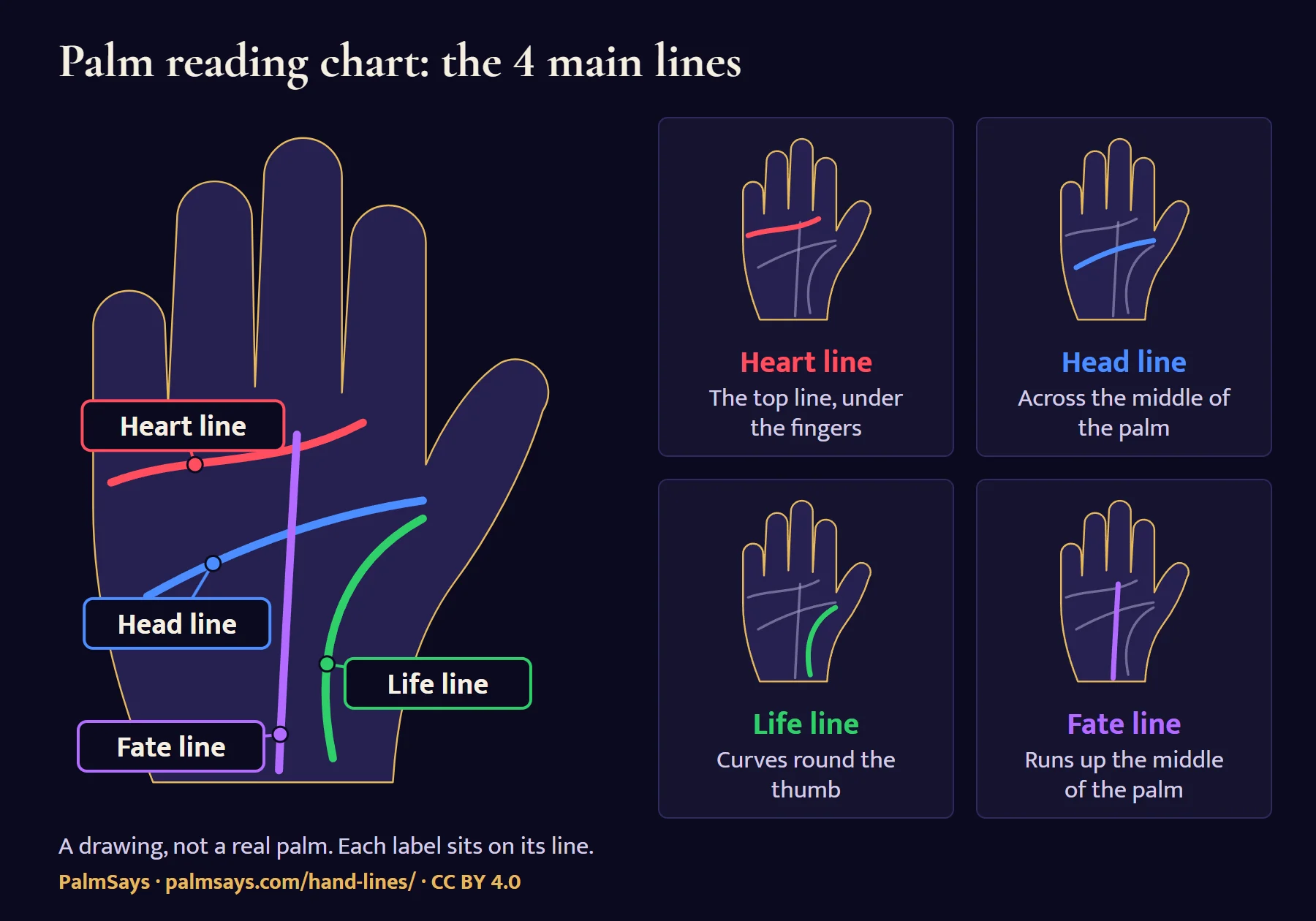
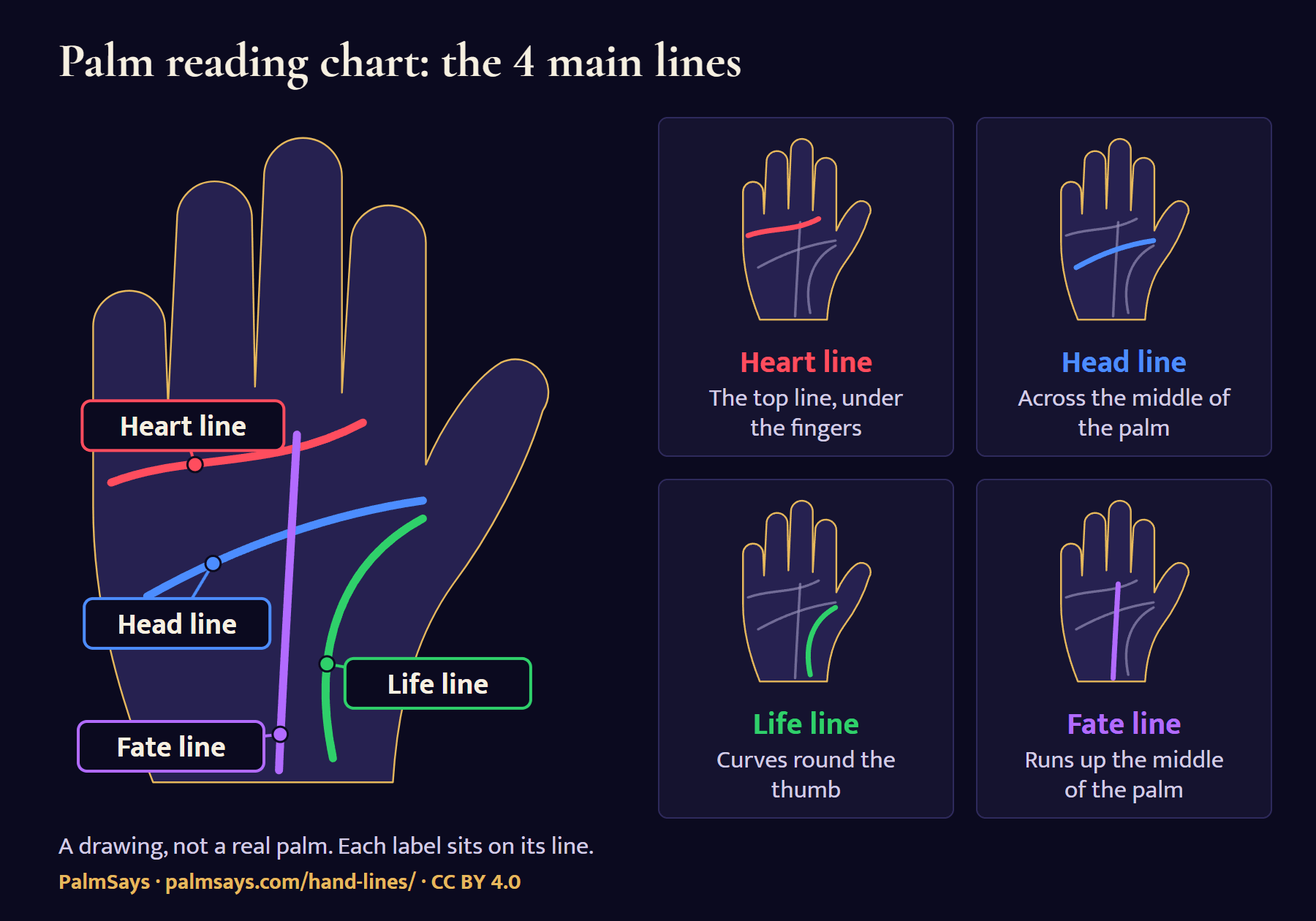
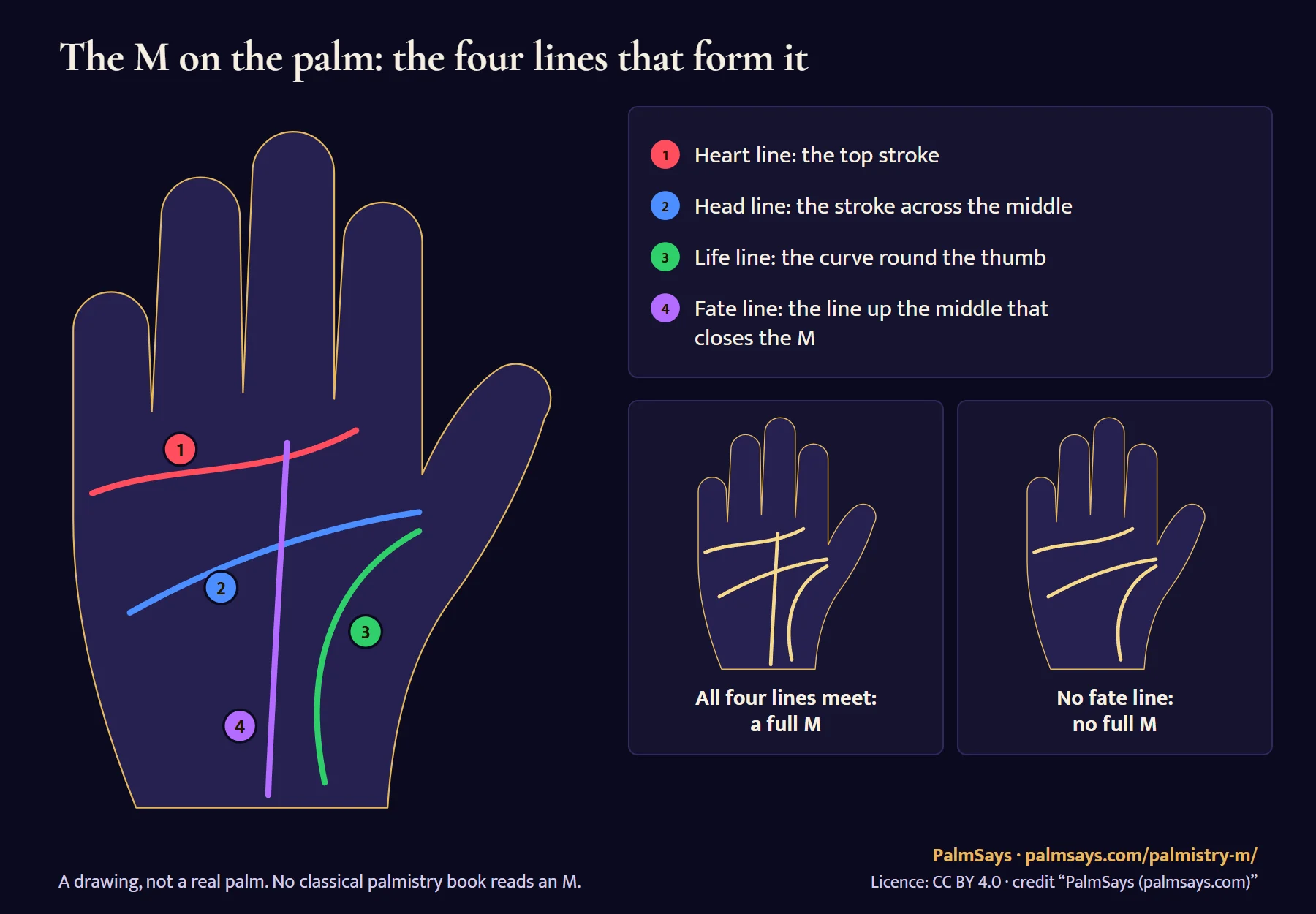
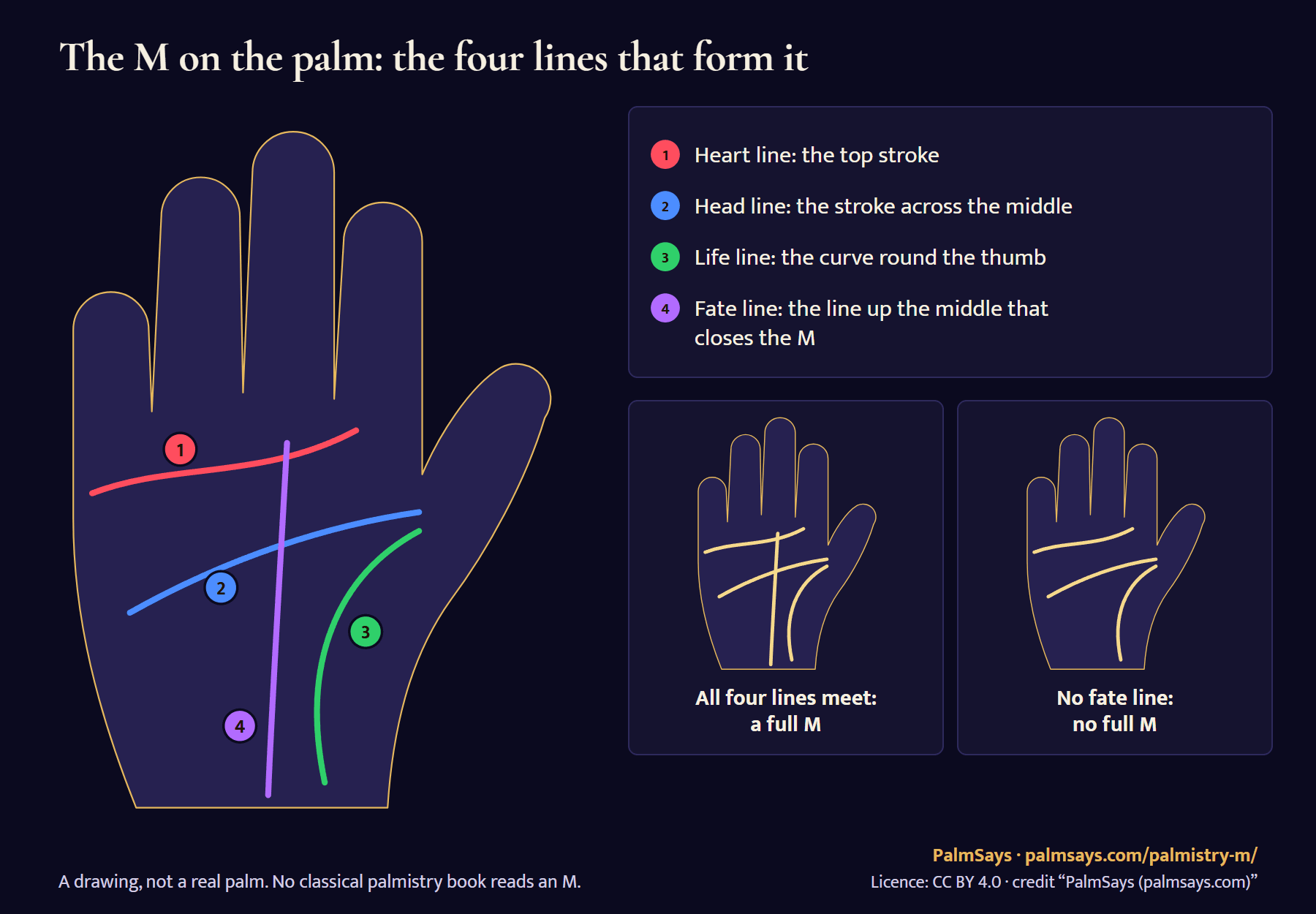
Palm lines are the creases of the palm. Most palms have three major lines (heart, head and life), and many also have a fate line and smaller lines.
Read more: Lines on your palm
Heart line हृदय रेखा
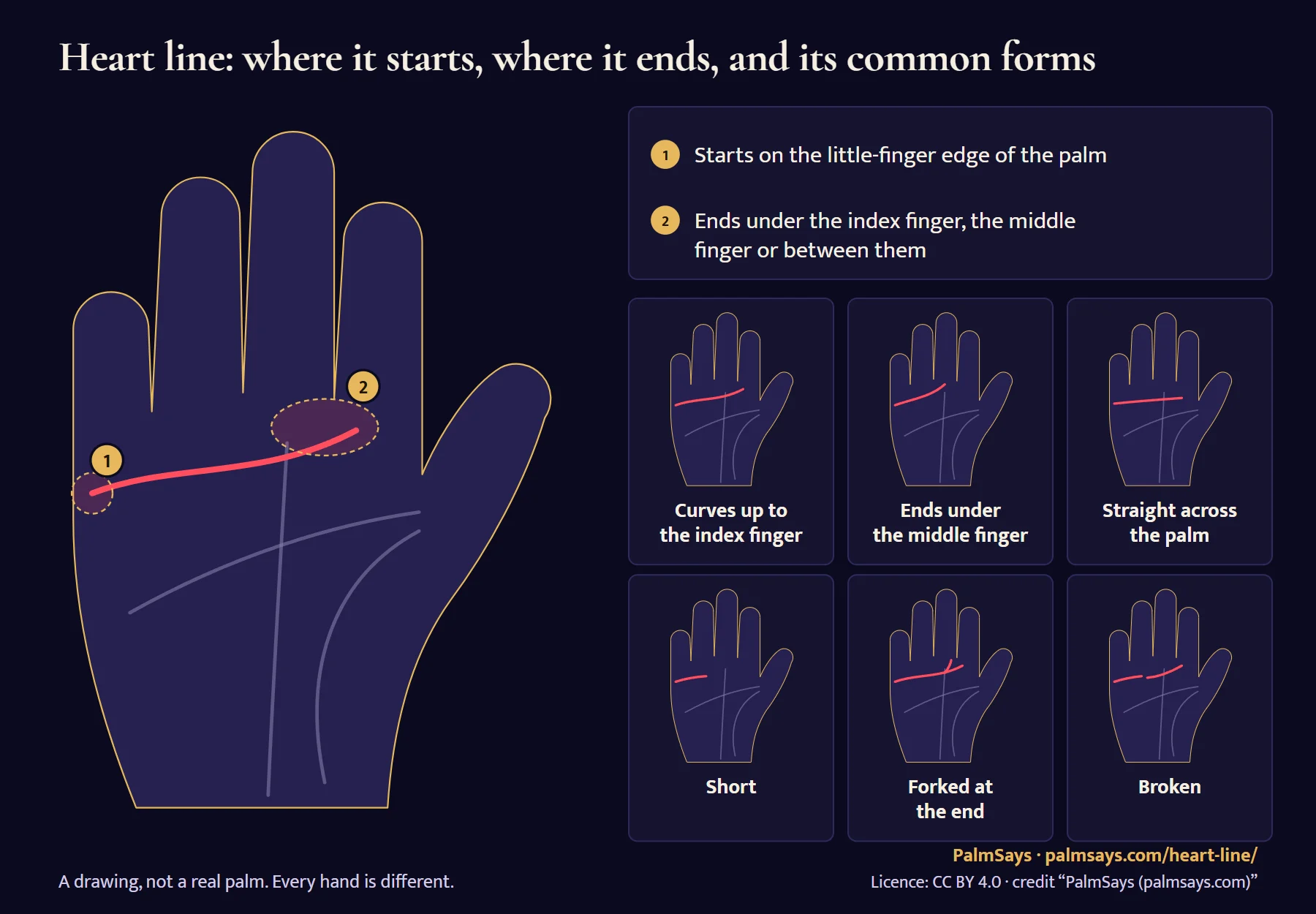
The heart line is the top line across the palm, just under the fingers. Palmistry reads it for your emotional style: how you show affection and relate to people.
Read more: Heart line
Head line मस्तिष्क रेखा
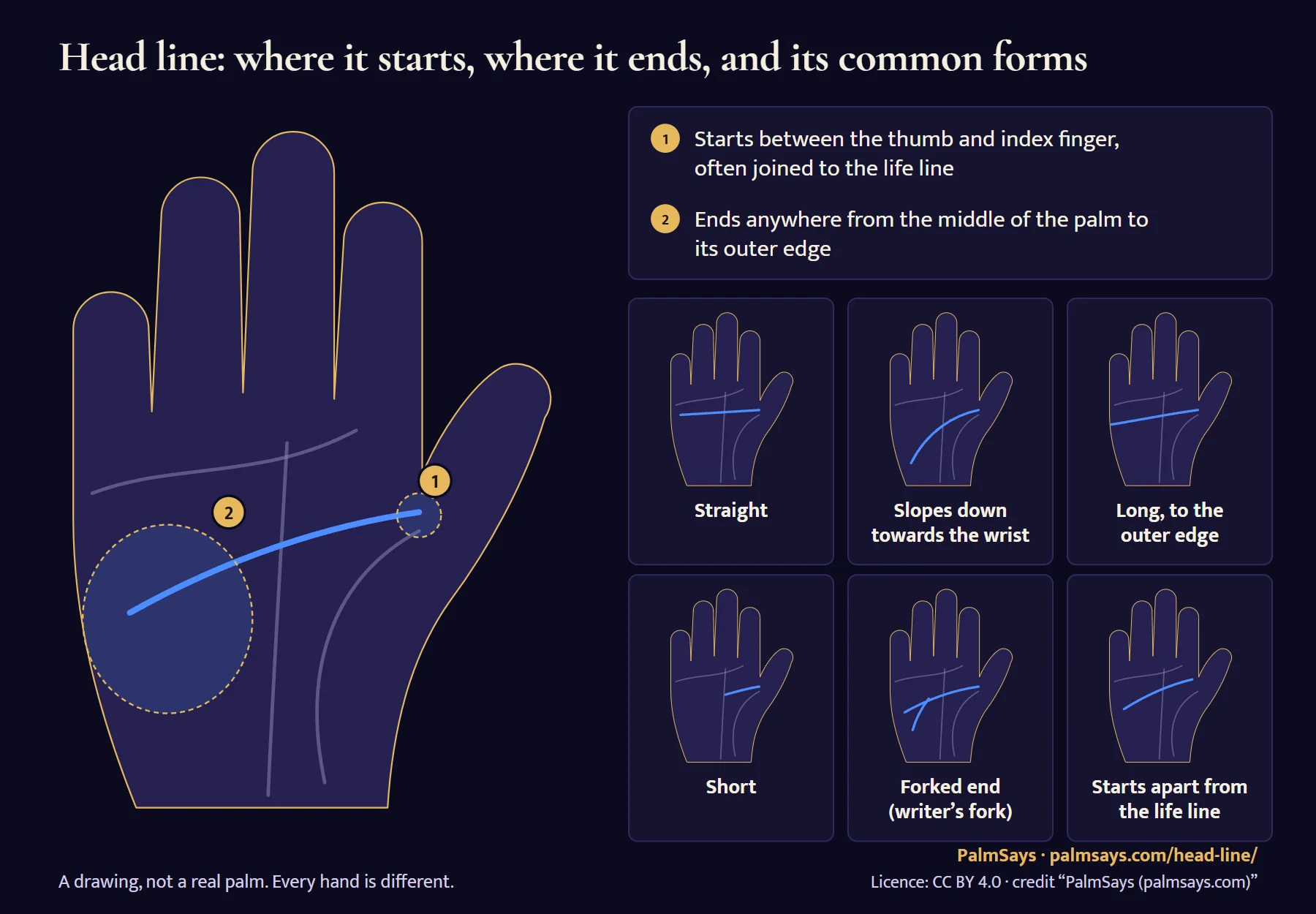
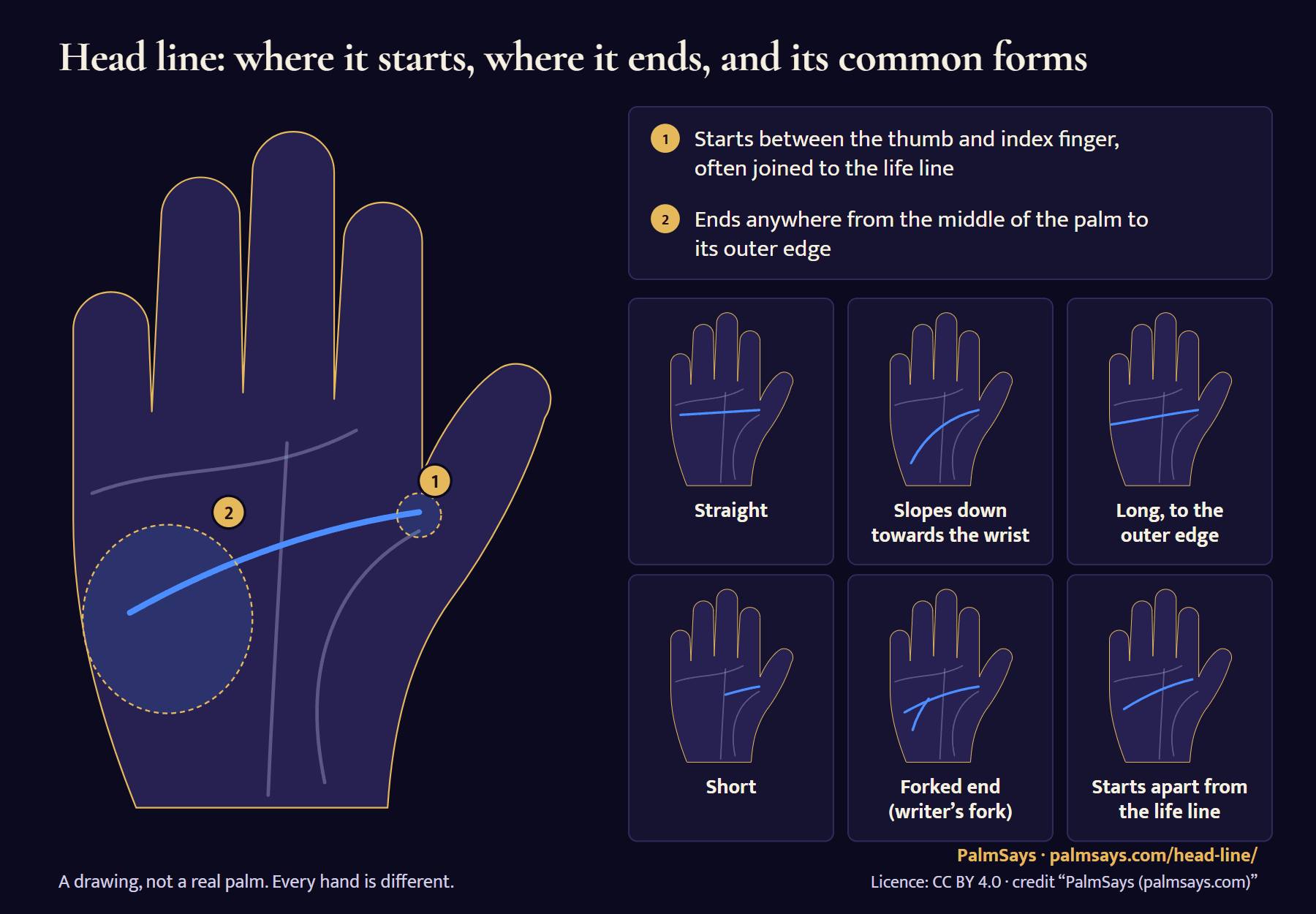
The head line crosses the middle of the palm, below the heart line. Palmistry reads it for how you think, learn and decide.
Read more: Head line
Life line जीवन रेखा
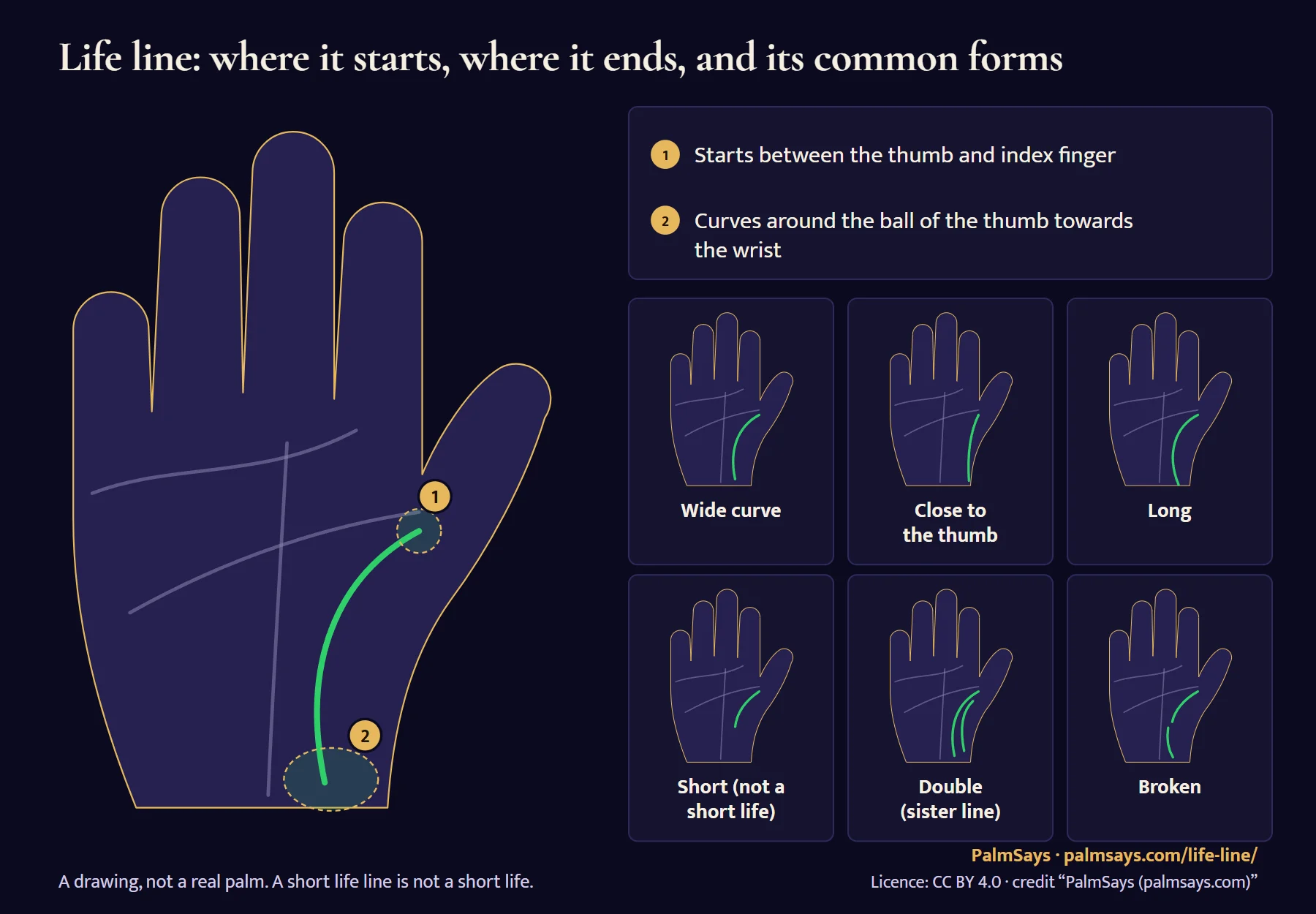
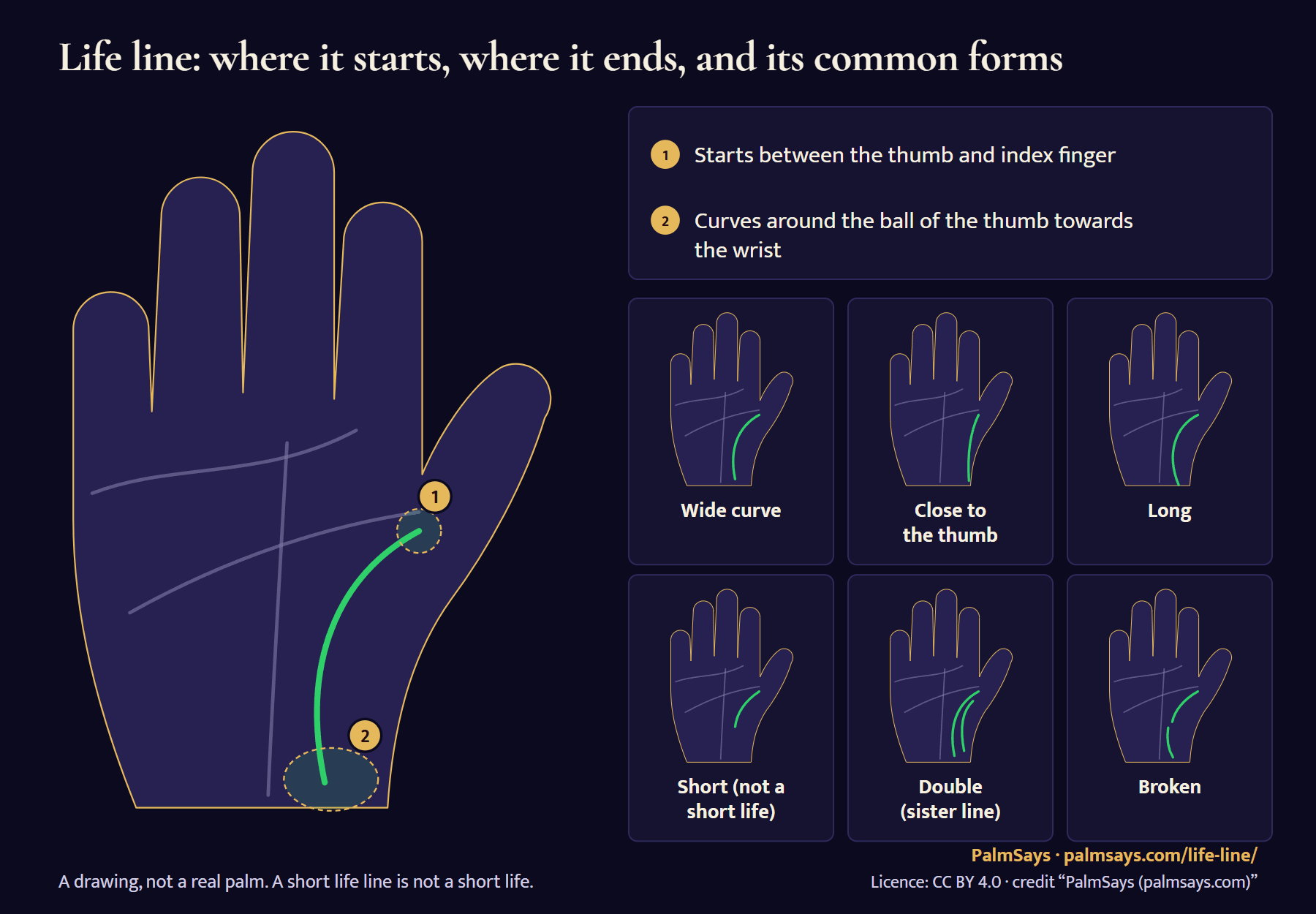
The life line curves around the base of the thumb. Palmistry reads it for energy and how you meet change, never for how long you will live.
Read more: Life line
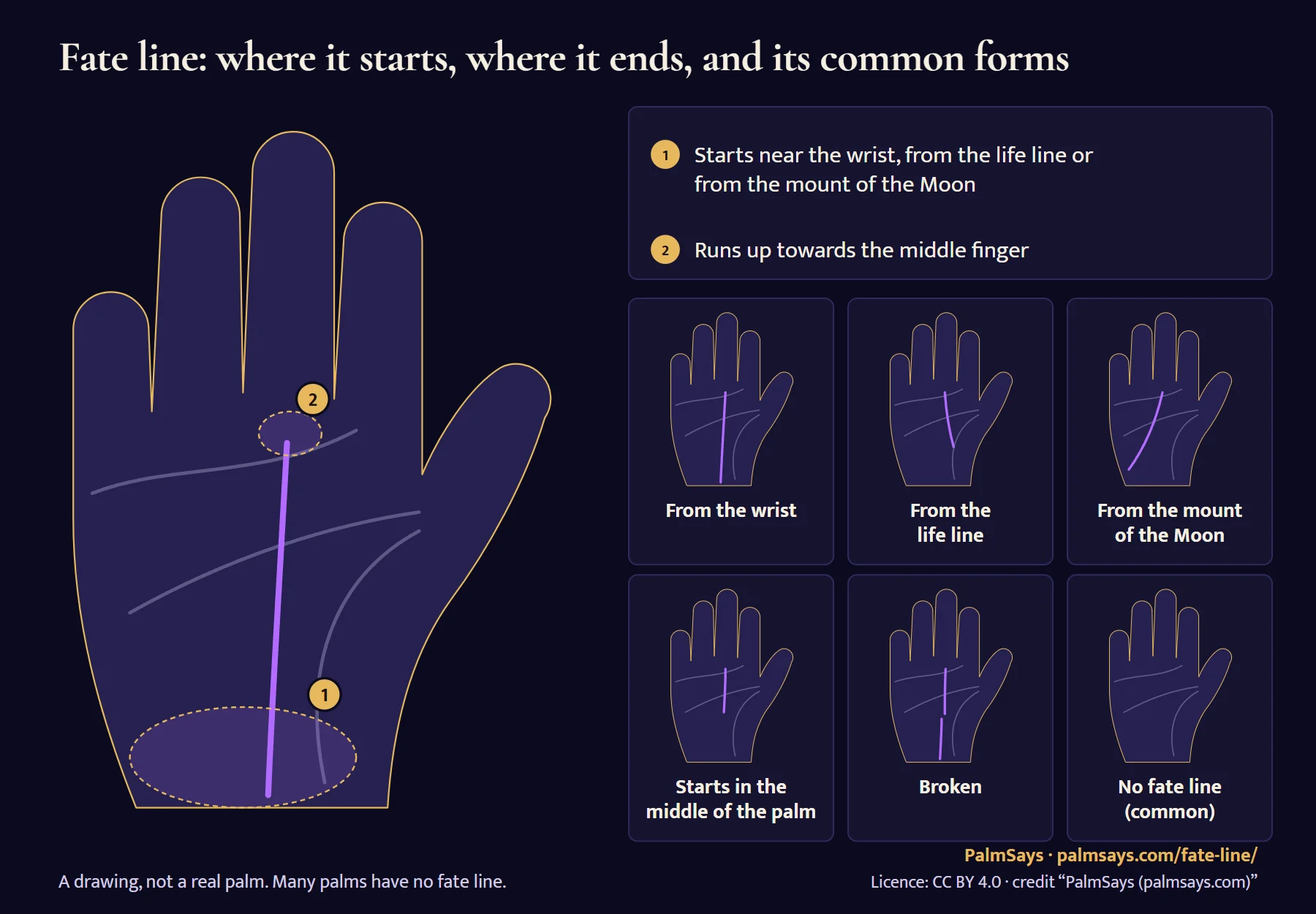
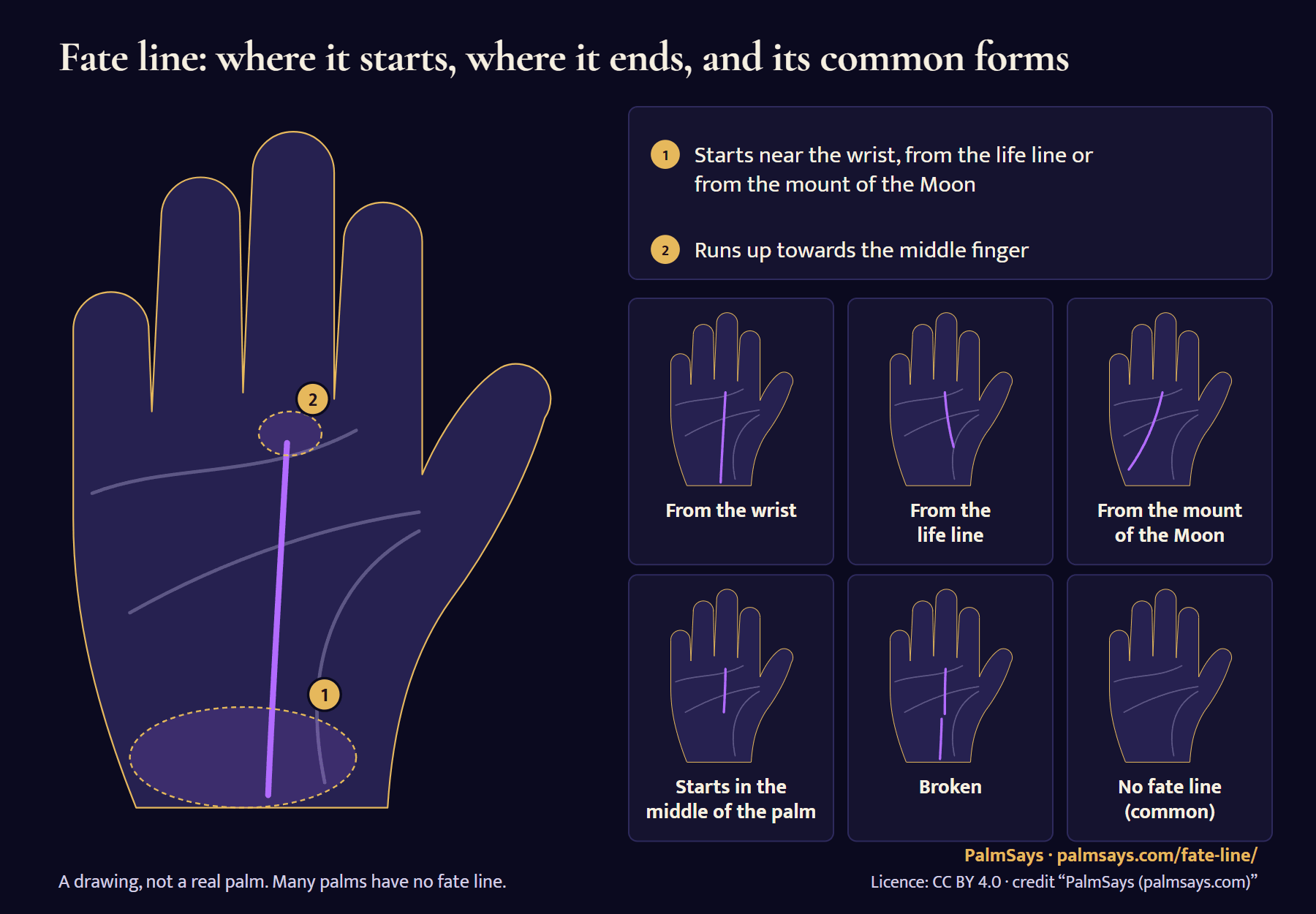
Fate line भाग्य रेखा
The fate line runs up the middle of the palm towards the middle finger. Palmistry reads it for direction and work; many palms show it faintly or not at all.
Read more: Fate line
The minor lines
Sun line सूर्य रेखा
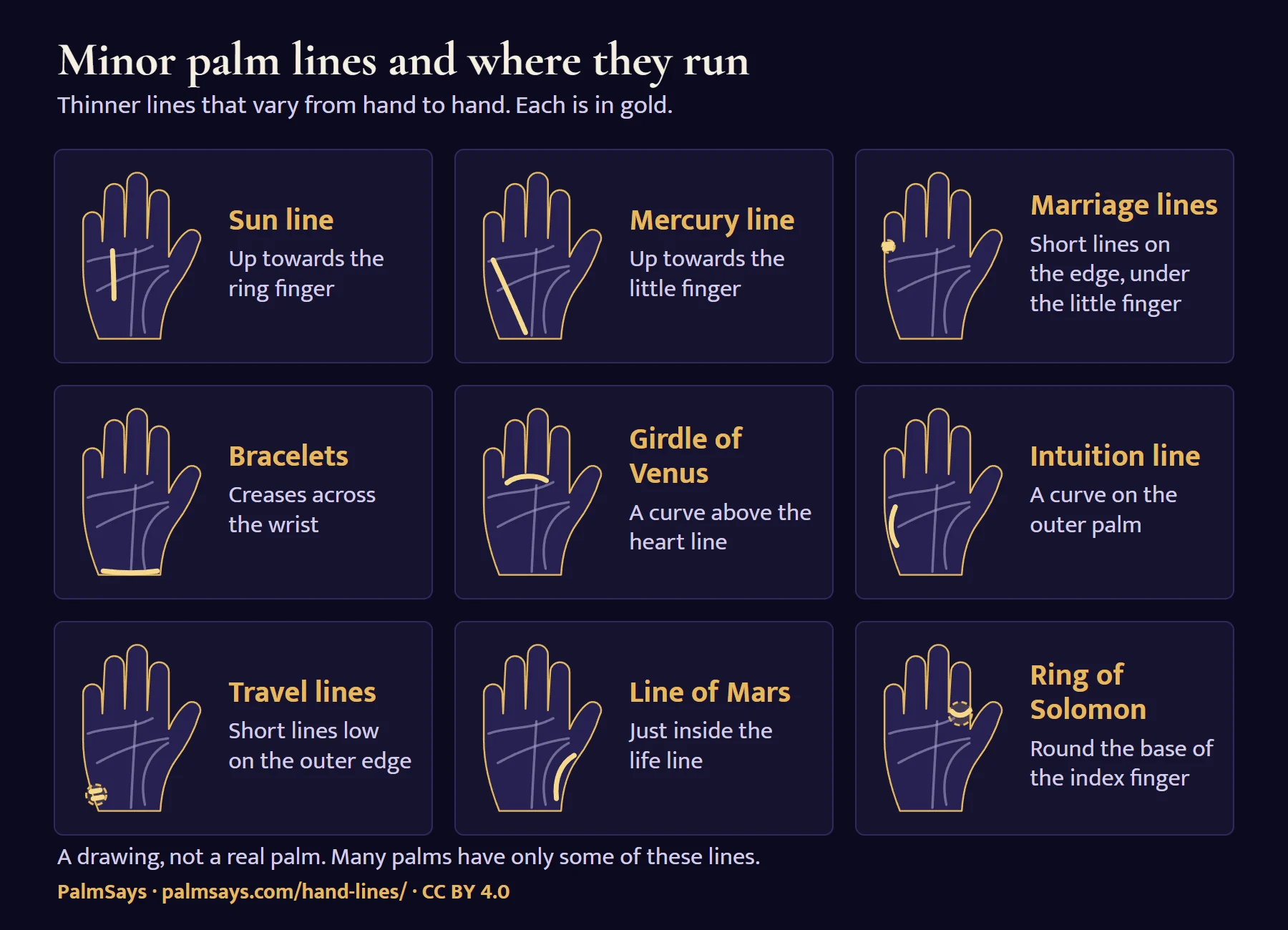
The sun line (line of Apollo) is a short line rising towards the ring finger. The classical books read it for creativity and recognition.
Read more: Sun line
Marriage line विवाह रेखा
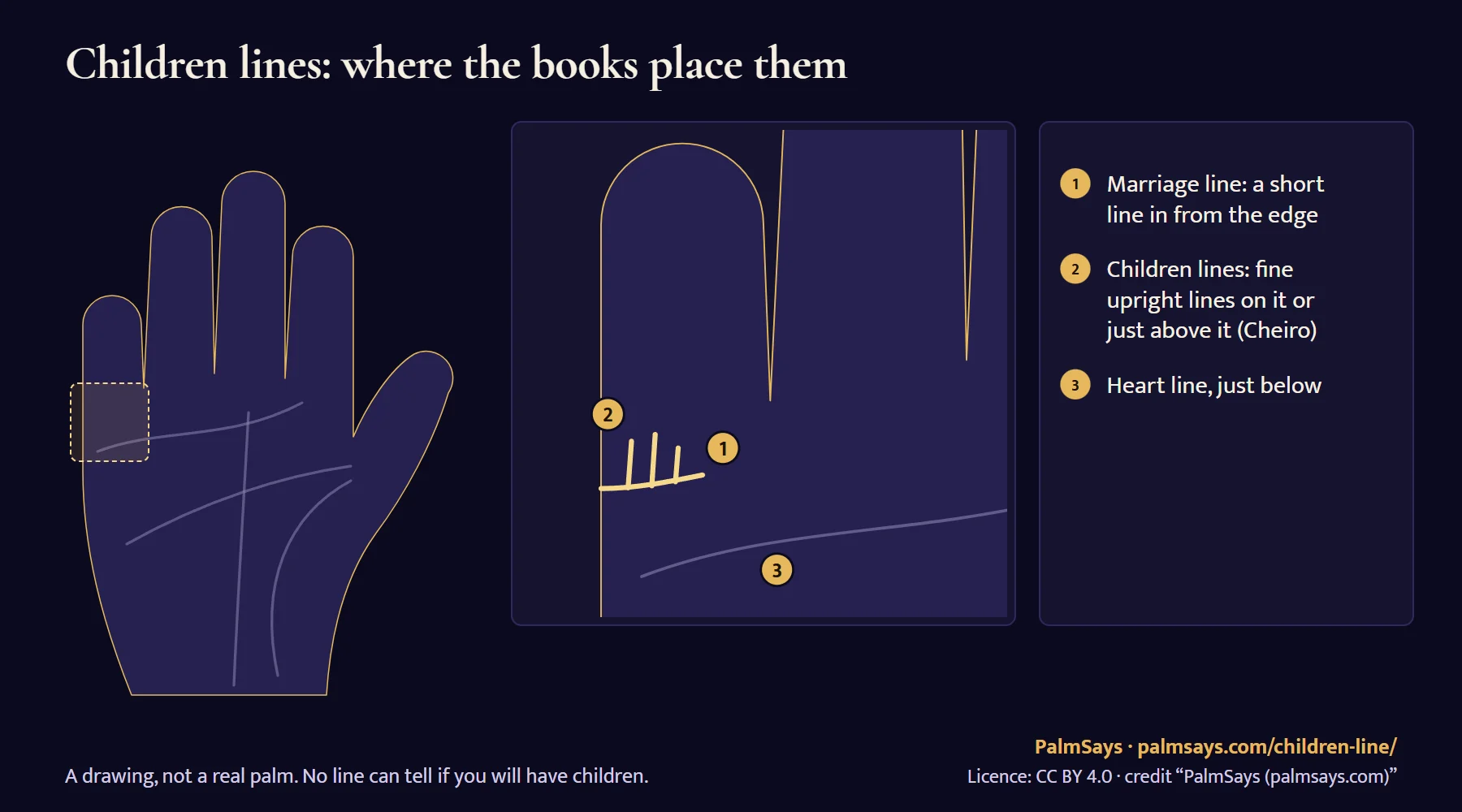
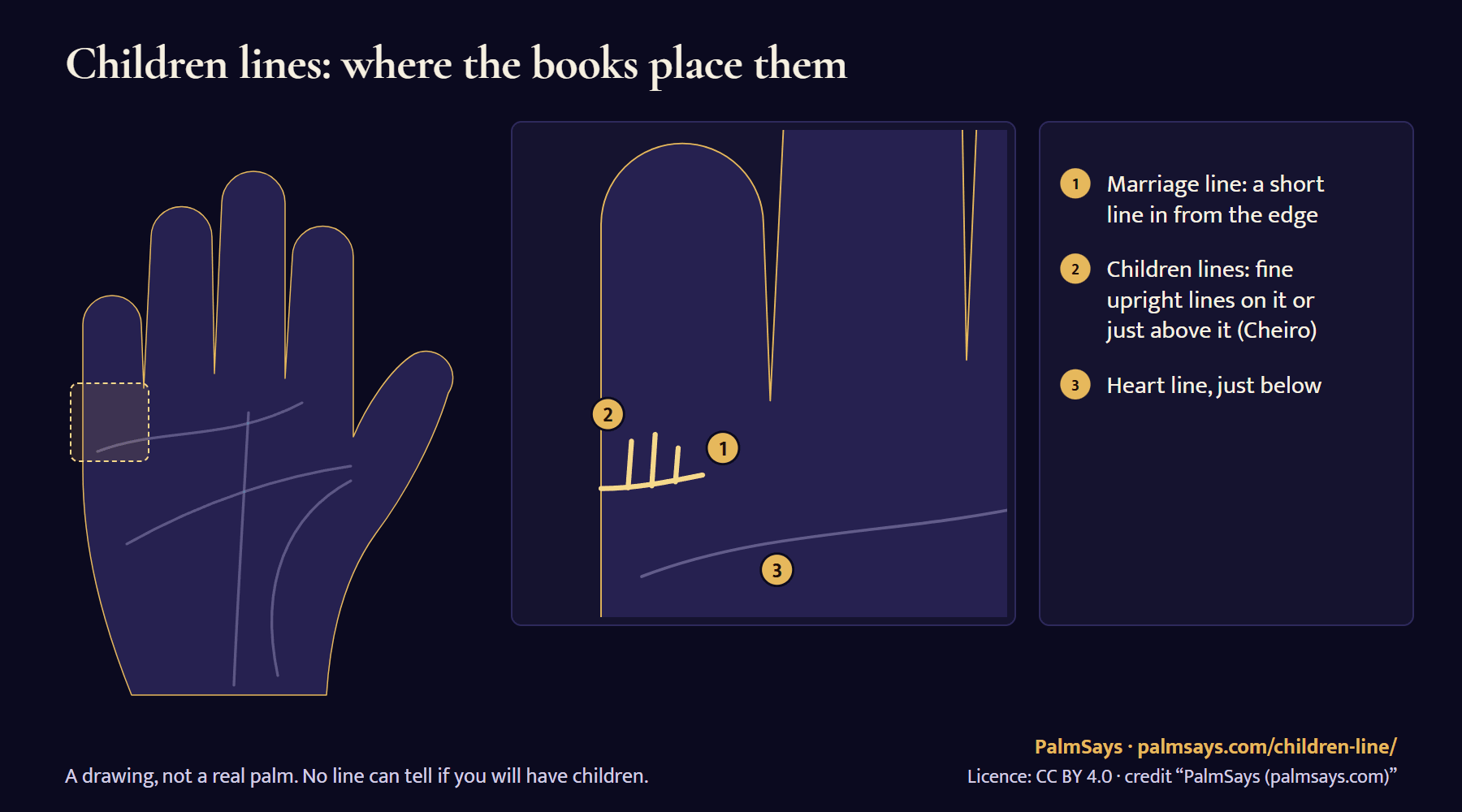
Marriage lines are the small lines on the edge of the palm under the little finger. Palmistry books read them as marks of deep affection; no line shows when or whom you marry.
Read more: Marriage line
Mercury line बुध रेखा
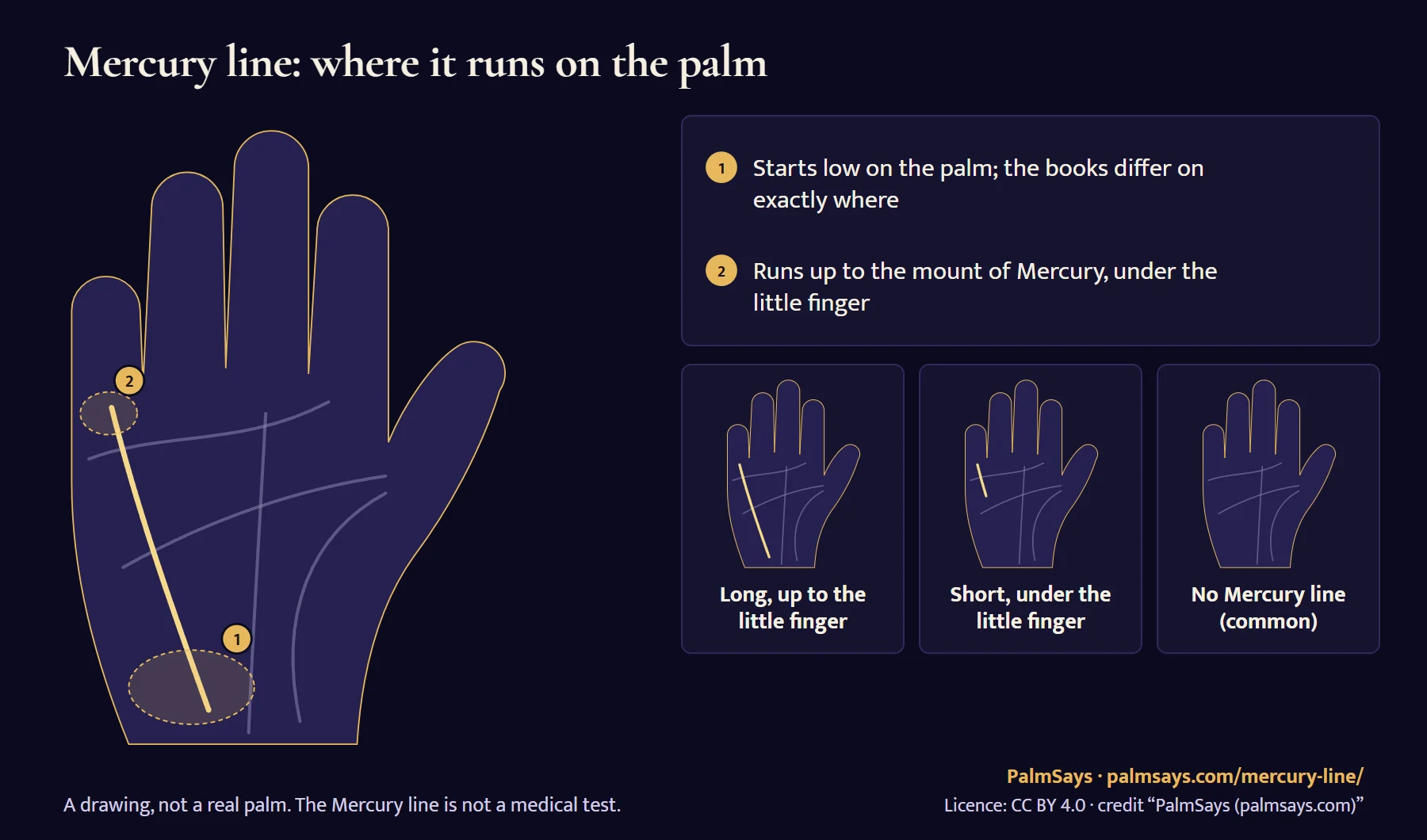
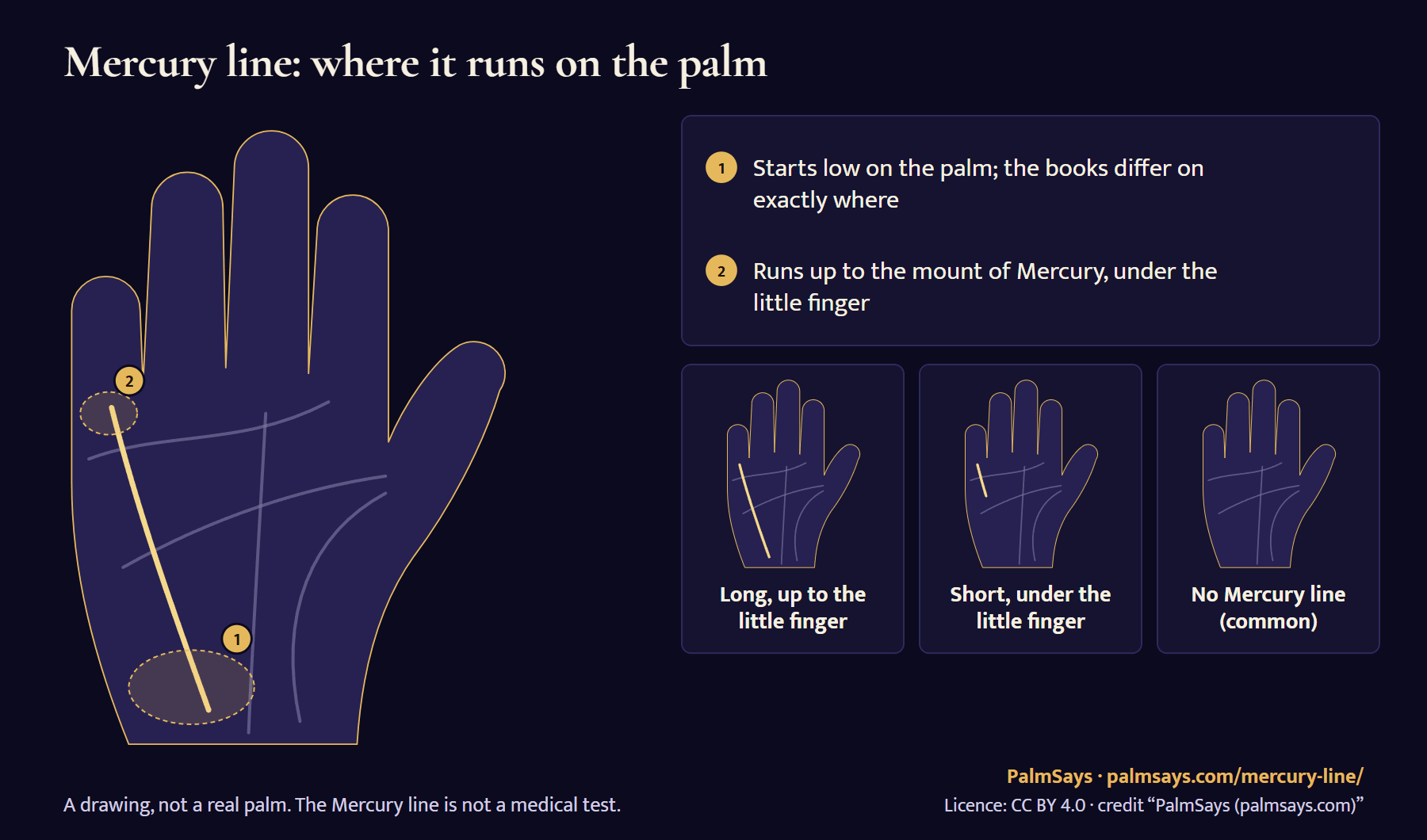
The Mercury line is a line some palms show rising towards the little finger. Old books call it the health line; no palm line shows your health.
Read more: Mercury line
Girdle of Venus शुक्र वलय*
The girdle of Venus is a curved line some palms show above the heart line, under the middle and ring fingers. The classical books read it for sensitivity.
Read more: Lines on your palm
Bracelet lines मणिबंध*
Bracelet lines (rascettes) are the creases across the inside of the wrist, just below the palm.
Read more: Lines on your palm
Intuition line अंतर्ज्ञान रेखा*
The intuition line is a rare curved line on the outer palm, bowing from under the little finger down towards the mount of the Moon. Cheiro read it for a sensitive, intuitive nature.
Read more: Lines on your palm
Travel lines यात्रा रेखा*
Travel lines are short lines on the outer edge of the palm, low on the mount of the Moon. Cheiro read them as journeys; no line gives a date.
Read more: Lines on your palm
Line of Mars मंगल रेखा*
The line of Mars is a line running just inside the life line, on the ball of the thumb. Cheiro called it the inner life line and read it for a strong temperament.
Read more: Lines on your palm
Ring of Solomon गुरु वलय*
The ring of Solomon is a small curved line around the base of the index finger, on the mount of Jupiter. Cheiro counted it among the marks of an interest in mysticism.
Read more: Lines on your palm
Via lasciva वाया लैसिवा*
The via lasciva is a rare curved line low on the palm, joining the mount of the Moon to the ball of the thumb. We don’t repeat the harsh reading old books give it.
Read more: Lines on your palm
Children lines संतान रेखा
Children lines are fine upright lines just above the marriage lines. Cheiro read them as children; whether you have children depends on life, health and choice, not on lines.
Read more: Children lines
Money line धन रेखा
Money line is a newer name. The classical books we use don’t describe a separate money line, and no line predicts money.
Read more: Money line
Unusual line patterns
Simian line सिमियन रेखा
A simian line is one straight crease across the palm in place of separate heart and head lines. It is usually a normal variation, not a diagnosis on its own.
Read more: Simian line
Double head line दोहरी मस्तिष्क रेखा
A double head line is two separate head lines across the middle of the palm, one above the other. It is uncommon.
Read more: Double head line
Broken life line टूटी जीवन रेखा*
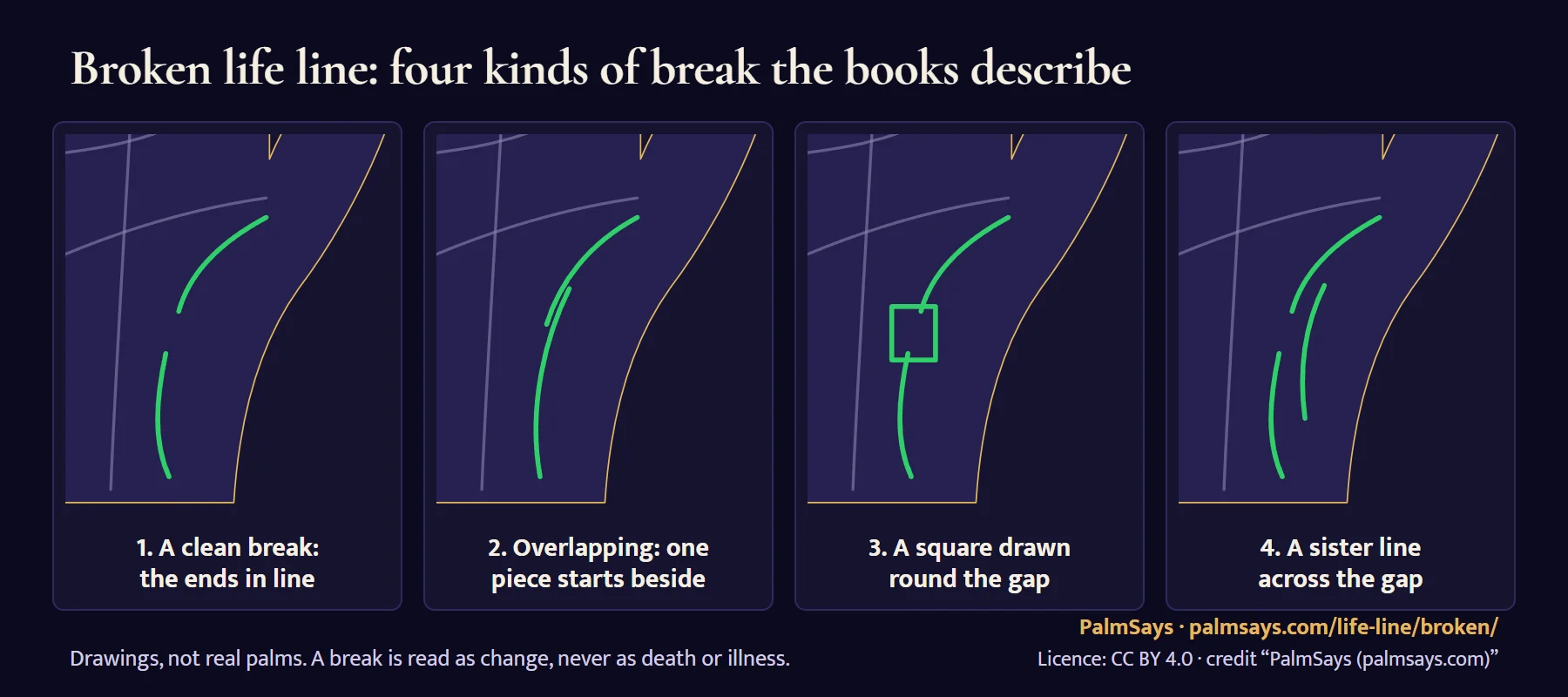
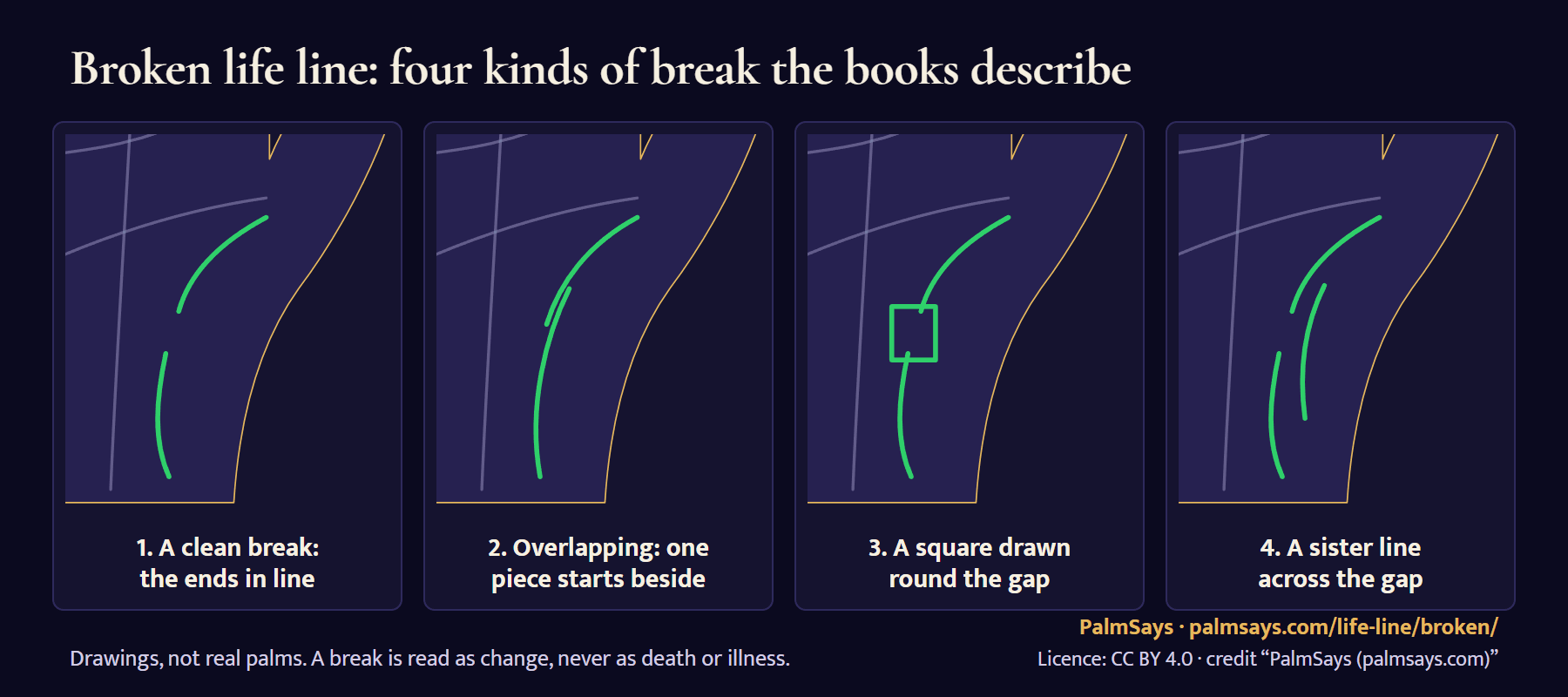
A broken life line has a gap, or stops and starts again beside itself. Palmistry books read it as a time of big change in how you live, never as death, illness or an accident.
Read more: Broken life line
Sydney line सिडनी रेखा
A Sydney line is a head line that runs right across the palm to its outer edge, with a separate heart line above it.
Mounts of the palm
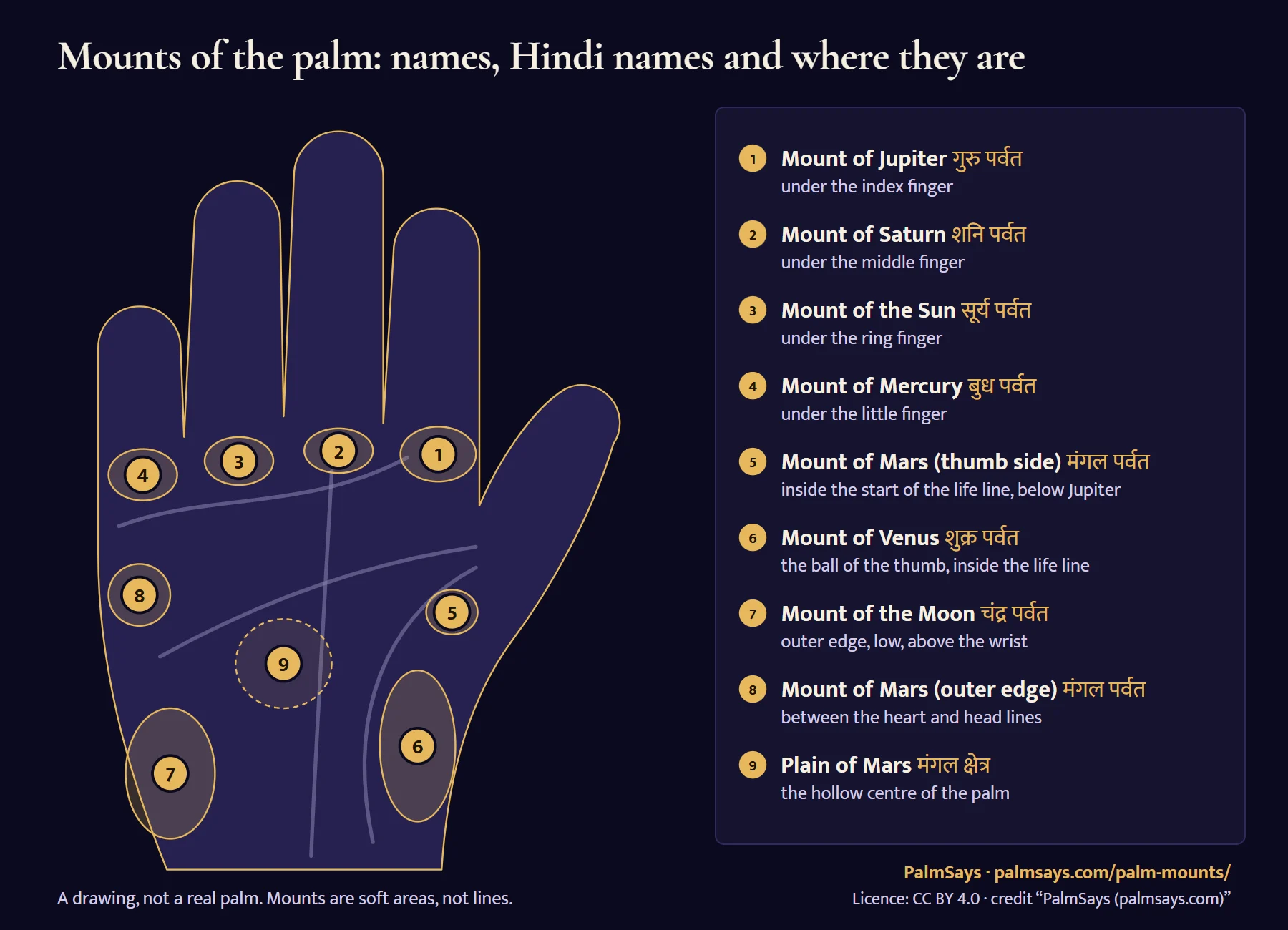
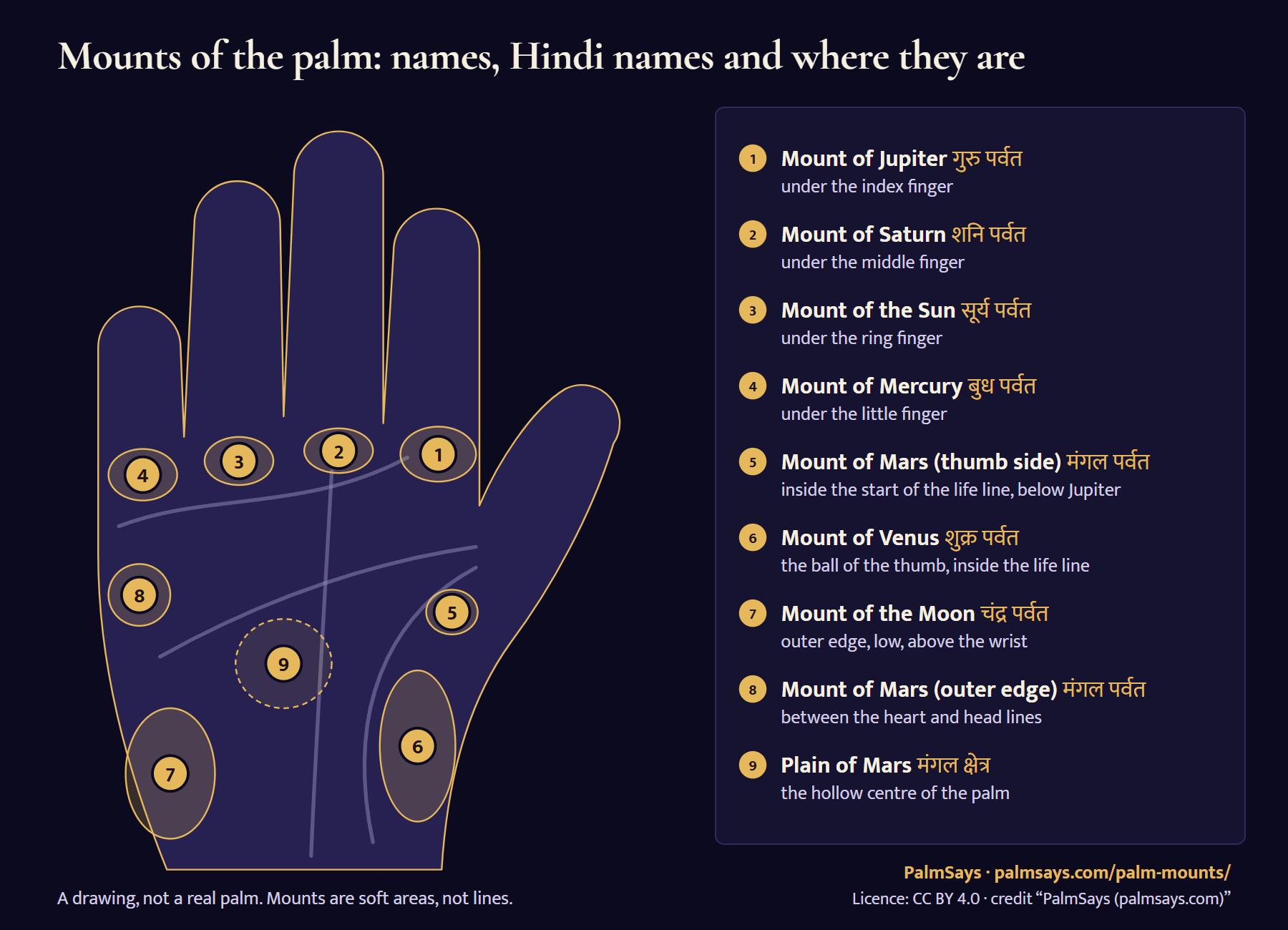
Mounts of the palm हथेली के पर्वत
Mounts are the fleshy pads of the palm. Palmistry names each after a planet (Venus, Jupiter, Saturn, Sun, Mercury, Mars and the Moon) and reads how full it is.
Read more: Palm mounts
Mount of Venus शुक्र पर्वत
The mount of Venus is the pad at the base of the thumb, inside the life line. The classical books read it for warmth and energy.
Read more: Palm mounts
Mount of the Moon चंद्र पर्वत
The mount of the Moon is the pad on the outer edge of the palm, low down near the wrist. The classical books read it for imagination.
Read more: Palm mounts
Mount of Jupiter गुरु पर्वत
The mount of Jupiter is the pad under the index finger. The classical books read it for ambition and leadership.
Read more: Palm mounts
Mount of Saturn शनि पर्वत
The mount of Saturn is the pad under the middle finger. The classical books read it for seriousness and a thoughtful, careful nature.
Read more: Palm mounts
Mount of the Sun सूर्य पर्वत
The mount of the Sun (mount of Apollo) is the pad under the ring finger. The classical books read it for a love of beauty and creative work.
Read more: Palm mounts
Mount of Mercury बुध पर्वत
The mount of Mercury is the pad under the little finger. The classical books read it for quick wit and a gift for words and trade.
Read more: Palm mounts
Mount of Mars near the thumb मंगल पर्वत (अंगूठे की ओर)*
The mount of Mars near the thumb is the pad just inside the start of the life line, below Jupiter. The classical books read it for active courage. Books label the two Mars mounts differently.
Read more: Palm mounts
Mount of Mars on the outer edge मंगल पर्वत (बाहरी किनारा)*
The mount of Mars on the outer edge is the pad between the mount of Mercury and the mount of the Moon. The classical books read it for moral courage and self-control.
Read more: Palm mounts
Plain of Mars मंगल क्षेत्र*
The plain of Mars is the hollow centre of the palm, between the mounts, where the fate line passes between the head and heart lines.
Read more: Palm mounts
Hand shapes and hand types
Hand shape हाथ की बनावट
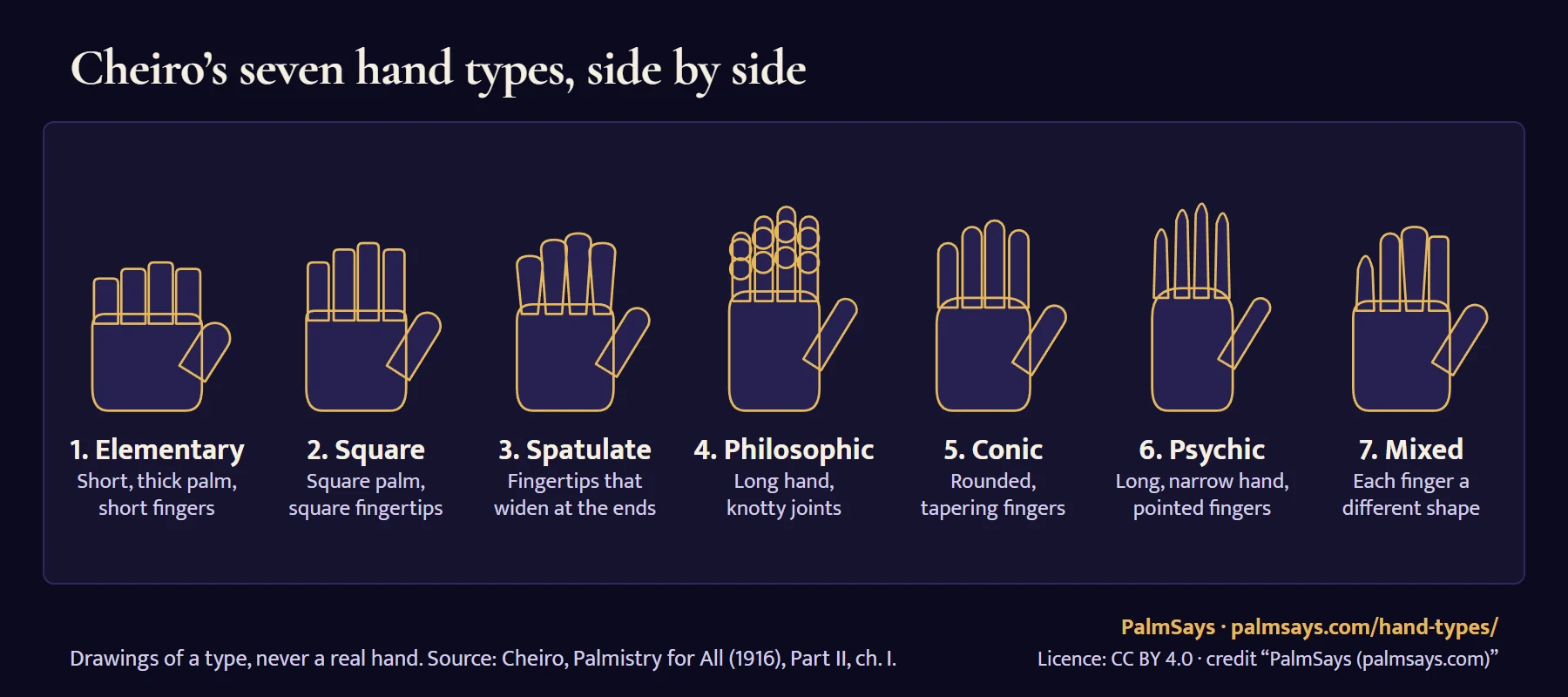
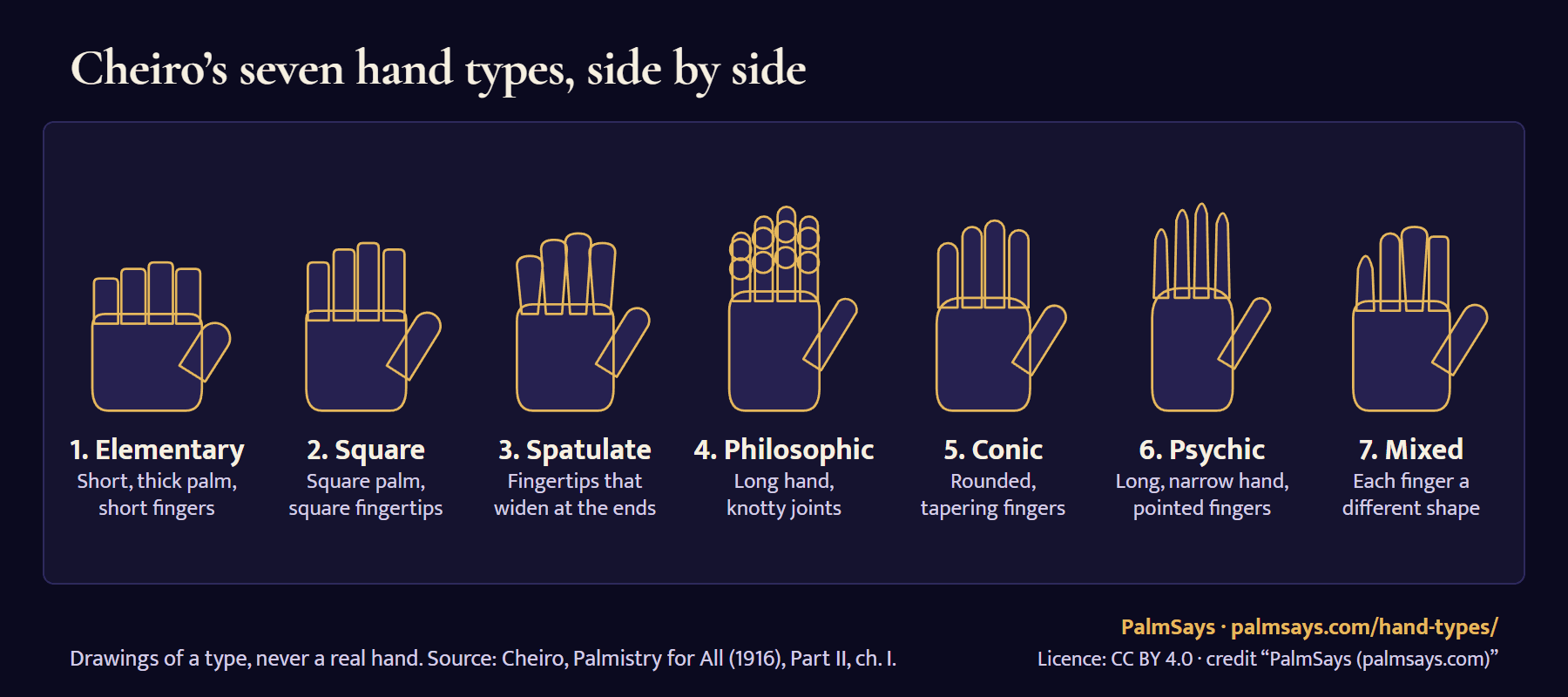
Hand shape is the palm’s proportions and the fingers’ length. Modern palmistry sorts hands into earth, air, fire and water types; Cheiro used seven types.
Read more: Hand types in palmistry
Earth hand पृथ्वी हाथ*
In the modern four-element system, an earth hand has a square palm and short fingers, and is linked with a practical, steady nature.
Read more: Hand types in palmistry
Air hand वायु हाथ*
In the modern four-element system, an air hand has a square palm and long fingers, and is linked with a curious, talkative mind.
Read more: Hand types in palmistry
Fire hand अग्नि हाथ*
In the modern four-element system, a fire hand has a long palm and short fingers, and is linked with energy and enthusiasm.
Read more: Hand types in palmistry
Water hand जल हाथ*
In the modern four-element system, a water hand has a long palm and long fingers, and is linked with sensitivity and imagination.
Read more: Hand types in palmistry
Elementary hand प्रारंभिक हाथ*
The elementary hand is the first of Cheiro’s seven hand types: a short, thick palm with short, heavy fingers.
Read more: Hand types in palmistry
Square hand वर्गाकार हाथ*
The square hand is one of Cheiro’s seven hand types: a square palm, square at the wrist and the finger bases, with square-cut fingertips.
Read more: Hand types in palmistry
Spatulate hand चमसाकार हाथ*
The spatulate hand is one of Cheiro’s seven hand types: fingertips that widen at the ends, like a spatula.
Read more: Hand types in palmistry
Philosophic hand दार्शनिक हाथ*
The philosophic hand is one of Cheiro’s seven hand types: a long, angular hand with knotty finger joints.
Read more: Hand types in palmistry
Conic hand शंक्वाकार हाथ*
The conic hand is one of Cheiro’s seven hand types: a graceful hand with fingers that taper to rounded tips.
Read more: Hand types in palmistry
Psychic hand आदर्शवादी हाथ*
The psychic (idealistic) hand is one of Cheiro’s seven hand types: a long, narrow hand with slender, pointed fingers.
Read more: Hand types in palmistry
Mixed hand मिश्रित हाथ*
The mixed hand is the last of Cheiro’s seven hand types: a hand whose fingers each belong to a different type.
Read more: Hand types in palmistry
Fingers and thumb
Fingers उंगलियां
Palmistry reads the fingers by their length, shape and joints; the classical books name each finger after a planet (index = Jupiter, middle = Saturn, ring = Sun, little = Mercury).
Read more: Fingers in palmistry
Thumb अंगूठा
The thumb is the first finger of the hand. The classical books read its length and how far it opens for will and logic.
Read more: Fingers in palmistry
Phalanges पोर*
The phalanges are the sections of a finger between its joints: three in each finger, two in the thumb. Palmistry books compare their lengths.
Read more: Fingers in palmistry
Knotty fingers गांठदार उंगलियां*
Knotty fingers have joints that stand out. The classical books read them as a mind that analyses and weighs details before acting.
Read more: Fingers in palmistry
Smooth fingers चिकनी उंगलियां*
Smooth fingers have joints that don’t stand out. The classical books read them as quick, intuitive thinking that acts on impulse.
Read more: Fingers in palmistry
Signs and marks on the palm
Palm signs हथेली के चिह्न
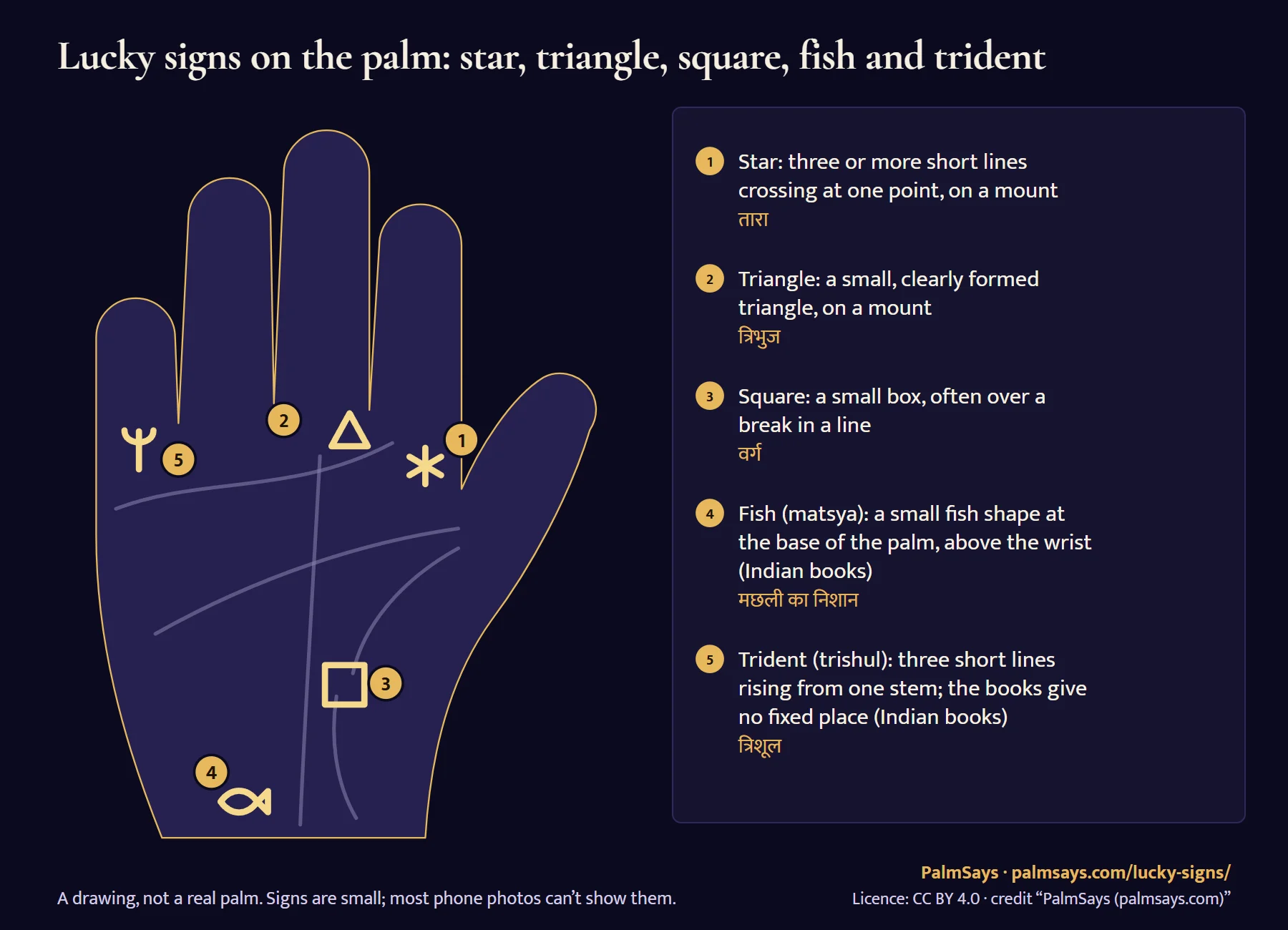
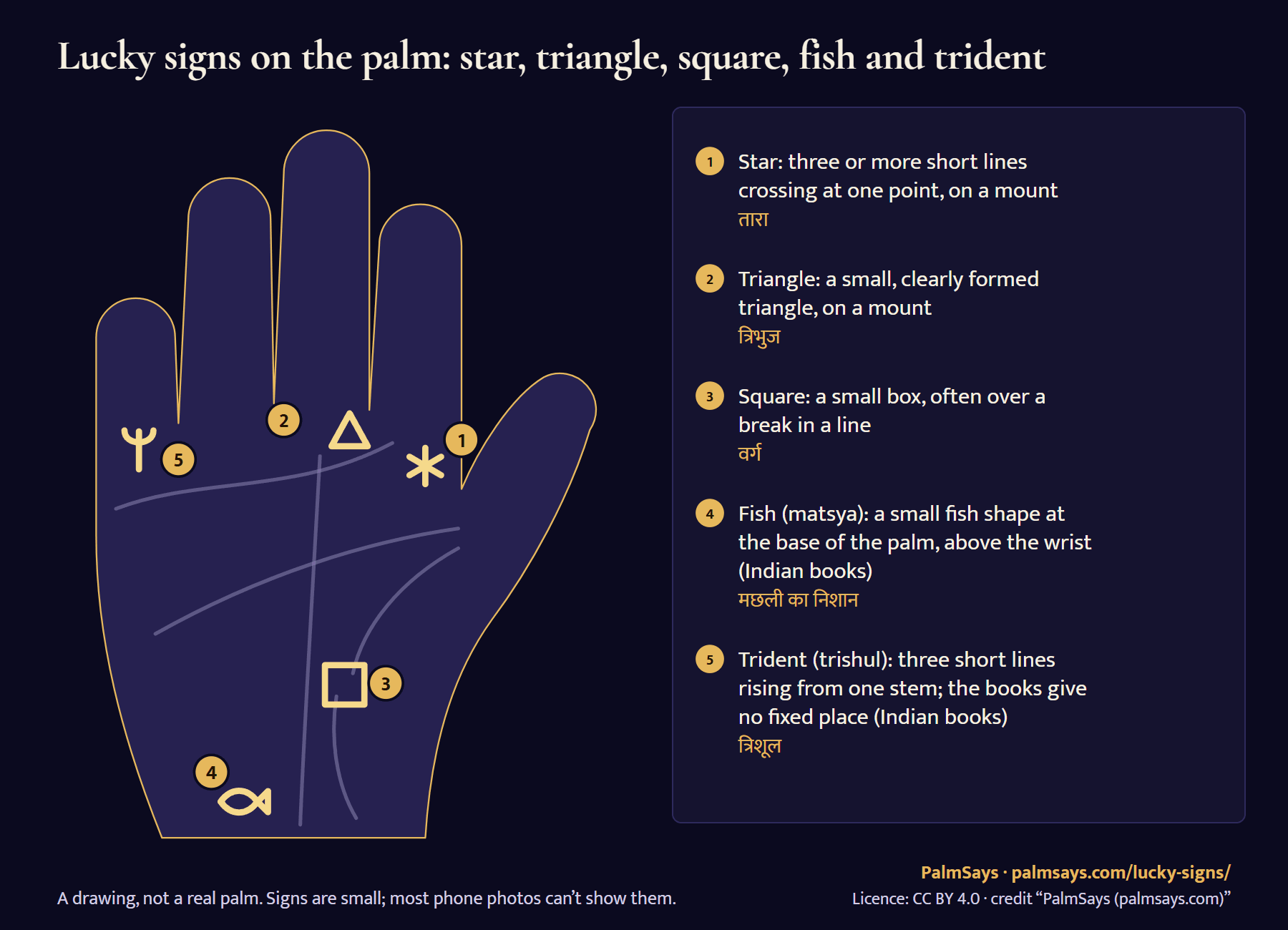
Palm signs are small marks on or between the lines, such as islands, crosses, stars, squares and triangles, each read by the classical books.
Read more: Lucky signs on the palm
Letter M हाथ में M का निशान
The letter M is not a separate mark: the heart, head and life lines (often with the fate line) draw an M across the palm. It is a modern idea; no classical book reads it.
Read more: M on the palm
Mystic cross रहस्यमय क्रॉस
The mystic cross is a small cross standing on its own between the heart and head lines. Cheiro read it as a gift for, and interest in, mysticism.
Read more: Crosses on the palm
Star तारा
A star is three or more short lines crossing at one point, usually on a mount. Cheiro read it as heightening whatever that mount stands for.
Read more: Lucky signs on the palm
Triangle त्रिभुज
A triangle is a small, clearly formed triangle on a mount. Cheiro read it by the mount it sits on, for example a talent for managing people under the index finger.
Read more: Lucky signs on the palm
Island द्वीप
An island is a small oval loop where a line splits and joins up again. The old books read it as weakness or illness; palm lines are not a health test.
Read more: Palm signs checker
Fish (matsya) मछली का निशान
The fish (matsya) is a small fish-shaped mark near the base of the palm. Indian palmistry books count it among the auspicious signs.
Read more: Lucky signs on the palm
Trident (trishul) त्रिशूल
The trident (trishul) is three short lines rising from one stem. Chhotelal Jain (1927) read it as the sign of a generous, religious-minded person.
Read more: Lucky signs on the palm
Cross क्रॉस*
A cross is two short lines crossing on the palm. The classical books read a cross by where it sits; the best known is the mystic cross.
Read more: Crosses on the palm
Square वर्ग*
A square is four short lines forming a small box, often over a line. Cheiro called it a mark of preservation, read as protection over a break.
Read more: Lucky signs on the palm
Grille जाली*
A grille is a small net of crossing lines, usually on a mount. The classical books read it as working against the qualities of that mount.
Chained line जंजीरदार रेखा*
A chained line is made of small linked loops instead of one clear crease. The classical books read it as a less settled stretch of that line.
Money triangle धन त्रिकोण*
The money triangle is a modern name for the small space the head, fate and Mercury lines can close. Older books read that triangle as an interest in the occult, not money.
Read more: Money line
Words palm readers use
Which hand to read कौन सा हाथ देखें
Palmistry looks at both hands: the tradition reads the hand you write with as the life you are making, and the other as what you started with.
Read more: Which hand to read
Fork द्विशाखा*
A fork is a line that splits into two branches, usually at its end. The best known is the head line’s writer’s fork.
Read more: Head line
Sister line सहायक रेखा*
A sister line is a second line running close beside a main line. The best known is the line of Mars beside the life line.
Read more: Lines on your palm
Influence lines प्रभाव रेखाएं*
Influence lines are fine lines that run beside or cross a main line. The classical books read them as other people’s influence in that part of life.
Quadrangle चतुष्कोण*
The quadrangle is the space between the heart line and the head line. The classical books read its width for how broad-minded a person is.
Read more: Crosses on the palm
Line of fortune फ़ॉर्च्यून रेखा*
Line of fortune is an old name that different books give to different lines: the heart line in Dale’s Indian Palmistry, the fate line in Heron-Allen and Markun.
Read more: Money line
Business line व्यापार रेखा*
Business line is a modern name used for different lines. No classical book we use names one; the nearest is Benham reading the Mercury line as a guide to business.
Read more: Career palmistry
Career palmistry करियर हस्तरेखा*
Career palmistry reads the hand for how you like to work: mainly the fate, head and sun lines, the mounts and the hand’s shape. It describes working style; it can’t choose a job.
Read more: Career palmistry
Science words
Pseudoscience छद्म विज्ञान
A pseudoscience is a set of claims presented as science without scientific evidence. Scientists count palmistry’s predictions as pseudoscience.
Read more: Is palmistry true?
Barnum effect बार्नम प्रभाव
The Barnum (Forer) effect is our habit of rating vague, general descriptions as personal and exact. It is one reason readings can feel true.
Read more: Is palmistry true?
Cold reading कोल्ड रीडिंग
Cold reading is the trick of guessing things about a stranger from their looks, words and reactions, so that a reading seems to know them.
Read more: Is palmistry true?
Dermatoglyphics डर्मेटोग्लिफ़िक्स
Dermatoglyphics is the scientific study of the skin ridge patterns of the fingers, palms and soles, such as fingerprints. It is not palmistry.
Read more: Is palmistry true?
Flexion crease मोड़ की रेखा*
A flexion crease is a line in the skin where it folds as a joint bends. Palm lines are flexion creases, and most form before birth.
Read more: Lines on your palm
Palmistry diagrams you can reuse
Our labelled diagrams of the palm, drawn from the same hand as the rest of the site. They are free to reuse under the CC BY 4.0 licence with credit to PalmSays (palmsays.com). Each links to its full-size file.
Where these definitions come from
The line, mount, hand-type and sign definitions summarise, in our own words, the classical books the rest of the site cites, mainly Cheiro’s Palmistry for All (1916) and Cheiro’s Language of the Hand, Mrs J. B. Dale’s Indian Palmistry (1895) and Chhotelal Jain’s Samudrik Shastra (1927). The earth, air, fire and water hands are a modern system, and we say so. The guide linked from each term gives the full citation. Read how we choose sources.