Fingers in palmistry
Palmistry names each finger after a planet: index Jupiter, middle Saturn, ring the Sun, little Mercury. It reads their length against each other and the palm, the thumb, the three sections of each finger, the joints and the gaps.
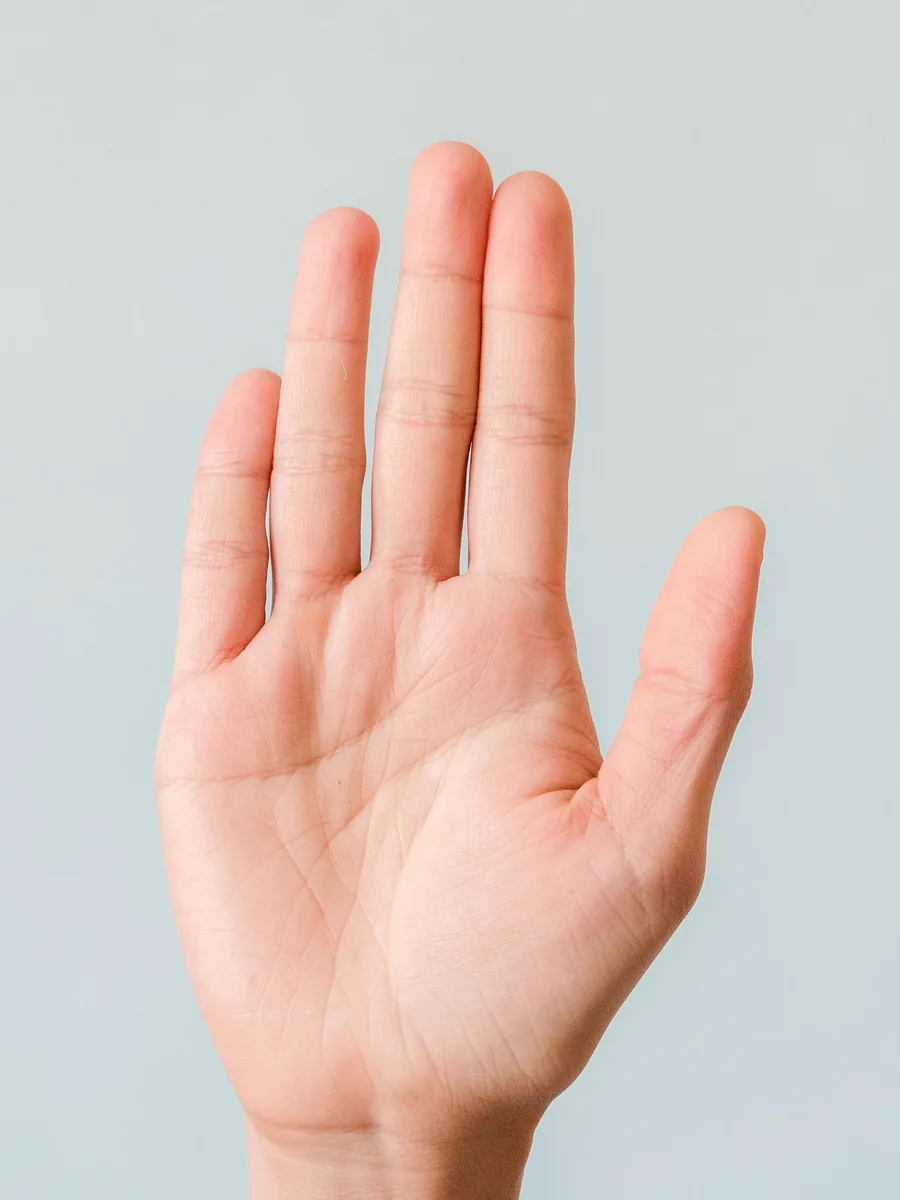
A real palm photo (Kevin Malik, Pexels), traced by the real PalmSays scanner. Your reading is made from your own photo.
Which finger is which in palmistry?
Hold your hand up with the fingers together. Is your index finger longer than your ring finger, or shorter?
- Hold your writing hand up, palm facing you, fingers straight and together.
- Look at the tips of your index finger (next to the thumb) and your ring finger, against your middle finger.
- Then spread your hand wide and notice the gaps between the fingers, and how far your thumb opens.
On this page
- Finger by finger: the planet names
- Is your index finger longer than your ring finger?
- Are your fingers long or short for your palm?
- The thumb in palmistry
- The three sections of each finger (phalanges)
- Knotty fingers or smooth fingers: the joints
- Gaps between the fingers
- Lines on the fingers
- Check yourself: fingers quiz
- Myths about the fingers in palmistry
- Questions people ask
- Sources
Finger by finger: the planet names
Palmistry names each finger after a planet, and the pad just below it, its mount, carries the same name. In Hindi the fingers are the अंगूठा (thumb), तर्जनी (index), मध्यमा (middle), अनामिका (ring) and कनिष्ठा (little).
- Thumb अंगूठा: will, logic and warmth, in its three parts
- Index तर्जनी: the finger of Jupiter
- Middle मध्यमा: the finger of Saturn
- Ring अनामिका: the finger of the Sun (Apollo)
- Little कनिष्ठा: the finger of Mercury
- I, II, III: the three sections (phalanges) of a finger, from the tip down
Index finger: the finger of Jupiter
Cheiro’s Palmistry for All (1916) reads a long index finger as a love of leading and of taking charge of others, and a short one as a dislike of responsibility. An index finger almost as long as the middle finger is read as pride.
Middle finger: the finger of Saturn
A long middle finger is read as prudence and a reserved, studious nature, with a liking for time alone. A short one is read as a lighter, less serious manner.
Ring finger: the finger of the Sun
A long ring finger is read as a love of beauty and a wish to be recognised. When it is very long, Cheiro reads a liking for risk and speculation. A short one is read as caring little for these things.
Little finger: the finger of Mercury
A long little finger, reaching past the top joint of the ring finger, is read as a gift for expression, in speaking and in writing. Cheiro reads a short one as finding it harder to put thoughts into words, and adds that such people often write better than they speak.
Cheiro also notes that a finger which leans towards its neighbour takes on some of that finger’s qualities. The pads under the fingers are read with them in palm mounts. New to these words? The palmistry terms glossary explains each one in a sentence.
Is your index finger longer than your ring finger?
This is the comparison people ask about most. Hold your fingers together and compare both tips against the middle finger.
Index and ring finger, side by side
- Index longerIndex tip above the ring tip
- Ring longerRing tip above the index tip
- About equalBoth tips level
Index finger longer than the ring finger
The index finger is the finger of Jupiter. When it is the longer of the two, palmistry reads it as a drive to lead and to take charge.
Ring finger longer than the index finger
The ring finger is the finger of the Sun, or Apollo. When it is the longer of the two, palmistry reads it as a love of beauty and art, and a wish to be recognised for what you do. This is the most common result: in most hands the ring finger is a little longer.
Index and ring fingers the same length
Cheiro reads index and ring fingers of equal length as a sign of a balanced mind, and calls it rare. The books disagree here: Heron-Allen (1885) and Cheiro’s own earlier book read equal fingers as a wish to shine in art.

Scientists study the same comparison as the “2D:4D” digit ratio. A review that pooled 116 samples of expert-measured fingers (Hönekopp and Watson, 2010) found that, on average, men’s ring fingers are a little longer compared with their index fingers than women’s. That is an average difference between large groups, not a reading of one person, and it does not make palmistry a science. Is palmistry real? looks at the evidence.
Are your fingers long or short for your palm?
Cheiro reads long fingers as a love of detail: noticing small things, and sometimes worrying over them. Short fingers are read as quick and impulsive, taking things in as a whole and not fussing over detail.
Markun (1927) describes how the old books measured this: the middle finger from its tip to the knuckle on the back of the hand, the palm from the base of that finger to the wrist. A finger about as long as the palm was taken as a sign of balance. Palm shape and finger length together give your hand types in palmistry.
The thumb in palmistry
Cheiro calls the thumb as important to the hand as the nose is to the face, and reads it for natural will power. Its three parts stand for three things: the top section (with the nail) for will, the middle section for logic, and the base, covered by the mount of Venus, for warmth. A larger part is read as a stronger quality.
How far does your thumb open?
- Held close to the hand: a careful, reserved nature that keeps its thoughts to itself.
- A moderate opening: independent without going to extremes. Cheiro says a thumb should neither stand at a right angle nor lie too close.
- Wide open: independence of will and fearlessness. Near a right angle, the books read a nature that goes to extremes.
How long is your thumb?
A long thumb is read as a strong will, guided by reason. A shorter thumb is read as being guided more by feeling than by reasoning. Thumbs often turn sideways to the camera, which makes them look shorter in a photo.
Is the top joint of your thumb supple or firm?
Cheiro sorts thumbs into two classes. A supple-jointed thumb bends back at the top joint: an adaptable, broad-minded nature, generous and quick to give in. A firm-jointed thumb stays straight: a more resisting nature that thinks before agreeing and holds to its view once decided. He also reads a middle section that narrows like a waist as tact, and a straight, full one as a preference for argument and reason.
The three sections of each finger (phalanges)
Each finger has three sections, called phalanges. Cheiro’s Guide to the Hand (1900) reads them from the tip down as three worlds: the top section for ideals, the middle for reason, and the base for material things. A long top section is read as a love of ideals; a large middle one as a love of reason; a long base section as a love of material things. A full, thick base is read as enjoying good food and comfort; a slim, waisted one as caring little for luxury.
The numbers I, II and III on the photo above mark the three sections of the middle finger.
Knotty fingers or smooth fingers: the joints
Cheiro’s Language of the Hand reads smooth joints as impulsive and intuitive, quick to reach a conclusion without working through each step. Knotty joints, where the knuckles stand out, are read as method and analysis: they “stop the tide of impulse”, in his words, and make a mind more observant and thoughtful. He adds that hard work neither makes nor removes them.
Gaps between the fingers
Spread your hand the way it opens naturally. Cheiro reads a wide gap between:
- the thumb and index finger: independence of will and fearlessness;
- the index and middle fingers: independence of thought;
- the middle and ring fingers: independence from circumstances;
- the ring and little fingers: independence in action.
Fingers held close together are read as a respect for custom and for what other people think. Fingers that bend back easily are read as quick to grasp ideas; fingers that curve inwards as slower to take up an idea but holding on to it. Older books disagree about the gaps: Heron-Allen (1885) and Frith (1895) read them as curiosity instead.
Lines on the fingers
The short creases across each finger joint are flexion creases, the places where the skin folds when the finger bends, the same kind of crease as the major palm lines. They form before birth (Kimura and Kitagawa, 1986). Older books also read fine lines on the finger sections: upright lines as helpful, crossing lines as obstacles, and particular patterns as particular events. Those are forecasts, and even Markun’s 1927 book tells them as tales, so we leave them out. Fine lines on the fingers rarely show clearly in a phone photo either.
For the lines on the palm itself, start with how to read palm lines.
Check yourself: fingers quiz
Three quick questions. Pick an answer to see if you are right.
Myths about the fingers in palmistry
- MythA long ring finger means you will be rich, or a gambler.
- Reality
The books read a love of beauty, a wish to be recognised and, when the finger is very long, a liking for risk. That is a tendency, not a forecast about money.
- MythFinger length proves palmistry is scientific.
- Reality
Digit-ratio research compares averages across large groups of people. It does not support reading one person’s character or future from their fingers.
- MythThe lines on your fingers foretell events.
- Reality
They are creases where the finger bends. The old readings of them are forecasts that no line can make.
Quick facts
- Hindi names
- अंगूठा (thumb), तर्जनी (index), मध्यमा (middle), अनामिका (ring), कनिष्ठा (little)
- Planet names
- Index: Jupiter. Middle: Saturn. Ring: the Sun (Apollo). Little: Mercury. Each finger’s mount sits just below it.
- What the books read
- Length against the other fingers and the palm, the thumb, the three sections of each finger, the joints and the gaps.
- The thumb
- Read for will (the top section), logic (the middle) and warmth (the base, the mount of Venus).
- Which hand
- Look at both. Tradition reads your writing hand as the life you are making. Which hand to read
- What the app reads
- The PalmSays app measures your fingers on your palm photo, the same way as the free finger reader here, which works on your phone.
Questions people ask
What does each finger mean in palmistry?
The index is the finger of Jupiter (leading and taking charge), the middle of Saturn (seriousness), the ring of the Sun (beauty and art) and the little of Mercury (expression). The thumb is read for will and logic.
What does it mean if my ring finger is longer than my index finger?
The books read a love of beauty and art, and a wish to be recognised for what you do. It is also the most common result.
What does a long index finger mean?
A drive to lead and take charge. Cheiro adds that an index finger almost as long as the middle finger is read as pride.
What do the lines on the fingers mean?
Older books read upright lines on the finger sections as helpful and crossing lines as obstacles. Those are readings of events, and even Markun’s 1927 book treats them as tales, so we don’t repeat them.
What does the thumb show in palmistry?
Cheiro reads the thumb for will power. Its top section is will, the middle is logic and the base, the mount of Venus, is warmth. How far it opens, how long it is and how its top joint bends are read too.
Is finger length science or palmistry?
Both, in different ways. Scientists study the index-to-ring finger ratio as a group average; palmistry reads it for character. The research does not support reading one person’s character from it.
Sources (8 books and studies)
- Cheiro, Palmistry for All (1916). Rules for Rapid Observation (the fingers considered separately); Part II, ch. II: The Thumb; ch. III, The Fingers: Length to One Another, the Smooth and the Knotty.
- Cheiro, Cheiro’s Language of the Hand (1900). Part I, ch. IX: The Thumb, pp. 45–50; ch. X: The Joints of the Fingers, pp. 51–52; ch. XI: The Fingers, pp. 53–55.
- Cheiro, Cheiro’s Guide to the Hand (1900). Ch. IV, Of the Different Shapes of Fingers: the spaces between the fingers, and The Phalanges of the Fingers, pp. 45–46.
- Edward Heron-Allen, A Manual of Cheirosophy (1885). Sect. I, § 8: The Thumb, ¶ 200.
- Henry Frith, Practical Palmistry (1895). Part I, § III: Fingers.
- Leo Markun, What You Should Know About Palmistry (1927). The sections on the fingers, on measuring the fingers and the palm, and on the lines of the phalanges.
- J. Hönekopp and S. Watson (2010). Meta-analysis of digit ratio 2D:4D shows greater sex difference in the right hand. American Journal of Human Biology, 22(5), 619–630.
- S. Kimura and T. Kitagawa (1986). Embryological development of human palmar, plantar, and digital flexion creases. The Anatomical Record, 216(2), 191–197.
Meanings on this page are written in our own words from these books. Books whose rights are unclear are used for facts only, never quoted. How we choose sources
See your own lines
Upload one photo of your palm. We trace your lines and show what palmistry says about each one.
- Open palm
- Good light
- Whole hand in the frame
A phone photo shows the main lines and their breaks, forks and branches. Tiny marks such as stars and crosses are too small, so an honest reading leaves them out.
Our Android app is coming soon, with 2 free readings. The scan on this website opens soon too.
Coming soon on Google Play. The Android app is not on Google Play yet. This page will get the link the day it is.
The iPhone app isn’t ready yet. You can keep using this website.
PalmSays is currently listed as Palm Read AI on Google Play. It is the same app.
Or see what the PalmSays palm reading app reads before you install it.