Which hand to read in palmistry, for women and men
Look at both hands. In palmistry tradition, the hand you write with is read as the life you are making, and the other as what you started with. The lines and their meanings are the same for women and men.
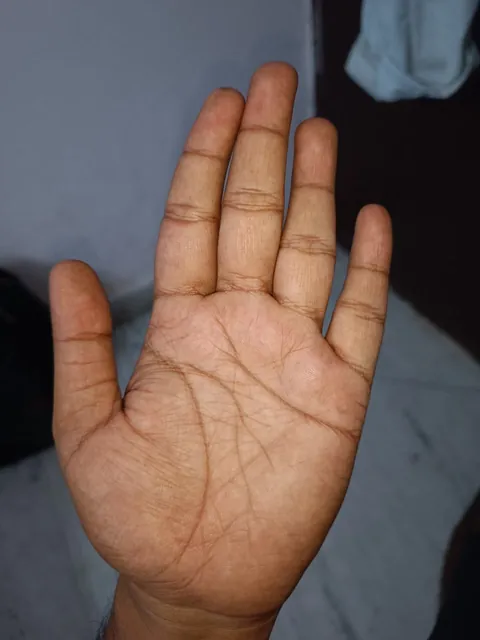
A real photo, traced by PalmSays. Your reading is made from your own photo.
Which hand should you read?
The same four lines are read on every hand. The question is which hand to start with. Which one do you write with?
- Put both palms side by side in good light.
- Start with the hand you write with.
- Then compare the same line on the other hand. Small differences are normal.
Our Android app is coming soon, with 2 free readings. The scan on this website opens soon too.
Or compare your two hands, photo by photo, in the left vs right hand tool
On this page
- Not sure which hand? Take the which-hand quiz
- Your writing hand vs your other hand
- Palm reading for female: which hand, and what to look at
- Palm reading for male: which hand, and what to look at
- What the traditions say
- Left-handed?
- Which hand for each line?
- Why your two hands look different
- Questions people ask
- Sources
Not sure which hand? Take the which-hand quiz
Two questions settle it for most people:
- Which hand do you write with? Start with that one.
- Do you use both hands about equally? Then read each hand on its own.
This is the same for women and men. The lines and their meanings don’t change; some traditions change only which hand comes first, as explained below.

Your writing hand vs your other hand
Your writing hand is read as the life you are making: what you have built, and what you are building now. Your other hand is read as what you started with: your natural tendencies, before life and effort shaped them. Some books call the writing hand the dominant hand or the active hand, and the other one the passive hand.
The idea comes from Cheiro. In Palmistry for All (1916) he writes that the right hand “denotes the developed or active brain, the left only giving the natural tendencies or inclinations.” In Cheiro’s Language of the Hand he quotes an old saying: “The left is the hand we are born with; the right is the hand we make.”
Notice that Cheiro speaks of the right and the left hand. Reading them as your writing hand and your other hand is a later convention, and it is the one the PalmSays app follows.
Cheiro’s own rule was to examine both hands, and to depend more on the right, the hand that shows what a person has developed. He also warns against reading one hand alone. Place both hands side by side, he advises, and look for the reason behind any change.
Your writing hand is read as the life you are making. Your other hand is read as what you started with.
Active hand and passive hand
Benham names the two hands the active and the passive hand: the right is active and the left passive, the other way round for a left-handed person. The hand that does the work, he writes, records the present; the passive hand shows your natural gifts. People today also say the dominant and the non-dominant hand. All of these name the same split: your writing hand and your other hand.
Palm reading for female: which hand, and what to look at
For a woman, the answer in palmistry tradition is the same as for anyone: compare both hands, and read your writing hand as the life you are making. If you are right-handed, that is your right hand. If you are left-handed, it is your left.
You may have heard that a woman’s left hand should be read. That is an old custom, recorded by Mrs J. B. Dale in Indian Palmistry (1895), and we explain it in what the traditions say. Dale herself adds that you should take the hand where the lines are clearest.
What to look at doesn’t change. The four main lines are read the same way on a woman’s hand as on a man’s:
- The heart line, for your emotional style: how you feel and show affection.
- The head line, for how you think and make decisions.
- The life line, for energy and how you meet change. Its length is never read as lifespan.
- The fate line, for direction and work. Many palms show a faint one, or none, and that is common.
There are no separate “female lines”. And no line reads a woman’s fate, her marriage or her children.
Palm reading for male: which hand, and what to look at
For a man, too, compare both hands and read your writing hand as the life you are making. If you are a right-handed man, every custom points the same way: your right hand. The old Eastern rule that Dale records reads a man’s right palm, and so does the writing-hand convention.
If you are a left-handed man, the two customs split: the writing-hand convention reads your left hand, the old custom your right. Reading both, side by side, settles it.
What to look at is the same four lines as for anyone. There is no separate “male palm”, and no line says what a man is fated to become.
What the traditions say
Palmistry books don’t agree on which hand to read, so here are the main views, each from its source.
| Tradition (book) | Hand read first | What the other hand shows |
|---|---|---|
| Western: Cheiro (1900, 1916) | Both, relying more on the right, the hand a person has developed | The left: the natural tendencies you were born with |
| Western: Benham (1900) | The active hand, the one that does the work (the left for a left-handed person) | The passive hand: your natural gifts |
| Indian: Dale, Indian Palmistry (1895) | A man’s right palm, a woman’s left; or the hand where the lines are clearest | The book gives no reading |
People also ask about a Chinese rule for which hand to read. None of the books we use gives one, so we don’t list it.
- Cheiro (1900 and 1916): examine both hands, and depend more on the right, which shows what you have developed. He calls reading the left hand because it is “nearest to the heart” a superstition from the Middle Ages.
- William G. Benham (1900): read both hands. The passive hand shows your natural gifts; the active hand, the one that does the work, shows the present. He also rejects the “nearest the heart” idea: the heart, he points out, has no more to do with the left hand than the right.
- Mrs J. B. Dale, Indian Palmistry (1895): “The general rule in the East is that the right palm of the male and the left palm of the female ought to be examined.” In the same passage she advises: “take the hand in which the signs and lines are clearly shown.”
The Eastern custom is a real tradition, and we don’t dismiss it. But it is about which hand to look at first, not about different lines or meanings. The lines, and what the books say they mean, are the same on every hand.
Left-handed?
Swap the hands. If you write with your left hand, palmistry tradition reads your left as the life you are making, and your right as what you started with. Benham gives the same rule: for a left-handed person, reverse the order and treat the left as the active hand.
Cheiro adds an observation of his own: “left-handed people have the lines more clearly marked on the left hand, and vice versa.”
Ambidextrous?
If you use both hands about equally, or you aren’t sure, the writing-hand idea doesn’t apply. Read each hand on its own, for what its lines show. The PalmSays app does the same when it doesn’t know which hand you use most. The books we use give no separate rule for people who use both hands equally.
Which hand for each line?
For every one of the lines on your palm, the answer is the same: compare both hands.
- Heart line: a difference between the hands is read as a change in how you show affection.
- Head line: your writing hand is read as how you think now.
- Life line: on neither hand is its length read as lifespan.
- Fate line: your writing hand is read as the direction you are taking now.
- Marriage line: these small lines are hard to see in photos, and no hand gives a date or a number. The PalmSays app doesn’t read them.
Why your two hands look different
Most people’s two palms differ. Cheiro noticed that in some people hardly two lines are alike on both hands, while in others the difference is barely visible. He read a big difference as a more eventful life, one that had moved far from where it started.
There are plainer reasons too. Your two hands do different work every day, and a photo adds its own differences: light, angle and how flat the hand is can make a line look deeper, fainter or broken. So photograph both hands the same way, in the same light, before reading much into a difference.
Quick facts
- In Hindi
- कौन सा हाथ देखें (kaun sa haath dekhen)
- The usual rule
- Compare both. In palmistry tradition, your writing hand is the life you are making; the other is what you started with.
- For women and men
- The same lines and the same meanings. An old Eastern custom reads a woman’s left palm and a man’s right palm first.
- Left-handed?
- Swap them: your left hand, the one you write with, is read as the life you are making.
- Both hands used, or not sure
- Each hand is read on its own, for what its lines show.
Questions people ask
Which hand is read in palmistry for a female?
Look at both, and read the hand you write with as the life you are making, the same as for a man. An old Eastern custom reads a woman’s left palm first; even Mrs Dale, who records it, advises taking the hand where the lines are clearest.
Which hand is seen in palmistry for a male?
Both, with the writing hand read as the life you are making. For a right-handed man, every custom points to the right hand. For a left-handed man, the writing-hand convention reads the left.
Is the left or right hand read in palmistry?
Both. In palmistry tradition, the hand you write with is read as the life you are making and the other as what you started with. Cheiro examined both hands and relied more on the right.
What does the left hand mean in palmistry?
For a right-handed person, tradition reads the left hand as what you started with: your natural tendencies. Cheiro quotes an old saying: “The left is the hand we are born with; the right is the hand we make.” If you are left-handed, the roles swap.
I’m left-handed. Which hand should I read?
Read your left hand as the life you are making, and your right as what you started with. Benham gives the same rule: for a left-handed person, reverse the hands.
Which hand should I read for the marriage line?
Compare both hands, as for every line. No hand can give a date, an age or a number of marriages; the marriage line guide explains what the books do say.
What if I use both hands?
Then the writing-hand idea doesn’t apply. Read each hand on its own, for what its lines show.
Sources (4 books and studies)
- Cheiro, Palmistry for All (1916). Part I, ch. XVII: Different Classes of Lines and Right and Left Hands.
- Cheiro, Cheiro’s Language of the Hand (1900). Part II, ch. IV: The Right and Left Hands, pp. 77–78.
- Mrs J. B. Dale, Indian Palmistry (1895). The Hand to Examine.
- William G. Benham, The Laws of Scientific Hand Reading (1900). Part I, ch. IV: Preliminary Arrangements, What Hand to Use, pp. 31–32. (facts only)
Meanings on this page are written in our own words from these books. Books whose rights are unclear are used for facts only, never quoted. How we choose sources
See your own lines
Upload one photo of your palm. We trace your lines and show what palmistry says about each one.
- Open palm
- Good light
- Whole hand in the frame
A phone photo shows the main lines and their breaks, forks and branches. Tiny marks such as stars and crosses are too small, so an honest reading leaves them out.
Our Android app is coming soon, with 2 free readings. The scan on this website opens soon too.
Coming soon on Google Play. The Android app is not on Google Play yet. This page will get the link the day it is.
The iPhone app isn’t ready yet. You can keep using this website.
PalmSays is currently listed as Palm Read AI on Google Play. It is the same app.
Or see what the PalmSays palm reading app reads before you install it.