Heart line meaning in palmistry (the love line)
The heart line is the top line across your palm, just under the fingers. Palmistry reads it for your emotional style: how you show affection and relate to people. It can’t tell who you’ll love, or when.
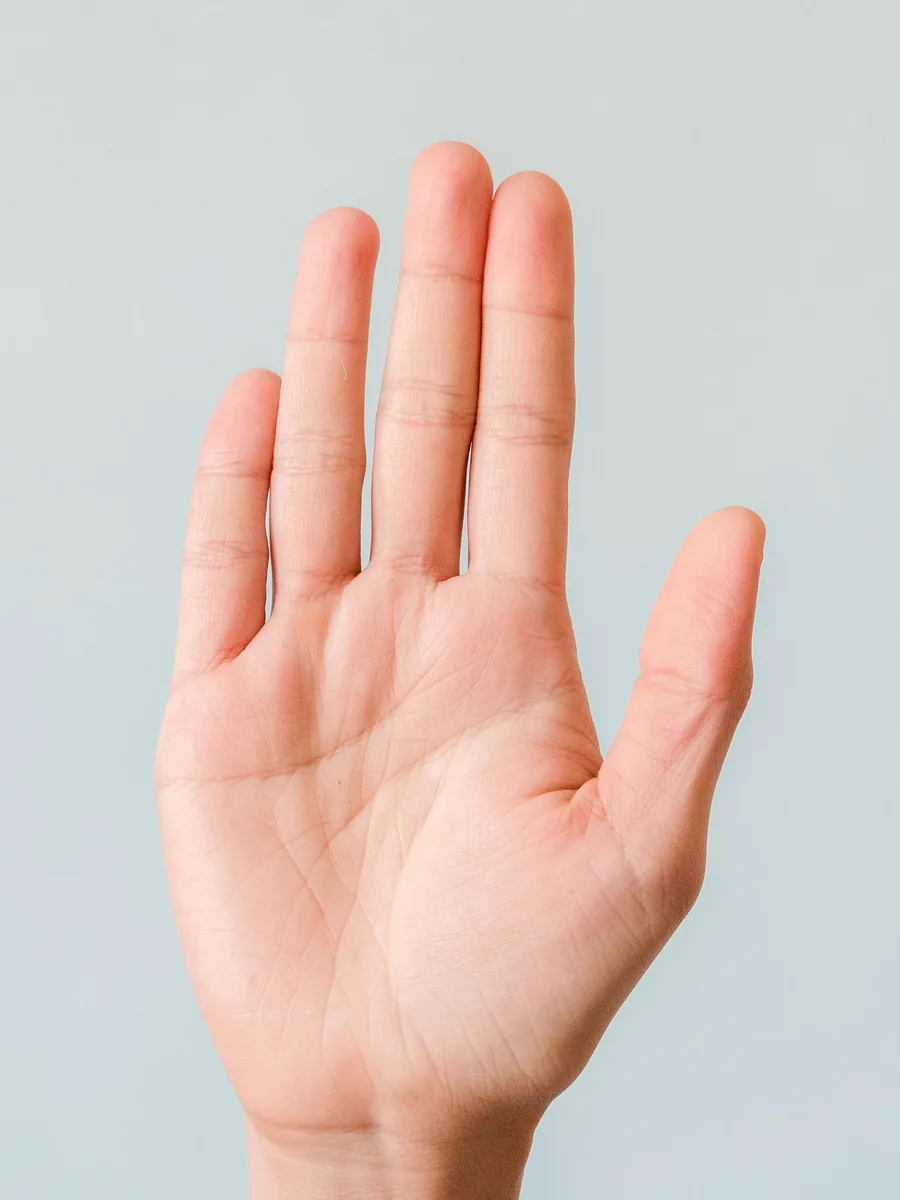
A real palm photo (Kevin Malik, Pexels), traced by the real PalmSays scanner. Your reading is made from your own photo.
Dotted lines are finger guides, not palm lines. The solid dot marks where the heart line starts, the ring where it ends.
Where is the heart line on your palm?
Heart lines end in different places. Where does yours stop?
- Hold your hand up in good light, palm facing you.
- Skip the short creases at the base of your fingers. The first long line below them is your heart line.
- Start at the little-finger edge and follow it across until it stops.
Our Android app is coming soon, with 2 free readings. The scan on this website opens soon too.
On this page
- Heart line types and their meanings
- How to tell the heart line from the head line
- Is the love line the same as the heart line?
- Which end of the heart line do you read from?
- Marks on the heart line
- Heart line in the left and right hand, for women and men
- When the heart and head lines join
- Check yourself: heart line quiz
- Myths about the heart line
- Heart line: questions people ask
- Sources for this heart line guide
Heart line types and their meanings
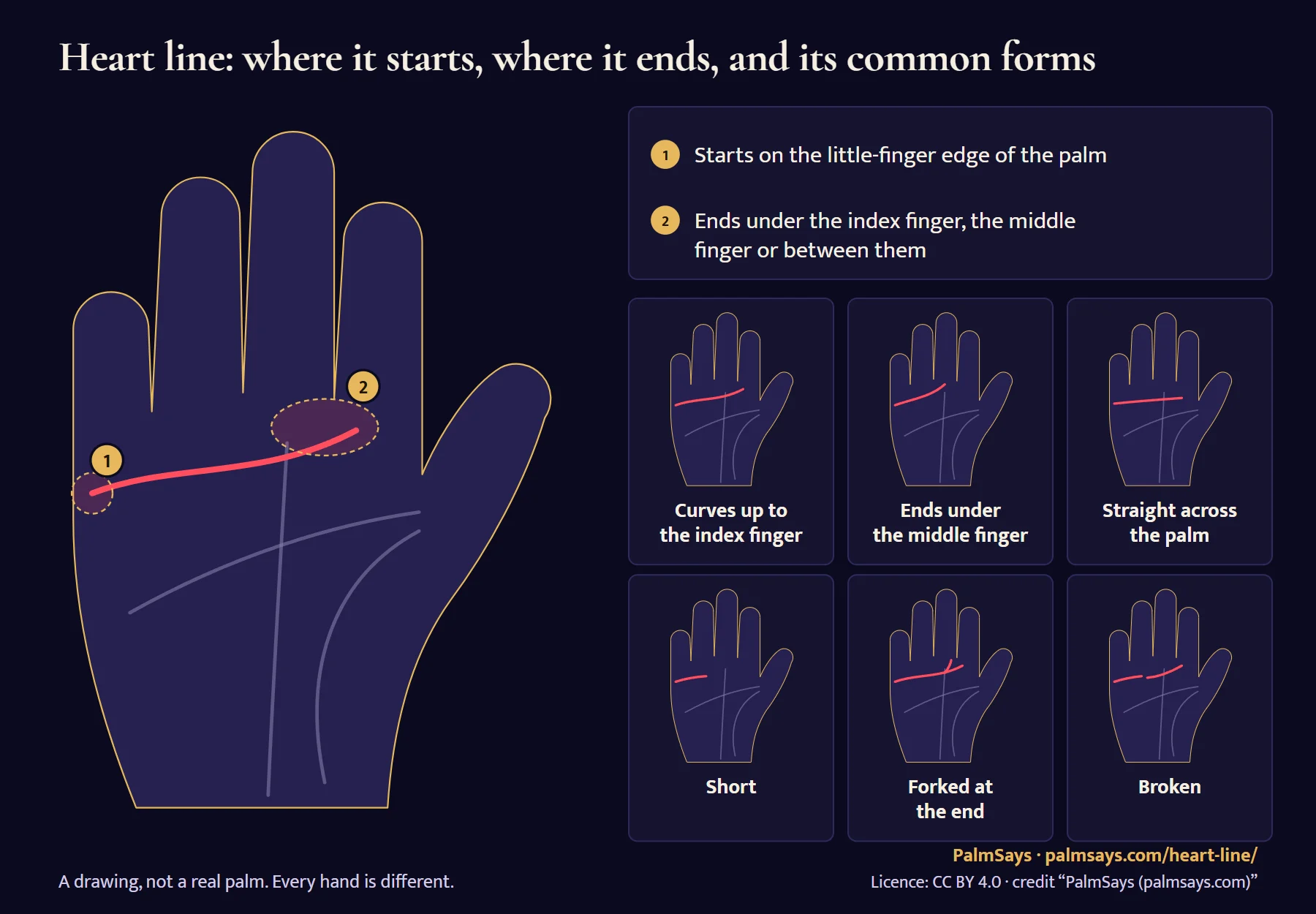
Match your own heart line to the cards. A line can fit more than one: long, forked and clearly marked all at once. Each meaning is in our own words, from the books named under it.
Read any line with 4 questions
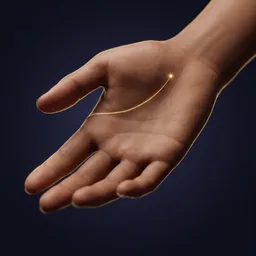
Under which finger does it stop?
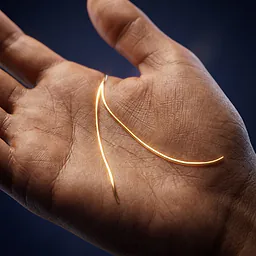
Right across the palm, or stopping early?
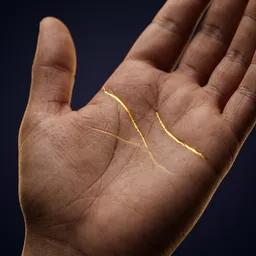
Deep and even, faint, or like a row of links?
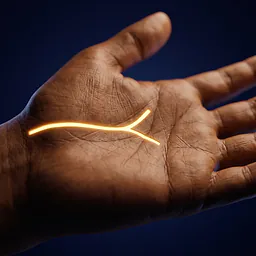
A fork, a gap, or small branches rising?


AI-made 3D pictures. The glow shows the idea; it is not a reading.
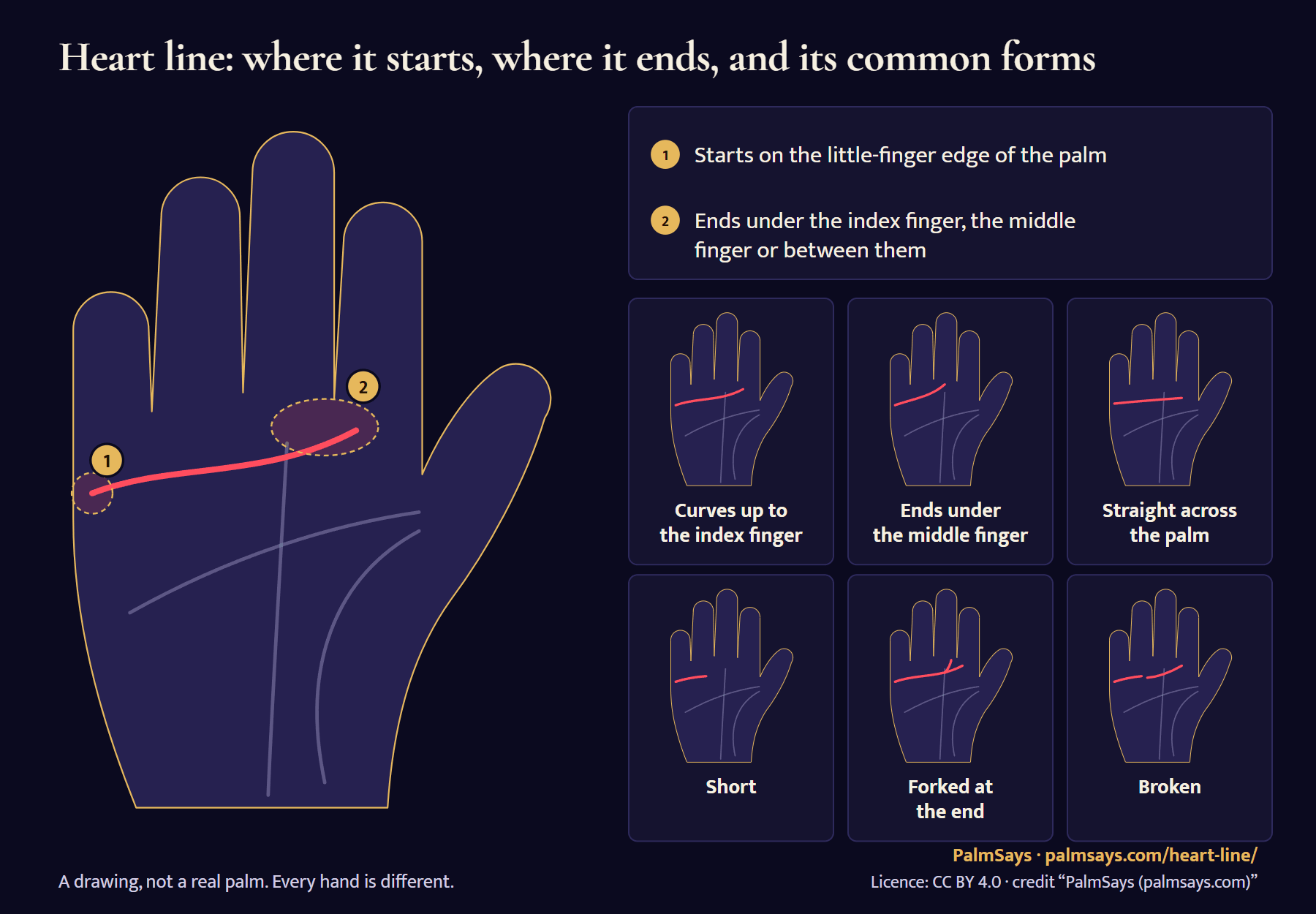
Where does your heart line start and end?
Side by side, at one scale
- Under the index finger
- Between index and middle
- Under the middle finger
- Straight across
- Curved
Drawings of the forms the books describe, not real palms.
Heart line ending under the index finger
Loyal, steady affection held to high ideals.
Do you have this? Does your top line curve up and stop under your first finger?
What the books say
The books read this as loyal, steady affection held to high ideals: once you are truly attached, you tend to stay attached. Some also read an idealistic view of love, a habit of looking up to the person you love.
Source: Cheiro (1916, 1900); Leo Markun (1927); William G. Benham (1900)
Heart line ending between the index and middle fingers
Calm but deep caring: not showy, but willing to do a great deal.
Do you have this? Does your top line stop in the gap between your first and middle fingers?
What the books say
A calm but deep way of caring. Not showy in love, but willing to do a great deal for the people you care about. Benham adds sensible, practical affection that isn’t easily swept away.
Source: Cheiro (1916, 1900); Leo Markun (1927); Albert Raphael (1901); William G. Benham (1900)
Heart line ending under the middle finger
Affection kept private, shown through closeness more than words.
Do you have this? Does your top line curve up and stop under your middle finger?
What the books say
Affection that stays private and is not often put on display, with a clear sense of what you want from a relationship. It is often shown through closeness and presence as much as words. The old books judge this ending harshly; we keep only the part about a style of affection.
Source: Cheiro (1916, 1900); Adolphe Desbarrolles (1859)
Straight heart line
Read by where it ends, not by the missing curve.
Do you have this? Does your top line run fairly straight, without curving up at the end?
What the books say
Most books don’t read the curve on its own. They read where the line ends. A straight line usually runs across towards the index-finger edge, so it is read like a long line; a line that curves up usually ends under a finger, so it is read by that ending.
Source: Cheiro (1916, 1900)
Curved heart line
Read by where the curve ends: under the index or the middle finger.
Do you have this? Does your top line bend up steeply towards your fingers at its end?
What the books say
The classical books give the curve itself no separate meaning. A curved heart line is read by where the curve ends: under the index finger, between the index and middle fingers, or under the middle finger, as in the cards above. Cheiro attaches a gloomy claim about love to one rare curve, a line that bends down at the base of the index finger; it is a claim about events, so we leave it out.
Source: Cheiro (1916, 1900)
How long is your heart line?
Side by side, at one scale
- Long
- Short
Drawings of the forms the books describe, not real palms.
Long heart line
Wholehearted affection; running right across, it can tip into possessiveness.
Do you have this? Does your top line run almost from one edge of your palm to the other?
What the books say
Strong, wholehearted affection: the books read a longer line as a fuller capacity for attachment. Jain’s Hindi book reads a spirited, cheerful nature, and Dale reads constancy in a long, unbroken line. When the line runs right across the hand, several books add a caution: affection given so fully can tip into possessiveness.
Source: Edward Heron-Allen (1885); Katharine St. Hill (1893); Adolphe Desbarrolles (1859); Chhotelal Jain (1927); Mrs J. B. Dale (1895)
Short heart line
Feelings shown sparingly. That says nothing about how much is felt.
Do you have this? Does your top line stop early, around your ring finger?
What the books say
Here the traditions differ. Cheiro and Frith read feelings that are shown sparingly, not always put into words or gestures. That describes how feeling is shown, not how much is felt. Dale reads attachment that is slower to hold steady.
Source: Cheiro (1916); Henry Frith (1895); Mrs J. B. Dale (1895)
How clear is your heart line?
Side by side, at one scale
- Deep and clear
- Faint
- Chained
- None
Drawings of the forms the books describe, not real palms.
Deep, clearly marked heart line
The books’ well-made heart line: warm, steady and even-tempered.
Do you have this? Is your top line deep and clear from end to end, with no gaps?
What the books say
The form the classical books hold up as the well-made heart line, especially when it runs unbroken to the index finger: a warm, steady, affectionate nature with an even temper.
Source: Cheiro (1916, 1900); Edward Heron-Allen (1885); Katharine St. Hill (1893)
Faint heart line
Feelings that run quietly, with a cooler manner. Not a lack of love.
Do you have this? Is your top line thin and hard to see, even in daylight?
What the books say
Feelings that run quietly under the surface, with a cooler, more detached manner in affection. It is a manner, not an absence of love. Light and focus also make lines look fainter in photos.
Source: Cheiro (1916)
Chained heart line
Attraction that forms easily and moves on easily.
Do you have this? Up close, does your top line look like a row of tiny links?
What the books say
A chained line looks like a row of small links. The books read attraction that forms easily and moves on easily, interest in people that shifts more than it settles. It is a pattern of attraction, not a judgement of character.
Source: Cheiro (1916); Leo Markun (1927)
No heart line
Uncommon. First check for one merged line across the palm (the simian line).
Do you have this? Can you find no long line at all under your fingers, even in daylight?
What the books say
A palm with no heart line at all is uncommon. More often the heart and head lines have formed one crease across the palm, the simian line (see when the heart and head lines join), or the line is only faint in the photo. For a line that is truly missing, Cheiro reads a cool, unemotional manner, with feeling kept under firm control. That describes how feeling is shown, not whether a person can love.
Source: Cheiro (1916, 1900)
Does your heart line break, fork or branch?
Side by side, at one scale
- Forked
- Broken
- Branches rising
- Branches falling
- Double
Drawings of the forms the books describe, not real palms.
Forked heart line
Balanced, faithful affection: ideals and everyday warmth held together.
Do you have this? Does your top line split into two small branches near its end?
What the books say
A fork at the finger end is one of the best-liked forms in the books: a balanced, honest and faithful style of affection, with ideals and everyday warmth held together. Jain adds a cheerful, generous nature, ready to help friends. A photo can’t always show exactly where a fork sits.
Source: Cheiro (1916, 1900); Leo Markun (1927); Katharine St. Hill (1893); Chhotelal Jain (1927)
Broken heart line
Attachment that is slower to settle. It does not mean heartbreak.
Do you have this? Is there a clear gap in your top line, where two pieces overlap?
What the books say
Dale reads attachment that is slower to hold steady, and Cheiro’s general rule for broken lines is that where the two ends overlap, the line’s qualities carry on. A crease or a shadow can also make a line look broken in a photo.
Source: Mrs J. B. Dale (1895); Cheiro (1916)
Branches rising from the heart line
Friendships that carry real weight in your life.
Do you have this? Do small lines rise from your top line towards your fingers?
What the books say
Small branches rising from the line towards the fingers. Markun reads them as friendship carrying real weight: warmth shared through close, supportive friendships.
Source: Leo Markun (1927)
Branches falling from the heart line
Feelings given to many people, which can be hurt when they aren’t returned.
Do you have this? Do small lines drop from your top line towards the middle of your palm?
What the books say
Small branches that drop from the heart line towards the head line. Frith reads branches below the line as disappointments in affection or friendship, and Benham’s general rule is that the more a heart line branches, the more its feeling goes out to many people. Together they describe feeling given widely, which can be hurt when it isn’t returned. That is a tendency, not a forecast of heartbreak.
Source: Henry Frith (1895); William G. Benham (1900)
Double heart line
A second line close beside it: read as a capacity for deep affection.
Do you have this? Does a second long line run just below your top line, close beside it?
What the books say
Two heart lines running close together are uncommon, and few books discuss them. Saint-Germain reads a double heart line as a capacity for deep affection, and Cheiro’s general rule is that a sister line, one running close beside another, adds to the power of the line it runs with. Saint-Germain also pairs it with future sorrow; that is a forecast, so we leave it out. Check that the second line isn’t a finger crease or your head line.
Source: Comte C. de Saint-Germain (1900); Cheiro (1916)

How to tell the heart line from the head line
The heart line is the highest long line across your palm, just below your fingers. The head line sits below it. To tell them apart:
Where is it? Three looks
1 Name your fingers.
2 Skip the short creases where the fingers join the palm.
3 The first long line below them, from the little-finger edge.
- Hold your hand up in daylight, palm facing you, fingers together.
- Skip the short creases at the base of each finger. Those are finger creases, not palm lines.
- The first long line below them, starting at the little-finger edge, is your heart line. It runs towards the index or middle finger, and often curves up at the end.
The next long line below it starts from the thumb side: that is the head line. If you see only one long line across the top of your palm instead of two, read when the heart and head lines join.
Heart or head line?
Follow the line back to where it starts.
At the little-finger edge: It is the heart line.
Between the thumb and index finger: It is the head line.
Only one line across the top half of your palm? When the heart and head lines join
How the heart line and head line differ
The two lines are read for different things. The heart line is read for feeling: how you show affection and relate to people. The head line is read for thinking: how you learn, plan and decide. Cheiro also reads the space between them. When the heart line sits very low, almost touching the head line, he reads feelings that keep stepping into decisions. When the head line sits unusually high, close under the heart line, he reads the reverse: matters of the heart decided by the head. That space has its own name, the quadrangle.
Is the love line the same as the heart line?
Yes. The love line in your hand is the heart line: “love line” is simply another name for it. In Hindi it is हृदय रेखा (hriday rekha). Older English books call it the mensal line, and Mrs Dale’s Indian Palmistry (1895) calls it the Line of Fortune. They all mean the same top line.
The small lines on the edge of your palm, under the little finger, are something else. Palmistry books call them marriage or relationship lines, and we explain them, honestly, in the marriage line guide.
Which end of the heart line do you read from?
Palmistry books disagree about this. Some read the heart line from the little-finger edge towards the index finger; others start from the index-finger end. So when two books read the same heart line in different ways, a careful reading shows you both instead of quietly picking one. That is what the PalmSays app does when its sources disagree.
Most readings look at just four things: where the line ends, how long it is, how clearly it is marked, and any forks, breaks or branches.
Marks on the heart line
The heart line can carry small marks: dots, islands, crosses, stars, squares or triangles. Books give each a meaning, but these marks are usually only a few pixels wide in a phone photo, too small to see reliably. So an honest reading leaves them out. What a good photo does show is a line’s breaks, forks and branches, and those are what the cards above describe.
Some Indian readings talk about signs such as a trident (त्रिशूल) or a fish (मछली) on or near the heart line. We will cover those signs, and what the books actually say about them, in a separate guide.
Heart line in the left and right hand, for women and men
The heart line is read the same way for everyone. There is no separate heart line for women or men. What changes is which hand you look at:
- Your writing hand is read as the life you are making.
- Your other hand is read as what you started with.

the life you are making

what you started with
Cheiro puts it as the right hand showing what a person has developed, and the left the natural tendencies. So compare both: if the line looks different on each hand, the tradition reads that as a change from where you started. Which hand to read explains the traditions, including left-handed readers.
When the heart and head lines join
Sometimes the heart line and the head line don’t run as two lines. They form one straight crease across the palm. Palmistry calls it the simian line; doctors call it a single palmar crease. It is usually a normal variation. Cheiro reads a single line like this as great intensity of character, and says where it sits matters: at head-line height it leans to the mind, higher up to feeling. The simian line guide covers the medical facts first, then what the books say.
Check yourself: heart line quiz
Three quick questions. Pick an answer to see if you are right. New to palmistry? Start with how to read palm lines.
Myths about the heart line
- MythA broken heart line means heartbreak or divorce.
- Reality
No line predicts a break-up. The books that read a broken heart line describe attachment that takes longer to settle: a tendency, not an event.
- MythA short heart line means you can’t love.
- Reality
The books read a short line as feelings shown sparingly. That is about how affection is shown, not how much is felt.
- MythThe heart line shows how healthy your heart is.
- Reality
Some old books say this. The app’s rule set leaves out every health claim they make, and so do we: palm lines are not a health test.
Heart line quick facts
- Hindi name
- हृदय रेखा (hriday rekha)
- Other names
- The love line. Older English books call it the mensal line; Dale’s Indian Palmistry (1895) calls it the Line of Fortune. All names: palmistry terms.
- Where it sits
- The highest long line across the palm, just below the fingers. It starts at the little-finger edge.
- What the tradition reads in it
- Emotional life: how you feel, show affection and relate to other people.
- Which hand
- Look at both. Tradition reads your writing hand as the life you are making. Which hand to read
Heart line: questions people ask
What does the heart line mean in palmistry?
It is read for your emotional style: how you feel, how openly you show affection and how you relate to people. The books describe tendencies, not events. Nothing in the line says who you will love or what will happen.
Is the love line the same as the heart line?
Yes. The love line in your hand is the heart line, the top line across the palm. “Love line” is just another name; there is no separate love line.
What does a broken heart line mean?
Not heartbreak. Dale’s Indian Palmistry reads it as attachment that is slower to settle, and Cheiro’s rule for any broken line is that the qualities carry on where the two ends overlap. A crease or a shadow can also make a line look broken in a photo.
Can the heart line predict marriage?
No. No line can tell whether or when you will marry. Palmistry books look for that in the small lines on the edge of the palm, and even those can’t give a date: see what the marriage line really means.
What if my marriage line touches my heart line?
Some old books read a marriage line that curves down into the heart line as the loss of a partner. No crease can show that, and lines often meet on the edge of the palm. We explain the shape in marriage line touching the heart line.
What does it mean if my heart line and life line are joined?
Check which line you are looking at. It is usually the head line, not the heart line, that starts joined to the life line; the head line guide explains that. The books we use give no separate reading for a heart line touching the life line, so we don’t invent one.
Which hand should I read for the heart line?
Look at both. Tradition reads the hand you write with as the life you are making, and the other as what you started with. More in which hand to read.
What if I can’t see my heart line clearly?
Try brighter, even daylight and a flat, open hand. Some heart lines are faint, and that is normal. A careful reading says a line is not clear instead of guessing.
Sources for this heart line guide (14 books and studies)
- Cheiro, Palmistry for All (1916). Part I, ch. VII: The Line of Heart; ch. XVII: Different Classes of Lines; ch. II: The Line of Head (the head and heart lines as one line).
- Cheiro, Cheiro’s Language of the Hand (1900). Part II, ch. X: The Line of Heart, pp. 98–101.
- Cheiro, Cheiro’s Guide to the Hand (1900). Ch. XIII: The Line of Heart, pp. 84–88.
- Leo Markun, What You Should Know About Palmistry (1927). The section on the Heart Line.
- Mrs J. B. Dale, Indian Palmistry (1895). The Line of Fortune (the old name for the heart line).
- Edward Heron-Allen, A Manual of Cheirosophy (1885). Cheiromancy, § 2: The Line of Heart, ¶¶ 551–553, pp. 244–245.
- Edward Heron-Allen, Practical Cheirosophy (1887). Cheiromancy or Palmistry: the Line of Heart, pp. 114–115.
- Henry Frith, Practical Palmistry (1895). The Heart Line, pp. 57–59; Spaces and Signs, p. 156 (branches below the heart line).
- Adolphe Desbarrolles, Chiromancie nouvelle (1859). Ligne de cœur, pp. 215–216. (in French)
- William G. Benham, The Laws of Scientific Hand Reading (1900). Part II, ch. V: The Line of Heart, pp. 387–393. (facts only)
- Albert Raphael, Cheirosophy (1901). The Heart Line, pp. 121–124. (facts only)
- Katharine St. Hill, The Grammar of Palmistry (1893). Line of Heart (Mensal), pp. 46–47. (facts only)
- Comte C. de Saint-Germain, The Practice of Palmistry for Professional Purposes (1900). The Line of Heart, Position and Length, pp. 242–243; Special Observations (a double line of heart). (facts only)
- Chhotelal Jain, Samudrik Shastra ya Bhagya Nirnay (1927). The top line (the heart line), pp. 10–11. (facts only, in Hindi)
Meanings on this page are written in our own words from these books. Books whose rights are unclear are used for facts only, never quoted. How we choose sources
See your own heart line
Upload one photo of your palm. We trace your lines and show what palmistry says about each one.
- Open palm
- Good light
- Whole hand in the frame
A phone photo shows the main lines and their breaks, forks and branches. Tiny marks such as stars and crosses are too small, so an honest reading leaves them out.
Our Android app is coming soon, with 2 free readings. The scan on this website opens soon too.
Coming soon on Google Play. The Android app is not on Google Play yet. This page will get the link the day it is.
The iPhone app isn’t ready yet. You can keep using this website.
PalmSays is currently listed as Palm Read AI on Google Play. It is the same app.
Or see what the palm reading app for Android reads before you install it.