Fate line meaning in palmistry
The fate line runs up the middle of your palm towards the middle finger. Palmistry reads it for direction and work. Many palms show it faintly or not at all, and that is common, not a lack of luck.
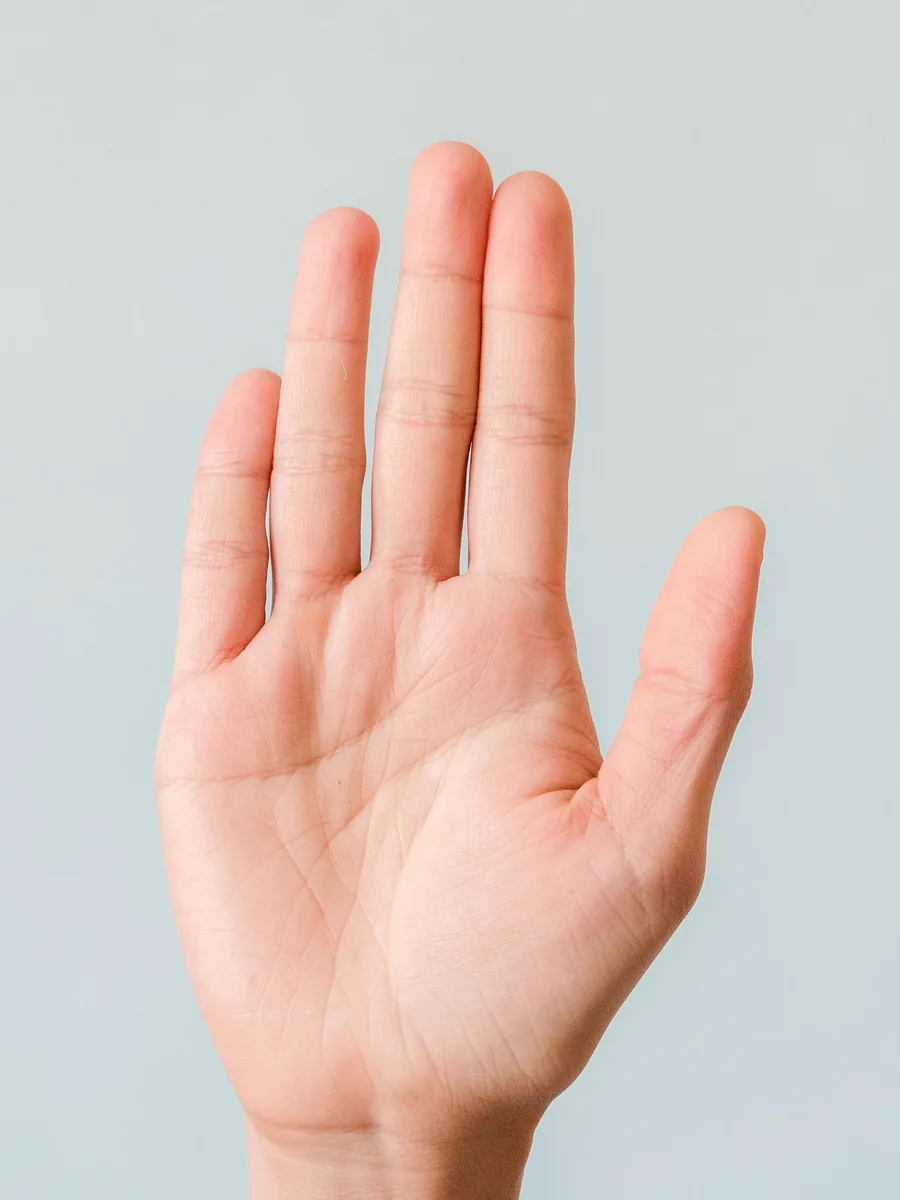
A real palm photo (Kevin Malik, Pexels), traced by the real PalmSays scanner. Your reading is made from your own photo.
Dotted lines are finger guides, not palm lines. The solid dot marks where the fate line starts, the ring where it ends.
Where is the fate line on your palm?
Many palms show a faint fate line, or none at all. Can you find yours?
- Hold your hand up in daylight, palm facing you.
- Look up the middle of your palm, from the wrist towards your middle finger.
- Check where a line starts (the wrist, the life line or the outer palm) and whether it breaks.
Our Android app is coming soon, with 2 free readings. The scan on this website opens soon too.
On this page
- Fate line types and their meanings
- Marks on the fate line
- No fate line? It’s common
- How to tell the fate line from the life line
- Is it the career line or the luck line?
- The fate line and your work
- Fate line in a woman’s and a man’s hand
- Check yourself: fate line quiz
- Myths about the fate line
- Fate line: questions people ask
- Sources for this fate line guide
Fate line types and their meanings
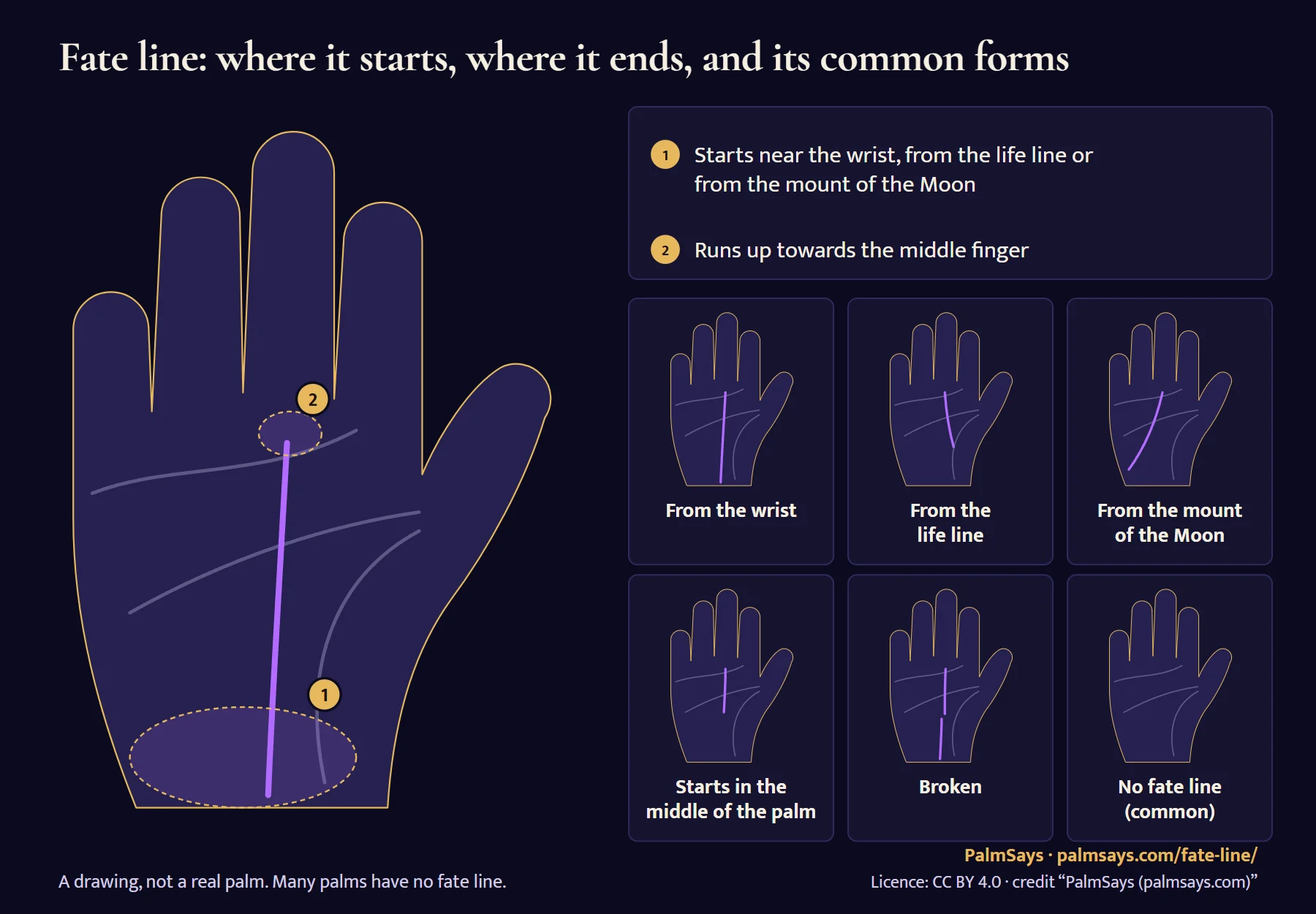
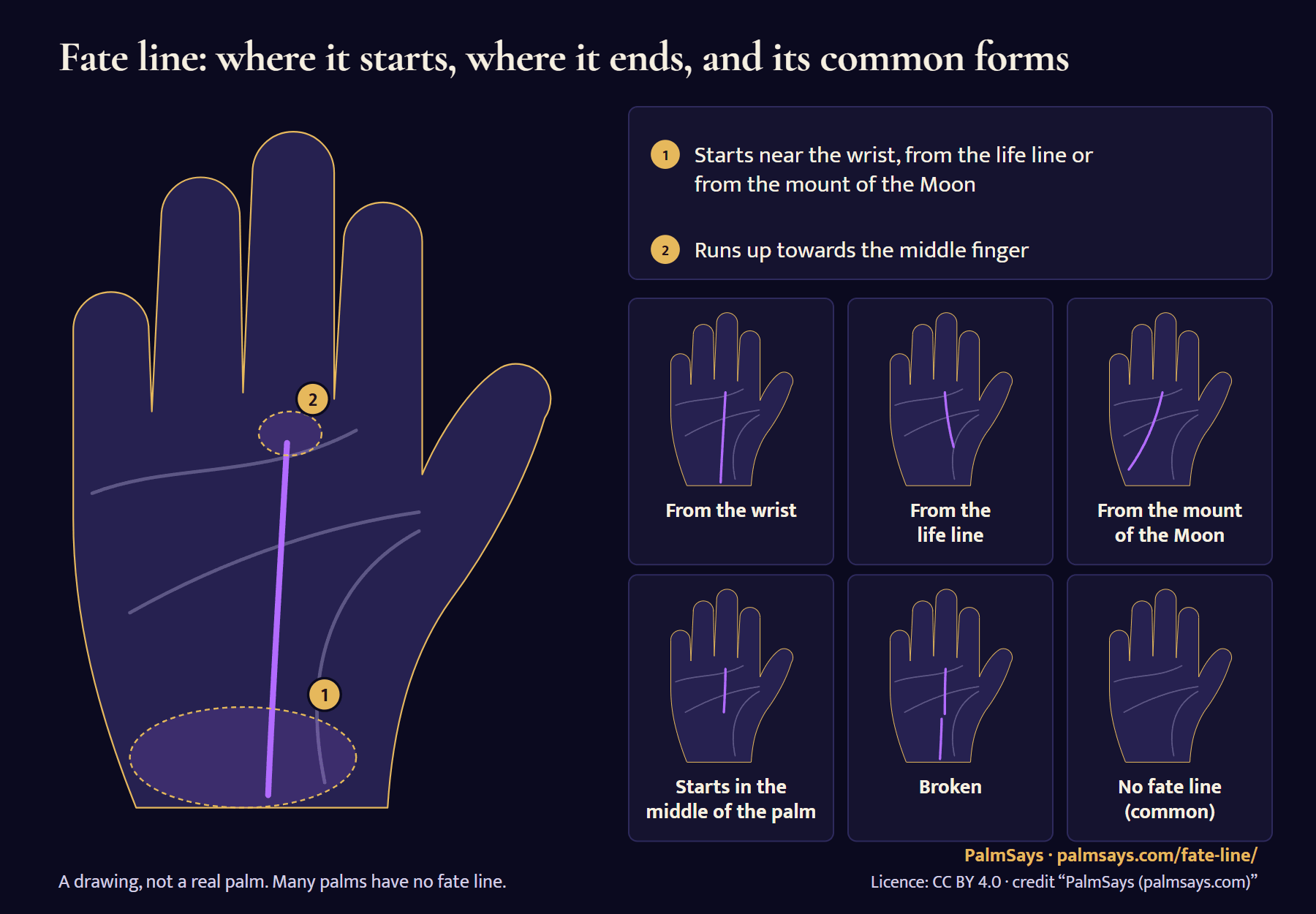
The books read the fate line mostly by where it starts and where it ends. Match your own line to the cards.
Read any line with 4 questions
From the wrist, the life line, the outer palm or mid-palm? Which finger does it reach?
Short, in pieces or missing: all common.
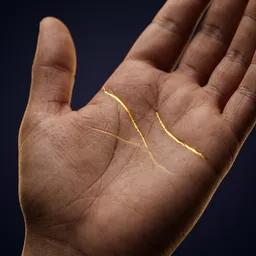
Faint, or deep and heavily marked?
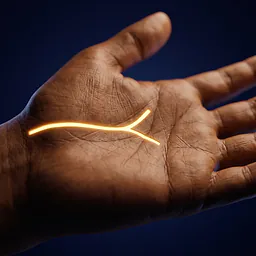
A gap, or two lines side by side?


AI-made 3D pictures. The glow shows the idea; it is not a reading.
Where does your fate line start and end?
Side by side, at one scale
- From the wrist
- From the life line
- From the outer palm
- From mid-palm
- From the head line
Drawings of the forms the books describe, not real palms.
Starting at the wrist
Responsibility that arrives early: a sense of duty towards work.
Do you have this? Does a line rise from your wrist straight up the middle of your palm?
What the books say
Responsibility that arrives early: a sense of duty towards work that starts young. When the line runs straight up to the middle finger, Cheiro’s Guide to the Hand reads a strong, self-directed personality that pushes past obstacles on its own path. Some old books also promise great success for this form; that promise is left out.
Source: Leo Markun (1927); Cheiro (1900)
Starting from the life line
Direction won by your own effort, after early years shaped by family.
Do you have this? Does the line start on your life line and rise from there?
What the books say
Cheiro reads direction won by your own effort and merit, after early years shaped a great deal by family and surroundings. He adds that the point where the line leaves the life line marks a year of independence; we never read dates from a palm.
Source: Cheiro (1916)
Starting from the outer palm (mount of the Moon)
A path shaped a great deal by other people: the public, patrons or partners.
Do you have this? Does the line rise from the lower outer edge of your palm, opposite the thumb?
What the books say
A path shaped a great deal by other people: work where the public, patrons or partners play a large part. It describes where influence comes from, not whether it helps.
Source: Cheiro (1916, 1900); Leo Markun (1927); Henry Frith (1895)
Starting in the middle of the palm
The self-made pattern: what you build comes from your own persistence.
Do you have this? Does the line only begin around the middle of your palm?
What the books say
The self-made pattern: what you build tends to come from your own persistence rather than an easy start. The books promise eventual success here; that promise is not repeated, because it describes effort, not an outcome.
Source: Cheiro (1916, 1900)
Starting inside the life line (mount of Venus)
A working life shaped a great deal by love and close family.
Do you have this? Does the line rise from the base of your thumb, inside your life line?
What the books say
A line that rises from the pad at the base of the thumb, inside the life line. Cheiro reads a working life strongly shaped by love and close relationships, and Cheiro’s Language of the Hand reads a line tied close beside the life line, low down, as early years given to the wishes of parents or relatives. Both describe where influence comes from, not how things turn out. Cheiro’s further claims about marriage are left out.
Source: Cheiro (1916, 1900)
Starting at the head line
Direction found later, through your own talents and hard work.
Do you have this? Does the line only begin where it meets your head line, in the middle of your palm?
What the books say
Cheiro’s Language of the Hand reads direction that is found later in life, after real effort and through your own talents. The book promises success at the end of that road; we keep the effort, not the promise.
Source: Cheiro (1900)
Starting at the heart line
Direction that settles very late, after long effort; Cheiro also reads a taste for art.
Do you have this? Does the line only begin at your heart line, just below the middle finger?
What the books say
A short line that only begins at the heart line. Cheiro’s Language of the Hand reads a direction that settles very late, after a long, difficult effort, and adds a strong taste for art and artistic things. As with every start point, it describes a pattern of effort, not a date or a result.
Source: Cheiro (1900)
Ending under the index finger
Effort pulled towards responsibility and leading others.
Do you have this? Does the top of the line bend towards your index finger?
What the books say
Effort pulled towards responsibility and leading others: ambition that looks for a position of trust. The old books call this a sign of success; here it describes where effort tends to go, not what it will bring.
Source: Cheiro (1916, 1900)
Ending under the ring finger
Effort drawn towards visible, public-facing work.
Do you have this? Does the top of the line bend towards your ring finger?
What the books say
Effort drawn towards visible, public-facing work, where being recognised matters. Cheiro reads a line bending towards the little finger instead as effort drawn to trade, business or skilled technical work.
Source: Cheiro (1916)
A line that ends under the middle finger, its usual place, is read by Dale’s Indian Palmistry as a reflective, deliberate approach to work, with decisions thought through before they are acted on. An unbroken line ending there she reads as a quiet, serious-minded nature, the kind of person others go to for considered advice. The fate line can also start inside the life line, on the thumb mound: Cheiro reads close relationships and strong feelings weighing heavily on the choices you make about work.
How clear is your fate line?
Side by side, at one scale
- Deep and clear
- Faint
- None
Drawings of the forms the books describe, not real palms.
Faint fate line
A strong preference for choosing your own path.
Do you have this? Is the line thin and faint, hard to see even in daylight?
What the books say
A strong preference for self-direction: little patience with the idea that anything but your own choices decides your path. A deep, heavily marked line is read the other way, as a steady, routine-shaped working life. Markun warns against reading a heavily marked fate line as luck, and we don’t.
Source: Cheiro (1916)
Does your fate line break, fork or branch?
Side by side, at one scale
- Broken
- Double
- Forked at the start
- Wavy
Drawings of the forms the books describe, not real palms.
Broken fate line
A working life that changes direction, not one straight road.
Do you have this? Does the line stop and start again, with the pieces overlapping?
What the books say
A working life that changes direction: a real change of job or surroundings rather than one straight road. The books disagree on whether such a change turns out well, and neither view is assumed here. Jain reads a line seen in pieces as quick and capable but restless, where staying with one course is harder than starting one.
Source: Cheiro (1916); Leo Markun (1927); Albert Raphael (1901); Chhotelal Jain (1927)
Double fate line
Two lines side by side: the fate line’s qualities made stronger.
Do you have this? Do two lines run side by side up the middle of your palm?
What the books say
Two lines running side by side. The app has no separate rule for this. Cheiro’s general rule for a sister line, one running close beside another, is that it strengthens the line it runs with, so the tradition reads a double fate line as the fate line’s qualities made stronger.
Source: Cheiro (1916)
Forked fate line
Two starts, from the thumb side and the outer palm: pulled between feeling and imagination.
Do you have this? Does the line start in two branches, one from each side of your lower palm?
What the books say
A fate line that starts in two branches, one rising from the base of the thumb and one from the lower outer palm. Cheiro’s Language of the Hand reads a path that swings between imagination on one side and love and feeling on the other. Frith reads a fork at the base as an unsettled, undecided start in life. The books give no clear reading for a fork at the top of the line.
Source: Cheiro (1900); Henry Frith (1895)
Wavy fate line
A course that keeps changing rather than running straight.
Do you have this? Does the line wander from side to side as it runs up your palm?
What the books say
Benham reads a wavy fate line (his line of Saturn) as a course that keeps changing, and Cheiro’s rule for any wavy line is uncertainty and a lack of decision. Many working lives change course often, by choice as much as by chance; the line says nothing about whether that goes well.
Source: William G. Benham (1900); Cheiro (1916)
A fork or a wavy stretch in the fate line is harder to read from a photo, because the fate line crosses the head and heart lines and branches often turn out to be other creases. The PalmSays app reads breaks in the fate line, but it has no separate reading for a forked or wavy one.

Marks on the fate line
Like the other lines, the fate line can carry tiny marks: squares, islands and crosses. Most are only a few pixels wide in a phone photo, so the PalmSays app leaves them out. The books read them like this:
- Square: Cheiro’s Language of the Hand reads a square on the fate line as protection from loss in work and money matters, as a square is protective on every line. It is a symbol in the books, not a promise.
- Island or cross: the old books read these as hard stretches in working life. Those readings forecast events, so we leave them out.
No fate line? It’s common
Many palms show the fate line faintly, in short pieces, or not at all. That is very common, and it isn’t read as a lack of luck or purpose.
No fate line is not bad luck. It is read as a path that isn’t fixed in advance.
The old books themselves disagree about a missing fate line. One judges it harshly; another notes that people without it often do well. The PalmSays rule set shows neither judgement as a prediction. What it keeps is the gentler reading: your direction isn’t set out in advance, and work tends to follow your circumstances and choices as they come, rather than one fixed track.
A fate line can also be missing from a photo when it is simply faint, so a careful reading says “not clearly seen” rather than “none”.
How to tell the fate line from the life line
The fate line is the vertical line up the middle of your palm; the life line curves around the thumb. To find it:
Where is it? Three looks
1 Name your fingers, and find the middle one.
2 Skip the finger creases at the top of the palm.
3 The line up the middle, from the wrist end towards the middle finger.
- Start near the wrist, in the middle of your palm.
- Look for a line running up through the centre, past the head and heart lines.
- Follow it towards the base of your middle finger. In Hindi it is भाग्य रेखा (bhagya rekha).
It doesn’t always start at the wrist. It may rise out of the life line, from the lower outer edge of the palm, or only from the middle of the palm. It may also fade out partway up, or stop at the head or heart line. All of these are common.
Life or fate line?
Look at the way the line runs.
It curves around the ball of the thumb: It is the life line.
It runs straight up the middle: It is the fate line.
A line that leaves the life line and runs up the palm is read as a fate line. Life line vs fate line
Is it the career line or the luck line?
It is the same line. People call the fate line the destiny line, the career line, the job line or the luck line. Dale’s Indian Palmistry (1895) calls it the Line of Saturn, after the mount under the middle finger where it usually ends. In Jain’s Hindi book it is the upward line, ऊर्ध्वरेखा (urdhva rekha).
Don’t mix it up with the sun line, a line some palms show beside it, rising towards the ring finger instead of the middle finger: see sun line meaning. Whatever the name, the books read the fate line for how you approach work and direction. None of them can tell you which job you will get, how much you will earn or how lucky you will be.
The fate line and your work
Because people call it the career line, the fate line gets asked the biggest questions: which job, how much money, when. The books read it for how you approach work: early responsibility, your own effort, other people’s influence, a change of direction. That can be a useful prompt to think about what you want from your working life. It can’t make the decision for you. Career palmistry reads the fate line together with the head line, the sun line and the shape of the hand, and the money line guide explains why no line shows income.
Does the fate line show when you’ll succeed?
No. Cheiro’s Palmistry for All (1916) divides the fate line, like the life line, into seven-year periods and reads dates from them. We don’t: a crease can’t carry a date, and no line can say whether or when success will come. What the books describe is how you approach work, and that part is yours to use.
Fate line in a woman’s and a man’s hand
The fate line is read the same way for everyone. The “job line in a female hand” or “lucky line in a female hand” that people search for is the same fate line, with the same readings. What traditions differ on is only which hand to read. Which hand to read explains the writing-hand tradition and the Indian custom of reading a woman’s left hand.

the life you are making

what you started with
Check yourself: fate line quiz
Three quick questions. Pick an answer to see if you are right. New to palmistry? Start with the 7 steps of a palm reading.
Myths about the fate line
- MythNo fate line means no luck or no career.
- Reality
Many palms show a faint fate line or none. That is common, and the tradition doesn’t read it as a bad sign: the gentler reading is simply a path that isn’t fixed in advance.
- MythA deep fate line means you will be lucky.
- Reality
Markun warns against reading a heavily marked fate line as luck. It is read as a steady, routine-shaped working life.
- MythA broken fate line means failure.
- Reality
A break is read as a change of direction, and the books themselves disagree about whether it turns out well. Changing work is common and often chosen.
Fate line quick facts
- Hindi name
- भाग्य रेखा (bhagya rekha)
- Other names
- The destiny line, and in everyday use the career, job or luck line. Dale’s Indian Palmistry (1895) calls it the Line of Saturn. All names: palmistry terms.
- Where it sits
- Up the middle of the palm, from near the wrist towards the middle finger. It may start higher up, from the life line or from the outer palm.
- What the tradition reads in it
- Direction, work and a sense of purpose. Not luck, income or success.
- How common it is
- Many palms show it faintly, in pieces or not at all. That is normal.
Fate line: questions people ask
What does it mean if I have no fate line?
It is common. The books disagree sharply about a missing fate line, and the gentler reading is that your direction isn’t set in advance: work follows your circumstances and choices as they come. It is not read as bad luck, and people without one often do well.
Is the career line the same as the fate line?
Yes. “Career line”, “job line”, “luck line” and “destiny line” are everyday names for the fate line. There is no separate career line on the palm.
What does a broken fate line mean?
A working life that changes direction, with a real change of job or surroundings rather than one straight road. The books disagree on whether such a change turns out well, so neither view is assumed.
What does a fate line starting from the life line mean?
Cheiro reads it as direction won by your own effort, after early years shaped a great deal by family and surroundings. It describes effort, not a result.
Is the fate line different in a woman’s hand?
No. The job line or luck line people ask about in a female hand is the same fate line, read the same way for everyone. What traditions differ on is which hand to read: see which hand to read.
Can the fate line tell if I will get a job or be rich?
No. It is read for how you tend to approach work and direction. No line predicts a job, an income, success or luck.
Sources for this fate line guide (9 books and studies)
- Cheiro, Palmistry for All (1916). Part I, ch. V: The Line of Destiny or Fate (incl. Rising from the Line of Life, and inside the life line on the mount of Venus); ch. XVII: Different Classes of Lines (sister lines, wavy lines); ch. XIX: How to Tell Time and Dates.
- Cheiro, Cheiro’s Language of the Hand (1900). Part II, ch. XI: The Line of Fate, pp. 102–105 (where it rises; the square, the island and the cross).
- Cheiro, Cheiro’s Guide to the Hand (1900). Ch. XIV: The Line of Fate, p. 89.
- Leo Markun, What You Should Know About Palmistry (1927). The section on the Fate Line.
- Mrs J. B. Dale, Indian Palmistry (1895). The Line of Saturn (the old name for the fate line); The Planet Saturn: its mount and the Line of Saturn.
- William G. Benham, The Laws of Scientific Hand Reading (1900). Part II, ch. X: The Line of Saturn (a wavy line). (facts only)
- Henry Frith, Practical Palmistry (1895). The Fate Line, pp. 88–93 (a fork at the base).
- Albert Raphael, Cheirosophy (1901). The Fate Line, p. 132. (facts only)
- Chhotelal Jain, Samudrik Shastra ya Bhagya Nirnay (1927). The fate line (urdhva rekha), p. 16. (facts only, in Hindi)
Meanings on this page are written in our own words from these books. Books whose rights are unclear are used for facts only, never quoted. How we choose sources
See your own fate line
Upload one photo of your palm. We trace your lines and show what palmistry says about each one.
- Open palm
- Good light
- Whole hand in the frame
A phone photo shows the main lines and their breaks, forks and branches. Tiny marks such as stars and crosses are too small, so an honest reading leaves them out.
Our Android app is coming soon, with 2 free readings. The scan on this website opens soon too.
Coming soon on Google Play. The Android app is not on Google Play yet. This page will get the link the day it is.
The iPhone app isn’t ready yet. You can keep using this website.
PalmSays is currently listed as Palm Read AI on Google Play. It is the same app.
Or see what the palm reading app for Android reads before you install it.