Life line on your palm: what it shows (and what it doesn’t)
No, a short life line doesn’t mean a short life. Palmistry reads the life line for your energy and how you meet change, never for how long you’ll live. Photos can make it look shorter too.
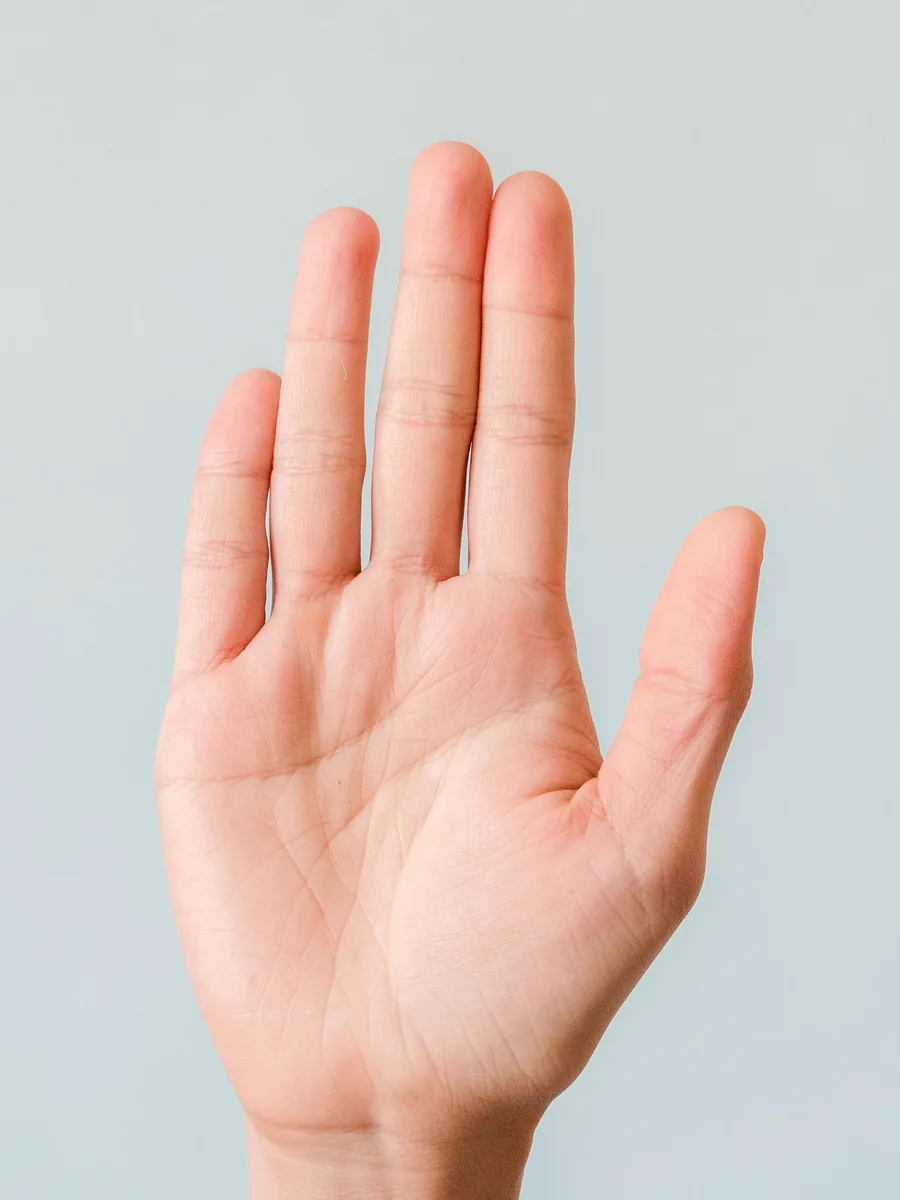
A real palm photo (Kevin Malik, Pexels), traced by the real PalmSays scanner. Your reading is made from your own photo.
Dotted lines are finger guides, not palm lines. The solid dot marks where the life line starts, the ring where it ends.
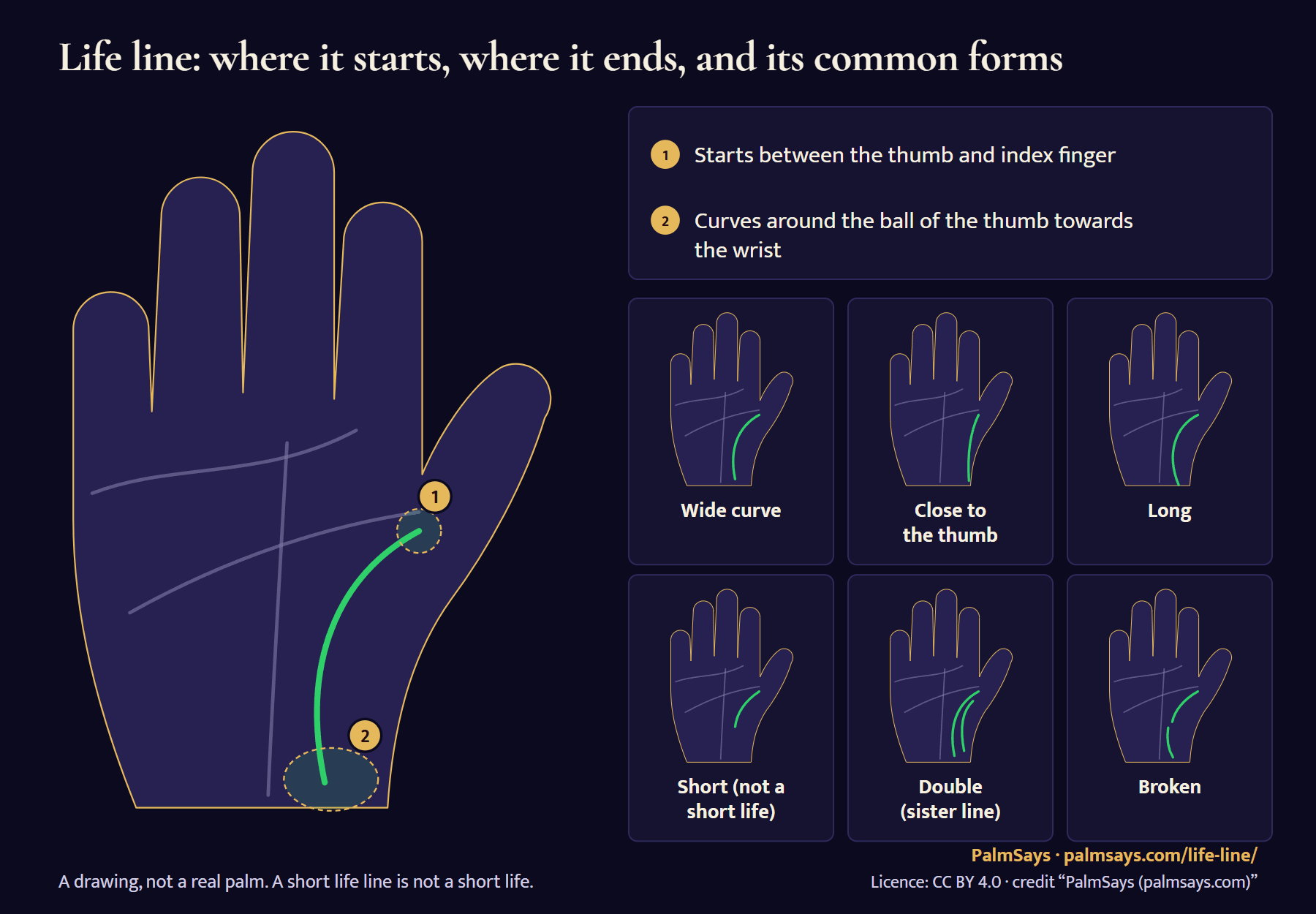
Where is the life line on your palm?
The books read the curve of your life line, never its length as years. How wide does yours swing?
- Hold your hand up in daylight, palm facing you.
- Find the line that starts between your thumb and index finger.
- Follow it as it curves around the fleshy base of your thumb towards the wrist.
Our Android app is coming soon, with 2 free readings. The scan on this website opens soon too.
On this page
- Does a short life line mean a short life?
- Life line types and their meanings
- Marks on the life line
- Life line vs fate line
- Life line age calculation: why we don’t do it
- Life line in the hand for women and men
- Left and right hand
- Check yourself: life line quiz
- Myths about the life line
- Life line: questions people ask
- Sources for this life line guide
Does a short life line mean a short life?
No. In palmistry, a short life line is not read as a short life. It is one of the most common fears about palm reading, partly because of the name “life line”. Careful readers don’t read it that way. Markun, and Cheiro’s Language of the Hand, warn against reading its length as a count of years, and the PalmSays rule set never does.
A short life line is not a short life. The books read this line for energy and how you meet change.
What the books do read in the life line is energy: how it is spent, how steady it is, and how you meet big changes. A line can also look short when the photo crops it, the light is flat or your thumb is bent.
- What you see
- Your life line looks short in this photo.
- What the tradition says
- That’s very common. In palmistry, the life line’s length is not read as how long you’ll live. Traditionally it’s linked to your energy and how you handle big changes.
- What it can’t tell you
- Palmistry can’t tell your lifespan or your health. For health, talk to a doctor. A clearer photo in good light often shows more of the line.
Life line types and their meanings
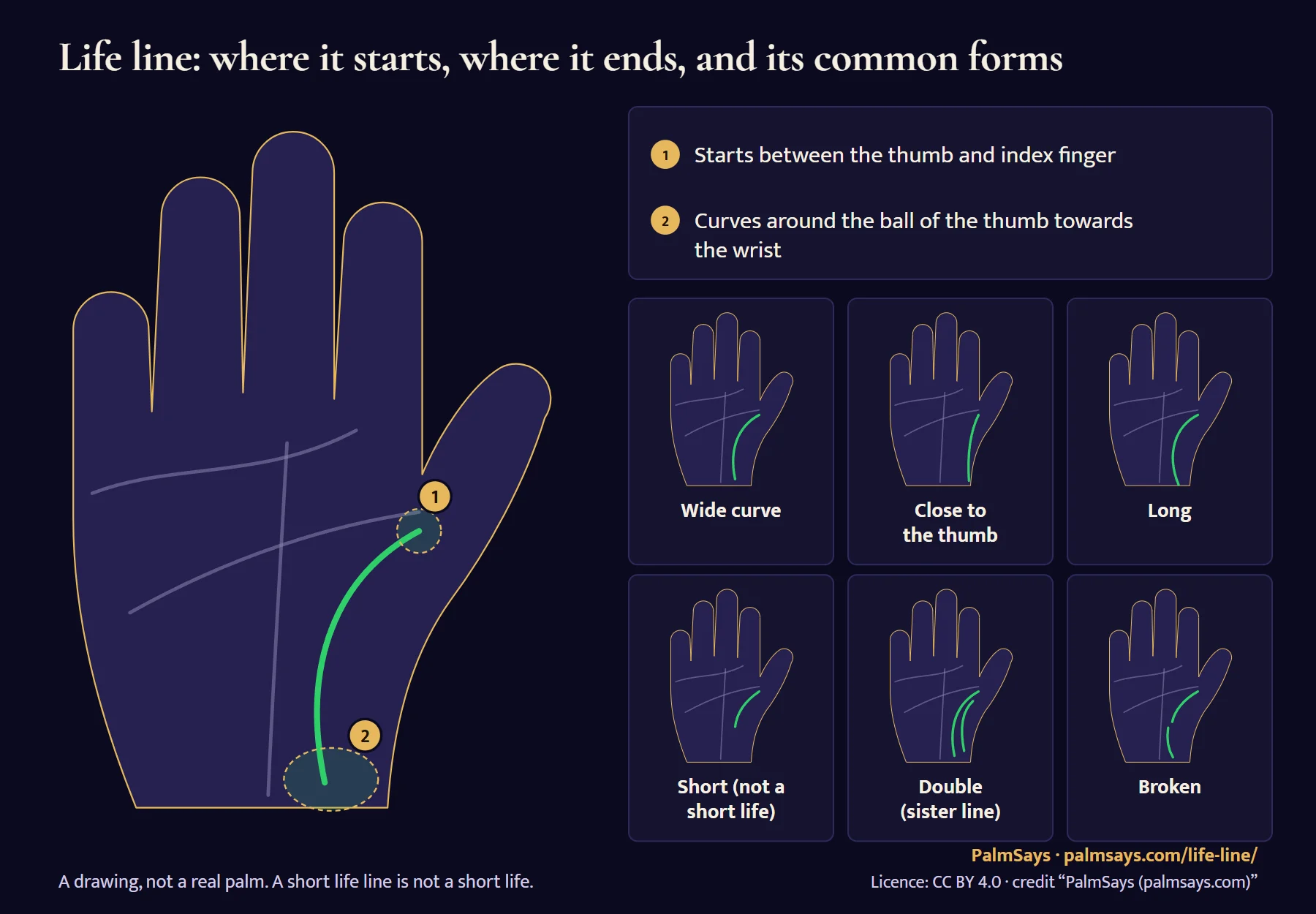
The books read the life line mostly by its arc (how wide it sweeps into the palm), its clarity and any breaks or branches. None of these is read as years or health. Match your own line to the cards.
Read any line with 4 questions
Starting high? Swinging wide, or close to the thumb?
All the way round to the wrist, or stopping partway? Never read as years.
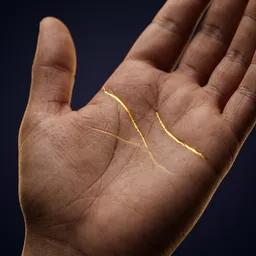
Deep and even, faint, or like a row of links?
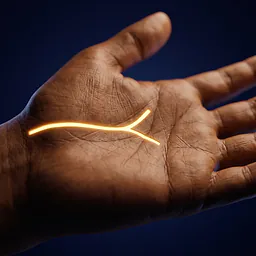
A gap, a second line inside it, or a fork near the wrist?


AI-made 3D pictures. The glow shows the idea; it is not a reading.
Where does your life line start and end?
Side by side, at one scale
- A wide curve
- Close to the thumb
- Starting high
Drawings of the forms the books describe, not real palms.
Wide, sweeping life line
An outgoing, energetic presence that reaches out to people.
Do you have this? Does your life line swing wide into the middle of your palm?
What the books say
An outgoing, energetic presence, with energy that reaches out towards people and activity. Benham adds a warm, generous, sympathetic nature. The books also read health, marriage and long life into this form; those claims are refused here.
Source: Cheiro (1916, 1900); William G. Benham (1900)
Life line close to the thumb
Energy held closer in: a quieter, more reserved presence.
Do you have this? Does your life line hug the base of your thumb in a narrow curve?
What the books say
Energy held closer in: a quieter, less forceful presence, and a reserved, self-contained manner that is slower to reach out for closeness. The books’ claims about health, fertility and length of life are refused.
Source: Cheiro (1916); William G. Benham (1900); Louis Williams (1902)
Life line starting high, under the index finger
A life steered by ambition from early on, with good self-command.
Do you have this? Does your life line start high, close to the base of your index finger?
What the books say
A life steered by ambition from early on, with good self-command. A line that starts lower, inside the thumb side, is read as a quick temper that takes conscious effort to manage.
Source: Cheiro (1916, 1900); Leo Markun (1927); Albert Raphael (1901)
The curve of the life line marks out the mount of Venus, the fleshy pad at the base of the thumb. Cheiro reads how much room the curve gives it: a line that sweeps well out into the palm is read as more vigour and warmth, a line that hugs the thumb as energy held closer in. Where the line ends is read too: a branch running out towards the lower outer palm is read as restlessness and a love of travel, as in the forked life line card.
How long is your life line?
Side by side, at one scale
- Long
- Short
Drawings of the forms the books describe, not real palms.
Long life line
The form the books call normal, read as steady vitality.
Do you have this? Does your life line curve all the way round to your wrist?
What the books say
The form the classical books call normal, read as steady vitality. The same books read its length as a count of years and as health; neither is claimed here.
Source: Cheiro (1916, 1900)
Short life line
A shorter line. It is never read as a count of years.
Do you have this? Does your life line stop partway round your thumb?
What the books say
A shorter line. Even the old books warn against reading its length as a count of years, and it is not read that way here. Many people have a short or faint life line on one hand or both.
Source: Leo Markun (1927); Cheiro (1900)
How clear is your life line?
Side by side, at one scale
- Deep and clear
- Faint
- Chained
Drawings of the forms the books describe, not real palms.
Faint or deep life line
Faint: a calmer, lower-key energy. Deep: stamina from will and nerve.
Do you have this? Is your life line thin and faint, or cut deep and clear?
What the books say
A faint line is read as a calmer, lower-key energy, steady rather than forceful. A deep one as stamina that comes more from will and nerve than from sheer physical strength. Neither is a health reading, and a photo shows only how faint a line looks.
Source: Cheiro (1916); Leo Markun (1927)
Chained life line
Energy and purpose that come and go rather than hold steady.
Do you have this? Up close, does your life line look like a row of tiny links?
What the books say
Energy and purpose that come and go rather than holding steady. The books read a chained life line mainly as a sign about the body; that is refused here, and only their general reading of chained lines is kept.
Source: Cheiro (1916)
Does your life line break, fork or branch?
Side by side, at one scale
- Broken
- Double
- Forked
- Branches rising
Drawings of the forms the books describe, not real palms.
Broken life line
A period of big change in the way life is lived. Not illness or harm.
Do you have this? Is there a gap in your life line, where one piece starts inside the other?
What the books say
Markun reads a break as a period of major change in the way life is lived. Other old books read it far more darkly, and that reading is refused. Cheiro’s rule for broken lines is that where the two ends overlap, the line’s qualities carry on.
Each kind of gap, and a square over it, is on our broken life line page.
Source: Leo Markun (1927); Cheiro (1916)
Double life line (sister line)
The inner life line, read as backing up the life line.
Do you have this? Do you see a second line just inside your life line, nearer the thumb?
What the books say
A second line running just inside the life line. Cheiro calls it the Line of Mars or inner life line, says it is found only on some hands, and reads it as backing up the life line, with a strong, fighting spirit. His claims about illness and danger are left out. Markun treats its old readings lightly.
Source: Cheiro (1916); Leo Markun (1927)
Forked life line
A branch to the outer palm: restlessness and a wish to travel.
Do you have this? Does your life line split near the wrist, one branch heading to the outer palm?
What the books say
A branch that runs off towards the lower outer palm (the mount of the Moon) is read as restlessness and a strong wish to travel and see new places. A line that ends at the wrist without a fork is read the other way: a settled life that keeps to familiar ground.
Source: Cheiro (1900, 1916); Leo Markun (1927)
Branches rising from the life line
Extra drive: moments of real effort towards a goal.
Do you have this? Do small lines rise from your life line up into your palm?
What the books say
Small lines that rise from the life line up into the palm. Cheiro reads a life line with rising branches, even small ones, as a life of greater energy, each branch a point of particular effort; branches rising towards the index finger he reads as the wish to rise and take charge. He also reads a date from each branch, and we never read dates. Fine lines that droop down from the life line get a health reading in the old books; that is refused here.
Source: Cheiro (1916)

Marks on the life line
The books describe small marks on the life line: islands, squares, crosses, and fine lines cutting across it. Most are only a few pixels wide in a phone photo, so the PalmSays app leaves them out, and an honest reading does too. Here is what the books say about each, and what we don’t repeat.
- Island, a small loop in the line: Cheiro reads it as a sign about health. Palm lines are not a health test, so that reading is left out.
- Square, four tiny lines boxing in part of the line, often over a break: Cheiro calls a square “the Mark of Preservation”, a protective sign wherever it appears. In the books it is a symbol, not a promise.
- Cross, lying close to the line: Cheiro’s Language of the Hand links it with friction among close relatives. Take that as a prompt to think about family ties, not a forecast.
Lines crossing the life line
Fine lines often run out from the base of the thumb and cut across the life line. Cheiro reads them as worry lines, also called influence lines: other people, often family, pressing on your plans and home life. They are very common, and most hands have a few. The same passage makes darker claims about some of them; those are refused here, because a crease is not an event.
Life line vs fate line
The life line curves around the base of your thumb. The fate line runs up the middle of the palm. To find yours and tell the two apart:
Where is it? Three looks
1 Name your fingers, and find the ball of your thumb.
2 Skip the finger creases at the top of the palm.
3 The line that curves around the ball of the thumb.
- Look at the edge of your palm between the thumb and the index finger. The life line starts there, often sharing its start with the head line.
- Follow it as it curves around the fleshy base of the thumb, which the tradition calls the mount of Venus (शुक्र पर्वत, Shukra parvat).
- It runs down towards the wrist. In Hindi it is जीवन रेखा (jeevan rekha).
Don’t confuse it with the fate line, which runs straight up the middle of the palm, or with a second, inner line some hands have right beside it (the double life line, above).
Life or fate line?
Look at the way the line runs.
It curves around the ball of the thumb: It is the life line.
It runs straight up the middle: It is the fate line.
A line that leaves the life line and runs up the palm is read as a fate line. Life line vs fate line
The two are easy to mix up where they meet: the life line curves around the thumb, the fate line runs straight up towards the middle finger. A fate line sometimes starts from the life line or inside it; the fate line guide explains how the books read that.
Life line age calculation: why we don’t do it
Some old palmistry books, Cheiro’s among them, read the life line’s length as a count of years. People search for this as the “age line” or “life line age calculation”. Other writers of the same time, Markun among them, warned against reading the line that way. No line can give a date.
So PalmSays never calculates an age, a year or a lifespan from your palm, on this website or in the app. If you have read an age reading somewhere else, you can let it go: it isn’t something a palm can show.
Life line in the hand for women and men
The life line is read the same way for everyone. There is no separate life line for women or men, and nothing in it is read as a woman’s or a man’s destiny. What traditions differ on is which hand to read: the hand you write with is read as the life you are making, and some Indian traditions read a woman’s left hand. Which hand to read explains this.

the life you are making

what you started with
Left and right hand
Compare both hands. The life line often looks different on each: longer, fainter or broken on one side only. Tradition reads your writing hand as what you have built and the other hand as what you started with, so a difference is read as change, not as a problem. It is also common for photos of the two hands to be lit differently.
Check yourself: life line quiz
Three quick questions. Pick an answer to see if you are right. New to palmistry? Start with how to read palm lines.
Myths about the life line
- MythA short life line means a short life.
- Reality
No book in our rule set reads it that way, and even the old books warn against it. The life line is read for energy and how you meet change.
- MythA broken life line means an accident or illness.
- Reality
Markun reads a break as a period of major change in the way you live. Darker readings are refused, and a crease or shadow can make a line look broken in a photo.
- MythA faint life line means weak health.
- Reality
Palm lines are not a health test. A faint line is read as a calmer kind of energy, and light often makes lines look fainter than they are.
Life line quick facts
- Hindi name
- जीवन रेखा (jeevan rekha)
- Where it sits
- It starts between the thumb and index finger and curves around the base of the thumb towards the wrist.
- What the tradition reads in it
- Energy, stability and the way you meet change.
- What it is not
- A measure of lifespan or health. Its length is never read as years.
- Which hand
- Look at both. Tradition reads your writing hand as the life you are making. Which hand to read
Life line: questions people ask
Does a short life line mean early death?
No. Palmistry does not read the life line’s length as lifespan, and even the old books warn against it. The line is read for energy and how you meet change. Light and cropping can also make a line look short in a photo.
What does a broken life line mean?
Markun reads a break as a period of major change in the way life is lived: a move, a new routine, a new direction. Darker old readings are refused. A crease or shadow can also make a line look broken.
What is a double life line?
A second line running just inside the life line, closer to the thumb. Cheiro calls it the Line of Mars or inner life line and reads it as backing up the life line. It is found only on some hands.
Can palmistry calculate my age from the life line?
No. Some old books read the life line’s length as a count of years, but other writers warned against it, and no line can give a date. We never calculate ages or lifespan.
Is the life line different for women and men?
No. The life line is read the same way for everyone. What traditions differ on is which hand to read: see which hand to read.
What if my life line is faint or I can’t find it?
A faint line is read as a calmer, lower-key kind of energy, and light often makes lines look fainter than they are. Try bright, even daylight with your hand flat and open.
Sources for this life line guide (7 books and studies)
- Cheiro, Palmistry for All (1916). Part I, ch. III: The Line of Life (incl. Ascending Lines); ch. IV: The Line of Mars or Inner Life Line; ch. XV: The Island, the Circle, the Spot and the Grille; ch. XVI: The Star, the Cross, the Square; ch. XVII: Different Classes of Lines.
- Cheiro, Cheiro’s Language of the Hand (1900). Part II, ch. V: The Line of Life, pp. 79–85 (incl. lines crossing it); ch. XIX: The Cross.
- Cheiro, Cheiro’s Guide to the Hand (1900). Ch. XI: The Line of Life, pp. 71–72.
- Leo Markun, What You Should Know About Palmistry (1927). The section on the Line of Life; the opening of the section on the lines; the Line of Mars.
- Albert Raphael, Cheirosophy (1901). The Life Line, p. 103. (facts only)
- William G. Benham, The Laws of Scientific Hand Reading (1900). Part II, ch. VII: The Line of Life, pp. 470–472. (facts only)
- Louis Williams, Key to Palmistry (1902). The Life Line of Action. (facts only)
Meanings on this page are written in our own words from these books. Books whose rights are unclear are used for facts only, never quoted. How we choose sources
See your own life line
Upload one photo of your palm. We trace your lines and show what palmistry says about each one.
- Open palm
- Good light
- Whole hand in the frame
A phone photo shows the main lines and their breaks, forks and branches. Tiny marks such as stars and crosses are too small, so an honest reading leaves them out.
Our Android app is coming soon, with 2 free readings. The scan on this website opens soon too.
Coming soon on Google Play. The Android app is not on Google Play yet. This page will get the link the day it is.
The iPhone app isn’t ready yet. You can keep using this website.
PalmSays is currently listed as Palm Read AI on Google Play. It is the same app.
Or see what the palm reading app for Android reads before you install it.