Mounts of the palm
The mounts are the soft, raised pads of your palm, each named after a planet: four under the fingers, Venus at the thumb, the Moon on the outer edge and two of Mars. Palmistry reads how full each is.
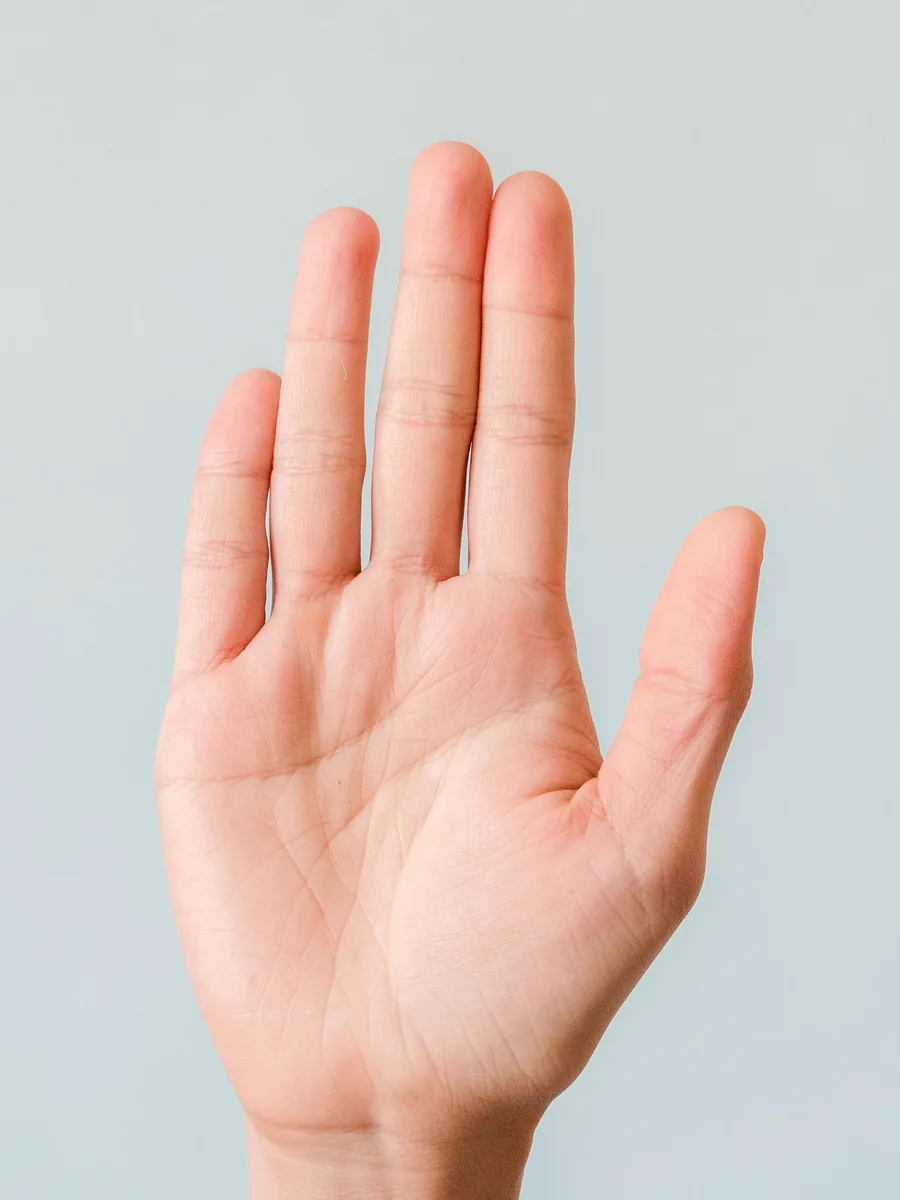
A real palm photo (Kevin Malik, Pexels), traced by the real PalmSays scanner. Your reading is made from your own photo.
Where are the mounts on your palm?
Press gently around your palm. Which pad feels the fullest on yours?
- Hold your hand open in good light, palm facing you.
- Look just under each finger, above the heart line: those four pads are the finger mounts.
- The big pad at the base of your thumb is Venus. The long pad on the outer edge, above the wrist, is the Moon.
- Press each one gently. Which feel full and firm, and which feel flat?
Our Android app is coming soon, with 2 free readings. The scan on this website opens soon too.
On this page
- What are the mounts of the palm?
- Mount by mount: where each one is and what it is read for
- How to read a mount: full, flat or leaning
- Mounts and the lines that start on them
- Marks on the mounts
- Mounts in the left and right hand, for women and men
- Check yourself: palm mounts quiz
- Myths about the palm mounts
- Questions people ask
- Sources
What are the mounts of the palm?
The mounts are the fleshy pads that rise on your palm. Palmistry books name each one after a planet: Jupiter, Saturn, the Sun, Mercury, Venus, the Moon and Mars. In Indian palmistry they are called पर्वत (parvat), “mountains”, with the same planets in Hindi: Guru, Shani, Surya, Budh, Shukra, Chandra and Mangal.
There are seven planet names but usually eight pads, because Mars has two mounts. Cheiro counts the mounts as part of the hand’s shape, not its lines. In Cheiro’s Language of the Hand (1900) he says he uses the planet names only as a quick way to name the qualities, not as astrology.
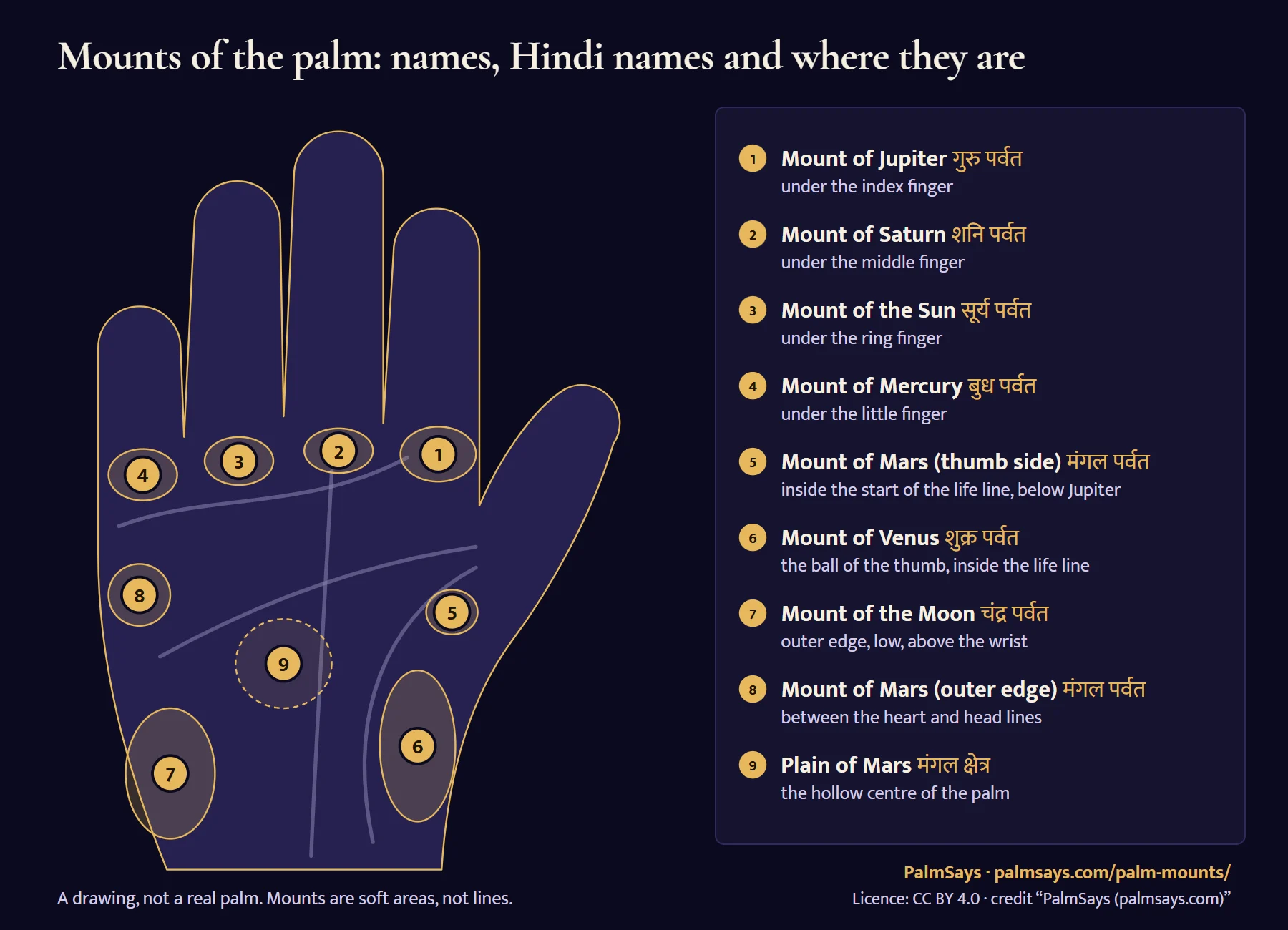
- Guru गुरु (Jupiter): under the index finger
- Shani शनि (Saturn): under the middle finger
- Surya सूर्य (Sun): under the ring finger
- Budh बुध (Mercury): under the little finger
- Mangal मंगल (Mars): near the thumb
- Shukra शुक्र (Venus): the ball of the thumb
- Chandra चंद्र (Moon): outer edge, above the wrist
- Mangal मंगल (Mars): outer edge
Each mount is read by how full it is: a well-developed pad strengthens its qualities, and a flat one plays them down. The mounts under the fingers carry the same planet names as the fingers above them, so the fingers in palmistry are read together with them.
Mount by mount: where each one is and what it is read for
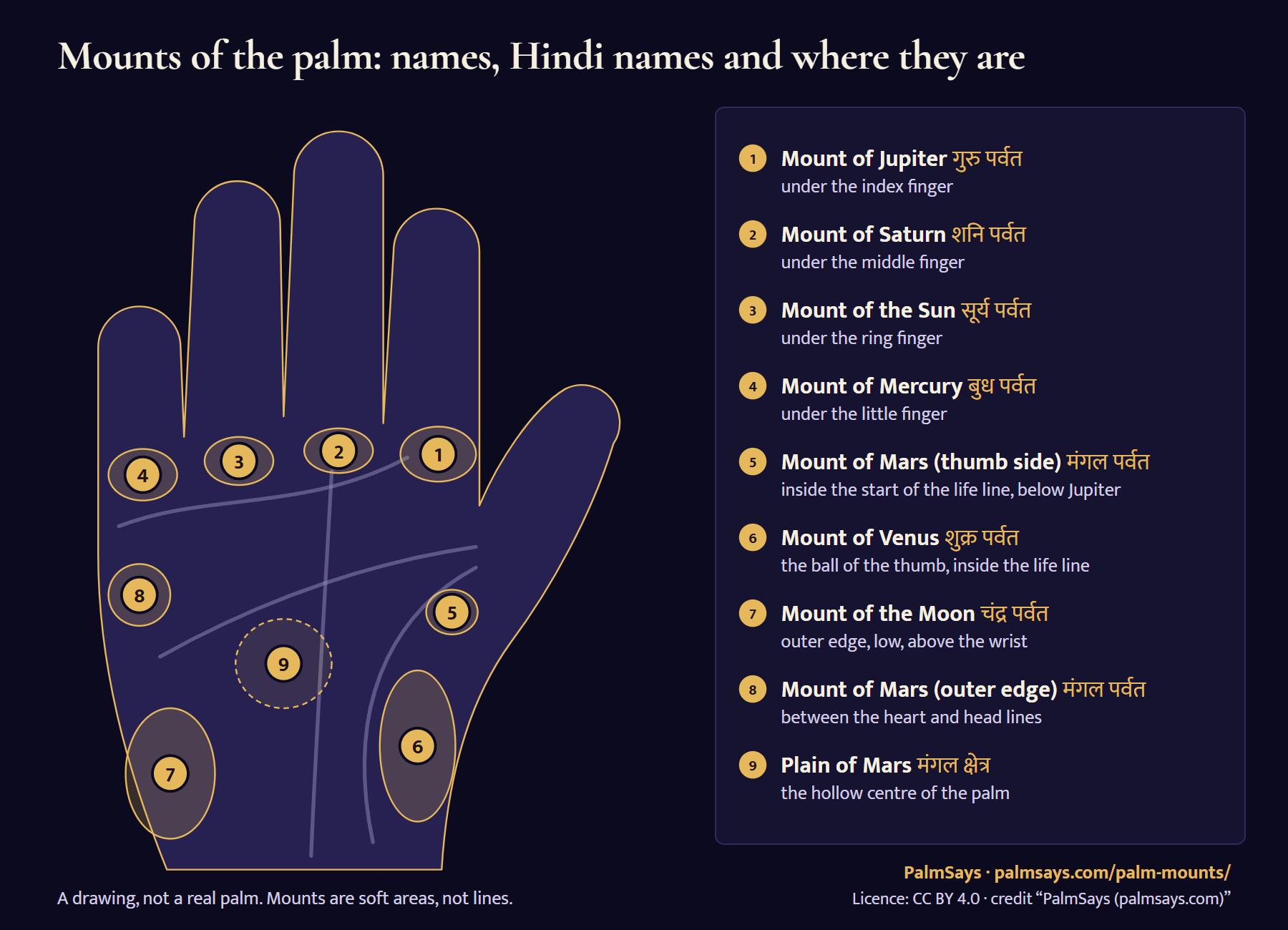
The chart shows all the mounts on one drawn hand, with their Hindi names, including the plain of Mars in the middle.
Mount of Jupiter (Guru)
Under the index finger. In Hindi it is गुरु पर्वत (Guru parvat). A full mount of Jupiter is read for ambition, pride and enthusiasm: a wish to lead, organise and carry a goal through. The old books add that, taken too far, this turns into vanity and a need to be in charge.
Mount of Saturn (Shani)
Under the middle finger (शनि पर्वत). A full mount of Saturn is read for seriousness and prudence: a liking for quiet, solitude and earnest work, and Cheiro adds a taste for serious music. Dale’s Indian Palmistry (1895) reads wisdom and a careful, considered way of doing things. A flat Saturn mount is read as a lighter, easier approach to life. Some old books add gloom to a very full one; like the app, we leave that out.
Mount of the Sun (Surya)
Under the ring finger (सूर्य पर्वत), also called the mount of Apollo. A full mount of the Sun is read for enthusiasm for beauty: art, poetry and pleasing surroundings, with a warm, generous manner. Cheiro says this holds whether or not you work in the arts. The sun line rises towards this mount.
Mount of Mercury (Budh)
Under the little finger (बुध पर्वत). A full mount of Mercury is read for quick wit and a ready tongue: a love of change and travel, quick thinking, and a flair for business and science. The small lines on the edge of the palm just below it are the marriage lines.
Mount of Venus (Shukra)
The large pad at the base of the thumb, inside the curve of the life line (शुक्र पर्वत). It is usually the fullest mount on the hand. A full mount of Venus is read for warmth and sympathy, a wish to please, and a love of beauty, colour and music. A flatter one is read as affection that lives more in the mind than in outward show. The old books also read its size for health; the app leaves that out, and so do we.
Mount of the Moon (Chandra)
On the outer edge of the palm, above the wrist and opposite Venus, also called Luna (चंद्र पर्वत). A full mount of the Moon is read for imagination and refinement, a love of scenery, romance and poetry.
Here the traditions differ about a flat Moon mount. Cheiro reads a reasoning, organising mind that prefers to work things out quietly. Dale reads a changeable way of living, where plans shift more than they settle. A careful reading shows you both.
The two mounts of Mars (Mangal)
Mars (मंगल) has two mounts, and the books give them different labels, sometimes the other way round. So we name them by where they sit:
- Mars near the thumb, just inside the start of the life line, below Jupiter and next to Venus: read for active courage and a fighting spirit, a temper that flares and passes.
- Mars on the outer edge, between Mercury and the Moon: read for moral courage and self-control, calm under pressure and a steady resistance to what seems wrong.
Between them lies the plain of Mars, the hollow middle of the palm. Older books read a high, hard plain as a combative temper; Markun (1927) repeats this with open doubt, and we give it no reading of its own.

How to read a mount: full, flat or leaning
How full is each mount?
Press each pad gently and compare it with the others on the same hand. The books read a mount against its neighbours, not by size alone:
- Full and firm: its qualities are strong in you. A very full mount can overdo them, in the books’ words: Jupiter’s ambition turning to vanity, for example.
- Flat: its qualities play a smaller part. That is not a lack, and not bad luck.
- All about even: Markun reports this as a character that has developed evenly, with no one side much stronger.
The fullest mount on your hand is read as your strongest leaning. The others shade it; none of them decides anything.
Markun adds an old rule: a mount that is not high but is covered with many small lines is read as though it were high. In a photo, a mount’s height shows mostly as shading, so flat light from the front can make every mount look flat.
Does a mount lean towards a finger?
Mounts don’t always sit straight under their finger. Cheiro reads a mount that leans towards its neighbour as blending the two: Saturn leaning towards Jupiter gives Jupiter’s ambition some of Saturn’s seriousness; Saturn leaning towards the Sun mixes serious thought with artistic taste; the Sun leaning towards Mercury lets a love of art shape a business-like or scientific mind. Markun reports that the chirosophists wanted a good mount to sit between two fingers rather than right under one.
Mounts and the lines that start on them
The main lines start and end on the mounts, which is why a reader looks at both together:
- The heart line starts on the outer edge under Mercury and runs towards Jupiter or Saturn.
- The life line curves around Venus, the ball of the thumb.
- The head line can start inside the life line on Mars near the thumb, and can slope down towards the Moon.
- The fate line can rise from the Moon, and runs up towards Saturn.
- The sun line runs up towards the Sun, under the ring finger.
If you are new to the lines, start with how to read palm lines, then come back to the mounts. The palmistry terms glossary gives every mount and line in one sentence each.
Marks on the mounts
The books also read small marks on the mounts: stars, crosses, triangles and grilles. Cheiro reads a clearly formed triangle by the mount it sits on: on Jupiter, a talent for managing people; on Venus, calm and self-control in love. Many of the other readings promise or threaten events, so we leave them out. The crosses on the palm guide explains the best-known mark, the mystic cross, and lucky signs on the palm covers the star, the triangle and the square.
Most of these marks are only a few pixels wide in a phone photo, too small to see reliably. So an honest reading of a photo leaves them out, and looks at them only on your own hand, in bright daylight.
Mounts in the left and right hand, for women and men
The mounts are read the same way for everyone. There is no separate mount of Venus for women or men. What changes is which hand you look at: tradition reads your writing hand as the life you are making and the other as what you started with, so compare both. Cheiro notes that hard manual work thickens the skin but does not flatten the mounts. Which hand to read explains the traditions.
Check yourself: palm mounts quiz
Three quick questions. Pick an answer to see if you are right.
Myths about the palm mounts
- MythThe mount of Mercury (or Jupiter) is the money mount.
- Reality
No mount predicts income. Mercury is read for a quick, business-like mind and Jupiter for ambition: ways of thinking and wanting, not amounts of money.
- MythA flat mount is a bad sign.
- Reality
A flat mount only means that its qualities play a smaller part. Most hands have some full mounts and some flat ones.
- MythThe mounts show your star sign.
- Reality
Cheiro’s later book links the mounts with birth dates, but his earlier Language of the Hand uses the planet names only as a quick way to name qualities. You don’t need a birth chart to read them.
Quick facts
- Hindi name
- पर्वत (parvat): गुरु, शनि, सूर्य, बुध, शुक्र, चंद्र and मंगल (Guru, Shani, Surya, Budh, Shukra, Chandra, Mangal)
- How many
- Seven planet names and usually eight pads, because Mars has two mounts.
- What the books read
- How full each pad is. A full mount strengthens its qualities; a flat one plays them down.
- Where to look
- Four under the fingers, Venus at the base of the thumb, the Moon on the outer edge above the wrist, and Mars near the thumb and on the outer edge.
- Which hand
- Look at both. Tradition reads your writing hand as the life you are making. Which hand to read
- What the app reads
- The PalmSays app shows where each mount sits on your own photo and gives the books’ reading with its source. It doesn’t judge how raised a mount is, because a flat photo can’t show height.
Questions people ask
How many mounts are there on the palm?
Seven planets give the mounts their names: Jupiter, Saturn, the Sun, Mercury, Venus, the Moon and Mars. Mars has two mounts, so most books show eight pads.
Which mount is under which finger?
Jupiter is under the index finger, Saturn under the middle finger, the Sun under the ring finger and Mercury under the little finger. Venus is at the base of the thumb and the Moon on the outer edge above the wrist.
What is the mount of Venus?
The large pad at the base of your thumb, inside the curve of the life line. Cheiro reads a full mount of Venus for warmth, sympathy and a love of beauty, colour and music.
What is the mount of the Moon (Luna)?
The long pad on the outer edge of the palm, above the wrist, opposite Venus. It is read for imagination, refinement and a love of scenery and poetry.
Which mount is for money?
None. The mount of Mercury is read for a quick, business-like mind, which is a way of thinking, not an amount of money. No mount predicts income.
What does a flat mount mean?
That its qualities play a smaller part in the reading. It is not a lack, and it is not bad luck. Many hands have several flat mounts.
Does the PalmSays app read the mounts?
Partly. The palm reading app shows where each of the eight mounts sits on your own photo and gives the books’ reading, with the source. It doesn’t judge whether a mount is raised or flat, because a flat photo can’t show a mount’s height, so that part is yours to feel with your thumb.
Sources (4 books and studies)
- Cheiro, Cheiro’s Language of the Hand (1900). Part I, ch. XV: The Mounts, their Position and their Meanings, and The Leaning of the Mounts toward One Another, pp. 63–65; Part II, ch. XXII: The Triangle, pp. 131–132.
- Cheiro, Palmistry for All (1916). Part II, ch. V: The Mounts of the Hand and their Meaning; chs. VI–XII: The Mounts of Mars, Jupiter, Saturn, the Sun, Mercury, the Moon and Venus.
- Leo Markun, What You Should Know About Palmistry (1927). The Mounts (the map of the hand, the height and balance of the mounts, the Plain of Mars).
- Mrs J. B. Dale, Indian Palmistry (1895). References to the Hand, No. 2: the Mount of Saturn; No. 3: the Mount of the Sun; The Moon: its mount.
Meanings on this page are written in our own words from these books. Books whose rights are unclear are used for facts only, never quoted. How we choose sources
See your own lines
Upload one photo of your palm. We trace your lines and show what palmistry says about each one.
- Open palm
- Good light
- Whole hand in the frame
A phone photo shows the main lines and their breaks, forks and branches. Tiny marks such as stars and crosses are too small, so an honest reading leaves them out.
Our Android app is coming soon, with 2 free readings. The scan on this website opens soon too.
Coming soon on Google Play. The Android app is not on Google Play yet. This page will get the link the day it is.
The iPhone app isn’t ready yet. You can keep using this website.
PalmSays is currently listed as Palm Read AI on Google Play. It is the same app.
Or see what the palm reading app for Android reads before you install it.