Lucky signs on the palm: star, triangle, square, fish and trident
Lucky signs are small marks the old palmistry books read kindly: the star, triangle and square in Western books, and the fish and trident in Indian ones. They are read as tendencies; no mark brings luck or money.
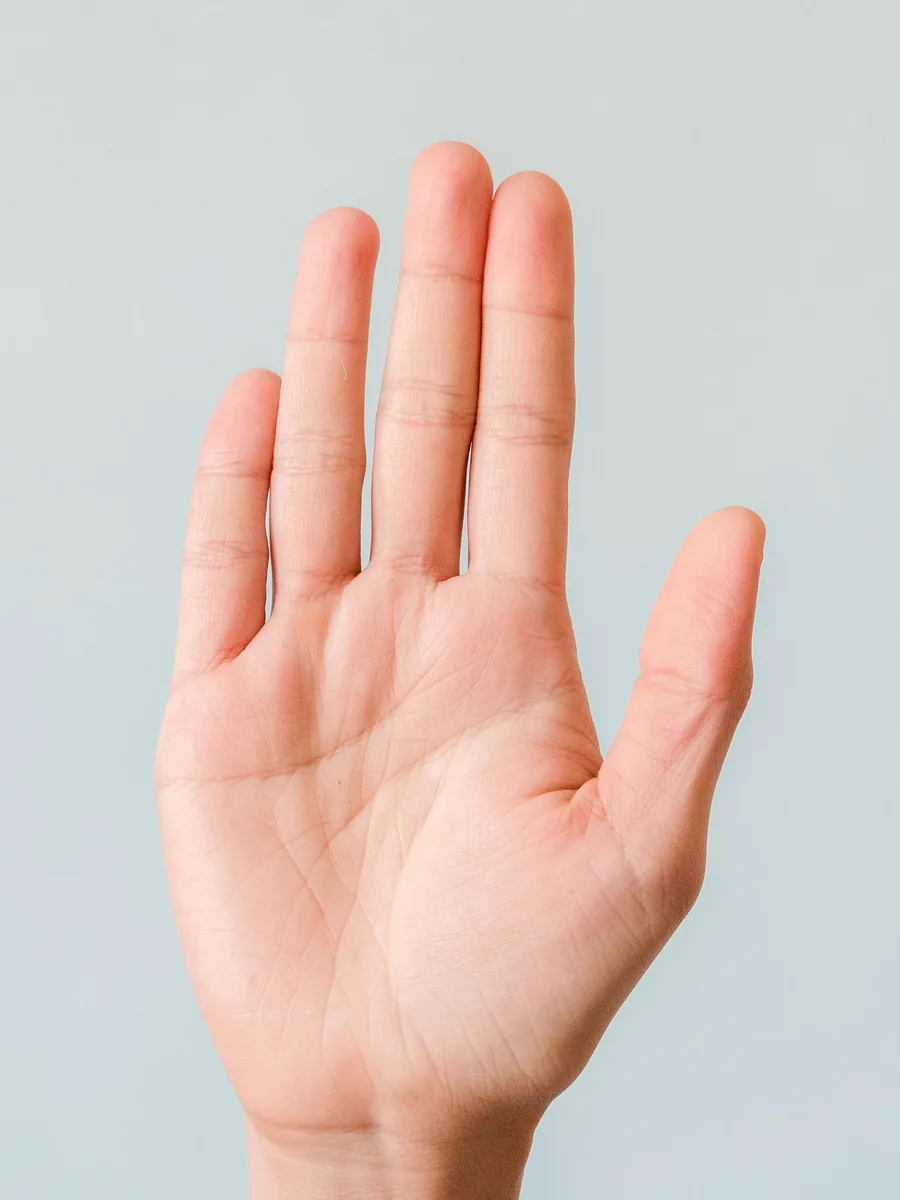
A real palm photo (Kevin Malik, Pexels), traced by the real PalmSays scanner. Your reading is made from your own photo.
Where are lucky signs on your palm?
Look closely at the pads under your fingers and the base of your palm. Can you see a small star, triangle, square or fish?
- Use bright light from one side, and zoom in with your phone camera if it helps.
- Look on the pads under each finger for a star or a triangle, and along the main lines for a small square.
- Look at the base of your palm, just above the wrist, for the fish of the Indian books.
- Be strict: a sign stands clear on its own. Two lines that happen to cross are not a sign.
On this page
- What are lucky signs on the palm?
- Lucky signs one by one
- Indian auspicious signs: conch, wheel, lotus and flag
- Which palm signs do the books not call lucky?
- Are lucky signs rare?
- Can a phone photo show these signs?
- Lucky signs in the left and right hand
- Check yourself: lucky signs quiz
- Myths about lucky signs
- Questions people ask
- Sources
What are lucky signs on the palm?
Lucky signs are small, clear marks on the palm that the old palmistry books read kindly. Western books, led by Cheiro, name three: the star, the triangle and the square. Indian books add the fish, the trident and shapes such as the conch, wheel and lotus.
The books rarely use the word “lucky” for a mark. Cheiro calls the star “with one or two exceptions, a fortunate sign” (Cheiro’s Language of the Hand, 1900, ch. XVIII). The Indian books call their signs auspicious.
A real sign stands on its own. Cheiro asks that a triangle be clear and distinct, “not formed by the chance crossing of lines” (ch. XXII). The same test works for every sign on this page.
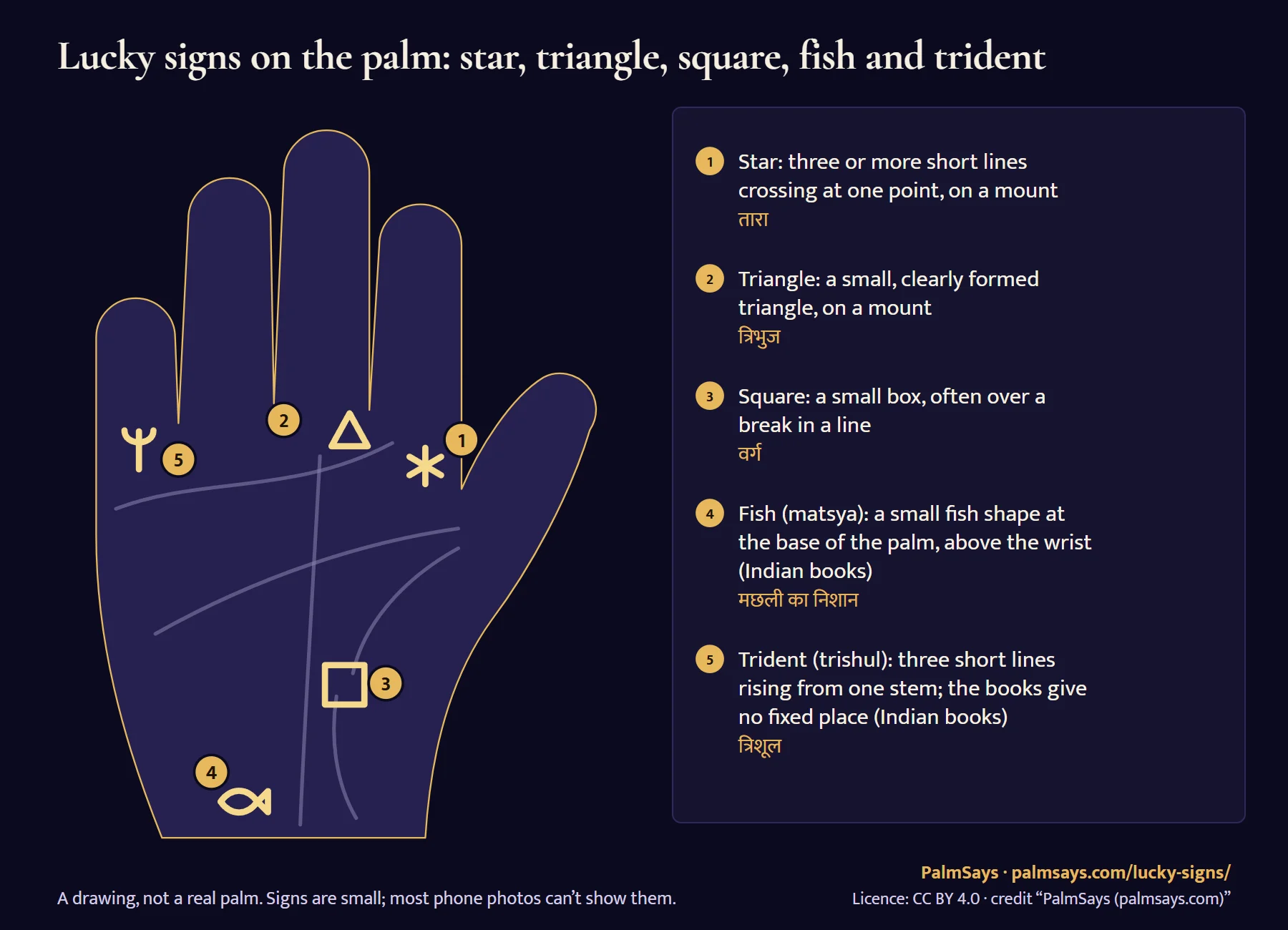
The PalmSays scanner traces the four major lines, not signs, so the photo at the top shows none. Every sign on this page is a drawing, in gold, of where the books place it.
Lucky signs one by one
Each card gives a sign in our own words, from the book named under it. The books also promise riches, fame, children or high rank from many signs. No mark can foretell those, so we leave them out and say so.
What does a star on the palm mean?
Star on the mount of Jupiter, under the index finger
Ambition and a wish to lead, read as made stronger.
Do you have this? Do three or more short lines cross at one point on the pad under your index finger?
What the books say
A star is three or more short lines crossing at one point. Cheiro reads it as a mark that makes its mount’s quality stronger. Under the index finger that quality is ambition. He also promises honour, power and position here, which no mark can do, so we leave that out.
Source: Cheiro (1900, 1916)
The same star is read differently on each mount:
| Where the star sits | What Cheiro reads (the part we keep) | What we leave out |
|---|---|---|
| Under the index finger (Jupiter) | Ambition, made stronger | Honour, power and position |
| Under the ring finger (Sun) | A love of art and beauty, made stronger | Riches and glory, which he says bring no contentment |
| Under the little finger (Mercury) | Eloquence and a flair for science or business | “Unusual success” |
| The two mounts of Mars | Patience and fortitude | Honours |
| Outer edge, above the wrist (Moon) | Imagination, made stronger | Fame through it |
| Ball of the thumb (Venus) | Warmth in love | “Extraordinary success” in love |
| Under the middle finger (Saturn) | Nothing: his reading here is a grave forecast | All of it |
Cheiro adds a fair warning of his own. A star, he says, has little power on a hand whose other signs, such as a weak head line, don’t support it.
What does a triangle on the palm mean?
Triangle on the mount of Jupiter
A talent for managing people and organising everyday affairs.
Do you have this? Is there a small, clear triangle on the pad under your index finger?
What the books say
Cheiro calls the triangle a curious sign that is often found clear and distinct. Under the index finger he reads more than usual skill in managing people and organising daily affairs.
Source: Cheiro (1900)
On the other mounts, Cheiro’s Language of the Hand reads the triangle like this:
- Under the middle finger (Saturn): a leaning towards mystical study.
- Under the ring finger (Sun): putting art to practical use.
- Under the little finger (Mercury): a steadier, less restless mind. He also promises success with business or money, which we leave out.
- On a mount of Mars: calm in a crisis.
- On the mount of the Moon: method in following up the ideas of the imagination.
- On the mount of Venus: calm and good sense in love.
What does a square on the palm mean?
Square over a break in the life line
The mark of preservation: protection at that point, as a symbol.
Do you have this? Is there a small, clear box over a gap in one of your lines?
What the books say
Cheiro calls the square “the mark of preservation”. On a line, he reads it as protection at that point from whatever the break seemed to threaten. Read it as a symbol in the books, not a promise. A gap in a line is often a crease or the light, not an event.
Source: Cheiro (1900, 1916)
On a mount, Cheiro reads a square as keeping that mount’s quality from going too far: ambition under the index finger, or imagination on the mount of the Moon. The palm mounts guide explains what each mount is read for.
What does the fish sign on the palm mean?
Fish at the base of the palm
An auspicious sign in Indian books; Jain reads a religious-minded person.
Do you have this? Is there a small fish shape near your wrist, at the base of your palm?
What the books say
The fish is मछली (machhli), or matsya. Mrs Dale (1895) places it at the root of the hand, and Chhotelal Jain (1927) at the wrist. Jain reads a religious-minded person, and a fish’s tail as the mark of a learned one. Both books also promise riches and children from the fish. No mark can tell either, so we leave that out.
Source: Mrs J. B. Dale (1895); Chhotelal Jain (1927)
What does a trident (trishul) on the palm mean?
Trident (trishul)
Jain reads a generous, religious-minded person.
Do you have this? Do three short lines rise from one stem somewhere on your palm?
What the books say
The trident is त्रिशूल (trishul). Jain reads the sign of a generous, religious-minded person. Mrs Dale reads a rise to fame and high rank, which we leave out. Neither book gives the trident one fixed place, so our drawing shows only its shape.
Source: Chhotelal Jain (1927); Mrs J. B. Dale (1895)
A sign is read as a tendency, never as luck that will arrive. The promises in the old books are theirs, not ours.
Indian auspicious signs: conch, wheel, lotus and flag
Mrs Dale’s Indian Palmistry (1895) and Jain’s Hindi book (1927) list more shapes. Most of their readings are promises of wealth, sons or high rank, so only a few tendencies are left to keep:
| Sign | Hindi | What we keep | What we leave out |
|---|---|---|---|
| Conch | शंख (shankh) | Dale: a learned person, above all on the little finger or the mount of Mercury | Nothing else is claimed |
| Flag | पताका (pataka) | Dale: a philosopher and a great thinker | Jain: a lord of treasure |
| Wheel | चक्र (chakra) | Jain: with the conch and flag, a learned person who gains standing easily | Riches and power |
| Lotus | कमल (kamal) | No tendency, only rank | Fame and rank in Dale, a king in Jain |
Jain even ranks the fish, wheel, lotus and conch by the amount of money each brings. That is a money forecast, and no mark can make one. We found no swastika or temple sign in either book, so pages that list them as classical signs give no source.
Which palm signs do the books not call lucky?
Not every mark is read kindly. Cheiro reads an island as weakening the line it sits on, and a grille as working against the qualities of its mount. He reads most crosses and circles as trouble. We give no meaning for an island at all: the old books read it as illness, and palm lines are not a health test.
The best-known exception is the mystic cross between the heart and head lines, read as an interest in the spiritual. The crosses on the palm guide covers it and the other crosses.
Are lucky signs rare?
We can’t say, and we won’t guess. No book we use counts how often any sign appears, and we know of no study that does. So we call none of them rare.
What makes signs hard to find is their size and the light. A sign is small, and many apparent signs are short lines that cross by chance. Check yours in bright daylight, from more than one angle.
Can a phone photo show these signs?
Usually not. Stars, triangles, squares and fish are only a few pixels wide in most phone photos, too small to see reliably. The PalmSays app observes marks like these but leaves them out of the reading for that reason. Look at your own hand instead.

The M is the exception. It is made of the four major lines, so a photo can show it: see the M on the palm.
Lucky signs in the left and right hand
A sign is read the same way on either hand, for women and men alike. Tradition reads your writing hand as the life you are making and the other as what you started with. Jain lists separate signs for women, nearly all about husbands and sons; we leave those out. The guide to which hand to read explains the traditions.
Check yourself: lucky signs quiz
Three quick questions. Pick an answer to see if you are right. New to palmistry? Start with how to read palm lines, or look up any sign in the palmistry terms glossary.
Myths about lucky signs
- MythA fish on your palm means wealth.
- Reality
The Indian books do promise it, but no mark on the skin can foretell money. What we keep from Jain is a religious-minded nature, and learning for a fish’s tail.
- MythA star on the palm is always lucky.
- Reality
Cheiro himself made exceptions. He read a star under the middle finger darkly, and said a star means little when the rest of the hand doesn’t support it.
- MythRare signs mark a special fate.
- Reality
No book we use counts how rare any sign is. A sign is read as a leaning in character, and your choices matter more than any mark.
Quick facts
- Hindi names
- तारा (star), त्रिभुज (triangle), वर्ग (square), मछली (fish), त्रिशूल (trishul)
- Western signs
- The star, triangle and square, read by Cheiro in Cheiro’s Language of the Hand (1900) and Palmistry for All (1916).
- Indian signs
- The fish, trident, conch, wheel, lotus and flag, in Mrs Dale’s Indian Palmistry (1895) and Chhotelal Jain’s Hindi book (1927).
- How common they are
- No book we use counts how often any sign appears, so we call none of them rare.
- Which hand
- Look at both. Tradition reads your writing hand as the life you are making. Which hand to read
- What the app reads
- The PalmSays app doesn’t read signs. They are too small for most phone photos, so it leaves them out rather than guess.
Questions people ask
What is the luckiest sign on the palm?
No mark can bring luck. Of the signs, Cheiro calls the star a fortunate mark, with one or two exceptions, and the Indian books count the fish among the auspicious signs.
What does a fish on the palm mean?
In the Indian books it is an auspicious sign. Jain (1927) reads it as a religious-minded person and a fish’s tail as a learned one. Their promises of riches and children are left out.
What does a star on the palm mean?
Cheiro reads a star as making its mount’s quality stronger, such as ambition under the index finger. Under the middle finger his reading is a dark forecast, which we don’t repeat.
What does a triangle on the palm mean?
Cheiro reads it by the mount it sits on. Under the index finger it is a talent for managing people; on the ball of the thumb, calm in love.
Is a trishul in the hand lucky?
Jain (1927) reads the trident as the sign of a generous, religious-minded person, and calls it lucky. The tendency is a reading; the luck is a promise no mark can make.
Are lucky signs on the palm rare?
No book we use counts them, and we know of no study that does, so we don’t call any sign rare. Many marks that look like signs are short lines crossing by chance.
Does the PalmSays app read lucky signs?
No. The palm reading app traces the four major lines and measures your hand type and fingers. Signs are too small for most phone photos, so it leaves them out.
Sources (4 books and studies)
- Cheiro, Cheiro’s Language of the Hand (1900). Part II, ch. XVIII: The Star, pp. 121–124; ch. XX: The Square, pp. 127–128; ch. XXII: The Triangle, pp. 131–132.
- Cheiro, Palmistry for All (1916). Part I, ch. XV: The Island, the Circle, the Spot and the Grille; ch. XVI: The Star, the Cross, the Square.
- Mrs J. B. Dale, Indian Palmistry (1895). Signification of Animals, Flowers and Promiscuous Marks Found on the Hand (the fish, conch, flag, trident, wheel and lotus).
- Chhotelal Jain, Samudrik Shastra ya Bhagya Nirnay (1927). Opening chapter on reading fortune: the signs in the palm, pp. 2–6. (facts only, in Hindi)
Meanings on this page are written in our own words from these books. Books whose rights are unclear are used for facts only, never quoted. How we choose sources
See your own lines
Upload one photo of your palm. We trace your lines and show what palmistry says about each one.
- Open palm
- Good light
- Whole hand in the frame
A phone photo shows the main lines and their breaks, forks and branches. Tiny marks such as stars and crosses are too small, so an honest reading leaves them out.
Our Android app is coming soon, with 2 free readings. The scan on this website opens soon too.
Coming soon on Google Play. The Android app is not on Google Play yet. This page will get the link the day it is.
The iPhone app isn’t ready yet. You can keep using this website.
PalmSays is currently listed as Palm Read AI on Google Play. It is the same app.
Or see what the palm reading app for Android reads before you install it.