The M on your palm: what the letter M means in palmistry
The M on your palm is a shape, not a separate mark: the heart, head, life and fate lines can join to look like a capital M. No classical palmistry book reads it, so we read the four lines.
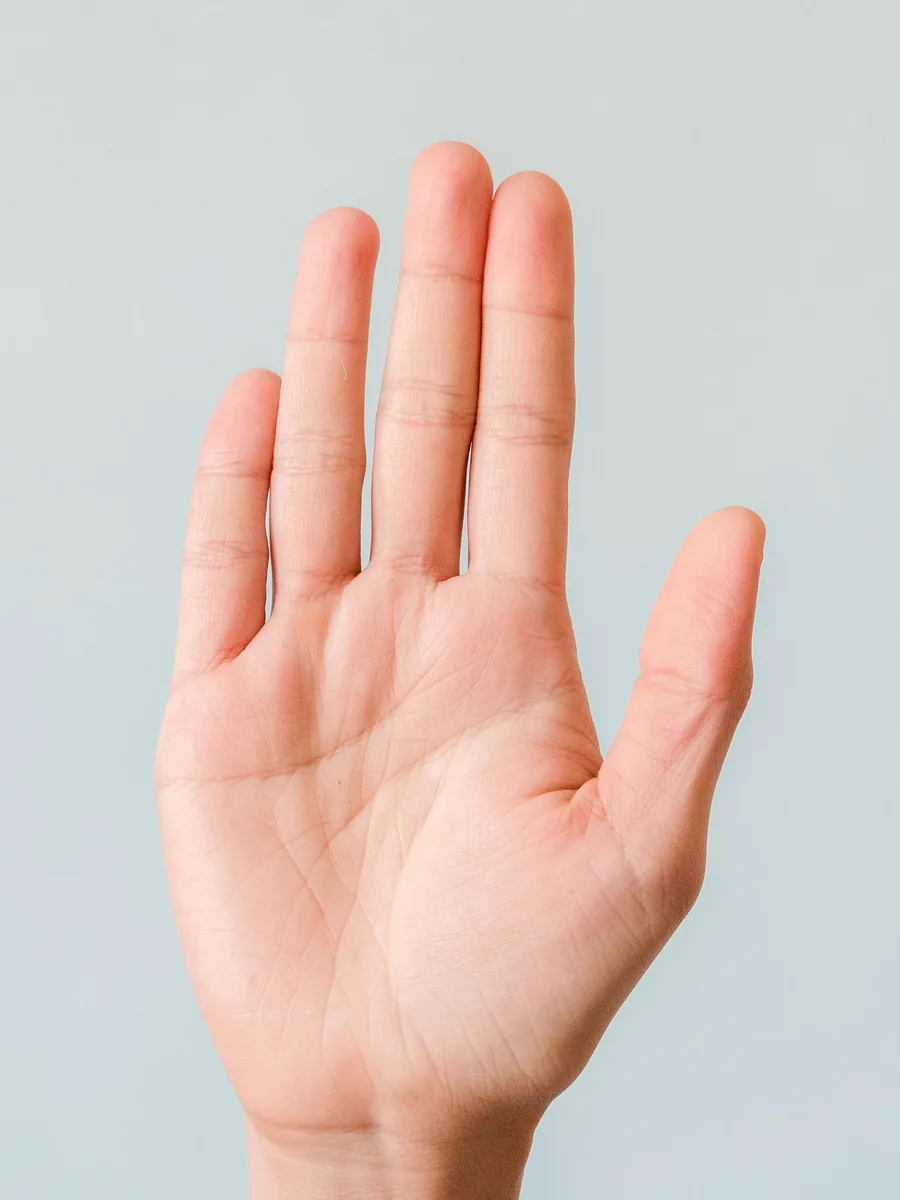
A real palm photo (Kevin Malik, Pexels), traced by the real PalmSays scanner. Your reading is made from your own photo.
Where is the M on your palm?
Look at the middle of your palm. Do your main lines join to make a shape like a capital M?
- Hold your hand up in bright, even light, palm facing you, fingers together.
- Find the heart line at the top and the head line below it. Then find the life line curving round your thumb.
- Look for a line running up the middle of your palm: the fate line. When it crosses the head and heart lines, the four lines can form an M.
Our Android app is coming soon, with 2 free readings. The scan on this website opens soon too.
On this page
What forms the M on your palm?
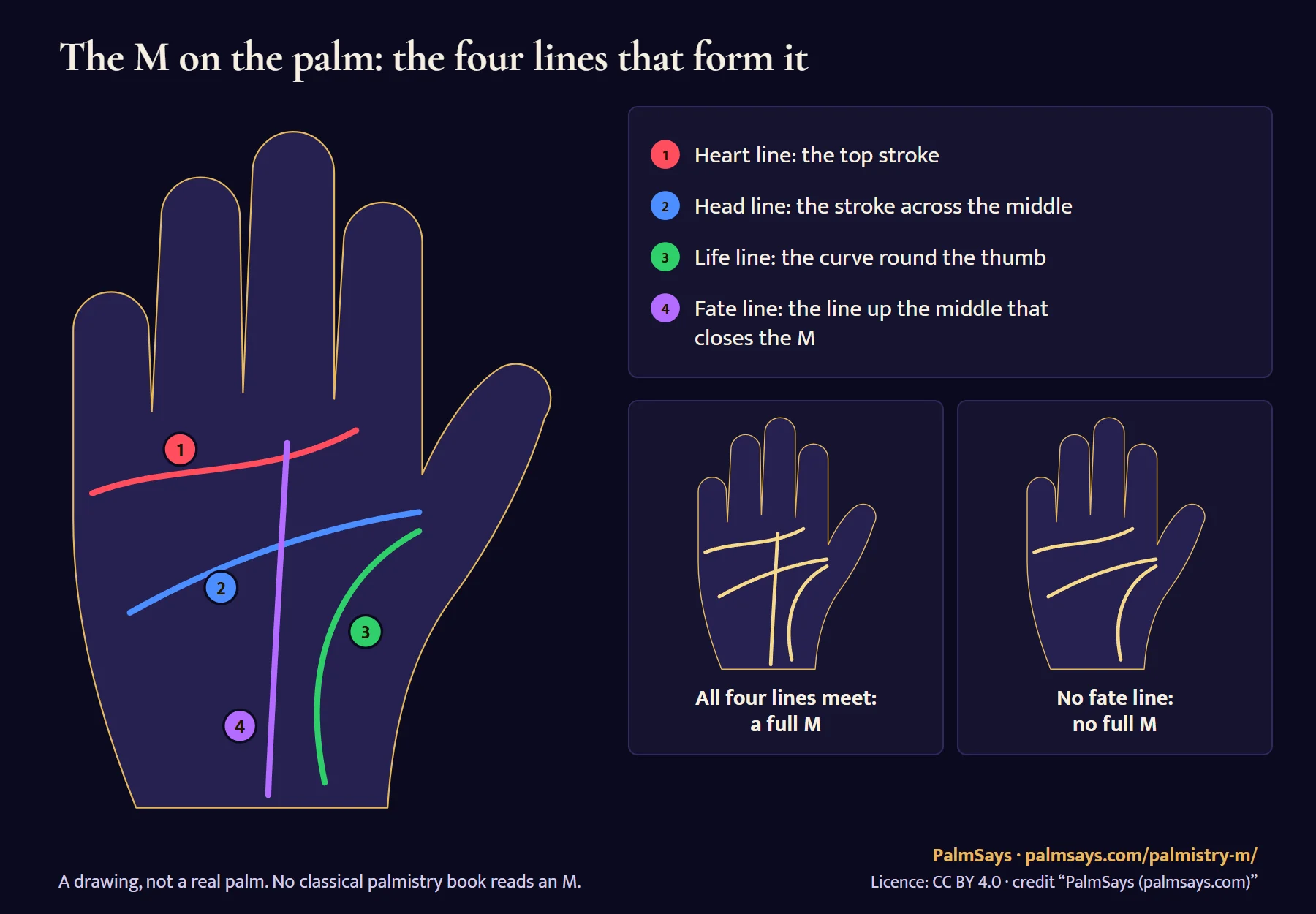
The M is made by four lines you already have. The heart line runs across the top of the palm, and the head line runs below it. The life line curves round the ball of the thumb.
The fourth is the fate line, which runs up the middle of the palm towards the middle finger. Where it crosses the head and heart lines, the four lines can look like a capital M. People call it the letter M on the palm, the M sign or, in Hindi, हाथ में M का निशान (hath me M ka nishan).
The photo at the top shows the real PalmSays scanner tracing these four lines on a palm. The cards below are drawings, in gold, of the two shapes people most often ask about.
Do your lines make a full M?
Side by side, at one scale
- A full M
- No fate line
Drawings of the forms the books describe, not real palms.
A full M: all four lines meet
No meaning of its own. The books read each of the four lines.
Do you have this? Does a line run up the middle of your palm and cross both the head and the heart line?
What the books say
Cheiro’s books read each of these lines on its own, and neither book names the shape they make together. So a full M is read as four lines: the heart line for feelings, the head line for thinking, the life line for energy and the fate line for work and direction. A deep, clear fate line is read as a steady working life.
Source: Cheiro (1916, 1900)
No fate line, so no full M
Common. A missing fate line is read as a path not fixed in advance.
Do you have this? Is there no clear line running up the middle of your palm?
What the books say
Without a fate line, the other three lines can’t close the M. The fate line is the major line most often faint or missing. The PalmSays app reads a missing fate line as work that follows circumstances and choices as they come, not one fixed track. The old books disagree about it, and neither view is a forecast.
Source: Leo Markun (1927); Cheiro (1900)
An M is four ordinary lines seen together. The books read the lines, not the letter.
The chart shows the four lines with their names, and why the fate line decides whether the M is full:
Is the M on your palm rare?
We can’t say, and neither can anyone we could cite. No study and no classical palmistry book we use counts how many palms show an M. Claims online that only a small share of people have one give no source, so we don’t repeat a number.
What we can say is why the M varies. Most hands show a heart, head and life line. The exception is a hand with one crease across the palm instead of two, the simian line. The fate line is the one most often faint, short or missing, so it usually decides whether your M is full.
What does the M on your palm mean?
In the classical books, nothing on its own. We checked the palmistry books the PalmSays app is built on, from Cheiro’s books to Mrs Dale’s Indian Palmistry (1895). None of them describes an M sign.
Online you may read that an M means intuition, leadership, luck or wealth. Those claims are modern and come with no source. Read them as belief, not tradition. The honest way to read an M is line by line.
The heart line in an M
The top stroke. Palmistry reads it for feelings and how you relate to other people. Its shape and where it ends are explained in heart line meaning.
The head line in an M
The stroke across the middle. It is read for how you think and decide: a straight line as practical, a sloping one as imaginative. See head line meaning.
The life line in an M
The curve round the thumb. It is read for energy and how you meet change. Its length is never read as years: see life line meaning.
The fate line in an M
The line up the middle that closes the M. It is read for direction and work, and a faint or missing fate line is common. See fate line meaning.
M on the left hand, right hand or both hands
The M is read the same way on either hand, for women and men alike. Tradition reads your writing hand as the life you are making and the other hand as what you started with.
An M on both hands means the four lines meet the same way on each. An M on one hand only is ordinary, because your two hands are rarely the same. No book gives either case a meaning of its own. The guide to which hand to read explains the traditions.
Can a phone photo show the M?
Usually, yes. The M is made of the four major lines, and those are big enough for a phone photo. Small marks such as crosses and stars are not: they are only a few pixels wide. The PalmSays scanner traces exactly these four lines.
The weak point is a faint fate line. Flat light can hide it, and then your M looks broken when it isn’t. Take the photo in bright, even daylight, with your palm flat and your fingers together.

People who look for an M often notice an X as well. A large X where long lines cross is not a classical sign either; the crosses on the palm guide explains the small crosses the books do read. For marks the books read kindly, see lucky signs on the palm.
Check yourself: M on the palm quiz
Three quick questions. Pick an answer to see if you are right. New to palmistry? Start with how to read palm lines, or look up any word in the palmistry terms glossary.
Myths about the M on the palm
- MythAn M on your palm is a sign of wealth or luck.
- Reality
No classical palmistry book says so. The M is four ordinary lines, and no line predicts money or luck.
- MythOnly a few people in the world have an M.
- Reality
No study counts it. Most palms show a heart, head and life line; a full M on yours depends mostly on the fate line.
- MythAn M shows a gift for reading people or seeing the future.
- Reality
That is a modern belief with no source in the books. The nearest classical reading is the mystic cross, read by Cheiro as an interest in the spiritual. It is a different mark, and it is still not a power.
Quick facts
- Hindi name
- हाथ में M का निशान (hath me M ka nishan)
- What forms it
- The heart, head, life and fate lines, where they cross and join.
- What the books read
- Nothing on its own. No classical palmistry book we use names an M sign. They read the four lines one by one.
- How common it is
- No study or classical book counts it, so we give no figure.
- Which hand
- Look at both. Tradition reads your writing hand as the life you are making. Which hand to read
- What the app reads
- The PalmSays app traces the four lines that form an M on your own photo and reads each one. It gives the M no meaning of its own.
Questions people ask
What does the M on my palm mean?
No classical palmistry book reads an M. It is formed by your heart, head, life and fate lines, so the honest way to read it is line by line.
Is it rare to have an M on your palm?
No study or classical book counts it, so we give no figure. A full M depends mostly on your fate line, which is often faint or missing.
What does an M on both hands mean?
That the four lines meet the same way on each hand. No book gives that a meaning of its own. Tradition reads your writing hand as the life you are making and the other as what you started with.
What does an M on the left hand mean?
The same as on the right: nothing on its own. For a right-handed person, tradition reads the left hand as what you started with. More in which hand to read.
Is the M on the palm a spiritual sign?
Some modern websites call it one, with no source. The classical books we use don’t mention an M at all. Their mark for an interest in the spiritual is the mystic cross, a different sign.
Does the PalmSays app read the M?
The palm reading app traces the four lines that form an M on your photo and reads each line from the books. It gives the M no meaning of its own, because no book does.
Sources (4 books and studies)
- Cheiro, Palmistry for All (1916). Part I, ch. II: The Line of Head; ch. III: The Line of Life; ch. V: The Line of Destiny or Fate; ch. VII: The Line of Heart.
- Cheiro, Cheiro’s Language of the Hand (1900). Part II, ch. V: The Line of Life; ch. VII: The Line of Head; ch. X: The Line of Heart; ch. XI: The Line of Fate, pp. 79–105.
- Leo Markun, What You Should Know About Palmistry (1927). The section on the Fate Line (a missing fate line).
- Mrs J. B. Dale, Indian Palmistry (1895). Searched for an M sign among the marks on the hand: none described.
Meanings on this page are written in our own words from these books. Books whose rights are unclear are used for facts only, never quoted. How we choose sources
See your own lines
Upload one photo of your palm. We trace your lines and show what palmistry says about each one.
- Open palm
- Good light
- Whole hand in the frame
A phone photo shows the main lines and their breaks, forks and branches. Tiny marks such as stars and crosses are too small, so an honest reading leaves them out.
Our Android app is coming soon, with 2 free readings. The scan on this website opens soon too.
Coming soon on Google Play. The Android app is not on Google Play yet. This page will get the link the day it is.
The iPhone app isn’t ready yet. You can keep using this website.
PalmSays is currently listed as Palm Read AI on Google Play. It is the same app.
Or see what the palm reading app for Android reads before you install it.