Head line meaning in palmistry
The head line crosses the middle of your palm, below the heart line. Palmistry reads it for how you think, learn and decide: practical or imaginative, quick or careful. It is not a measure of intelligence.
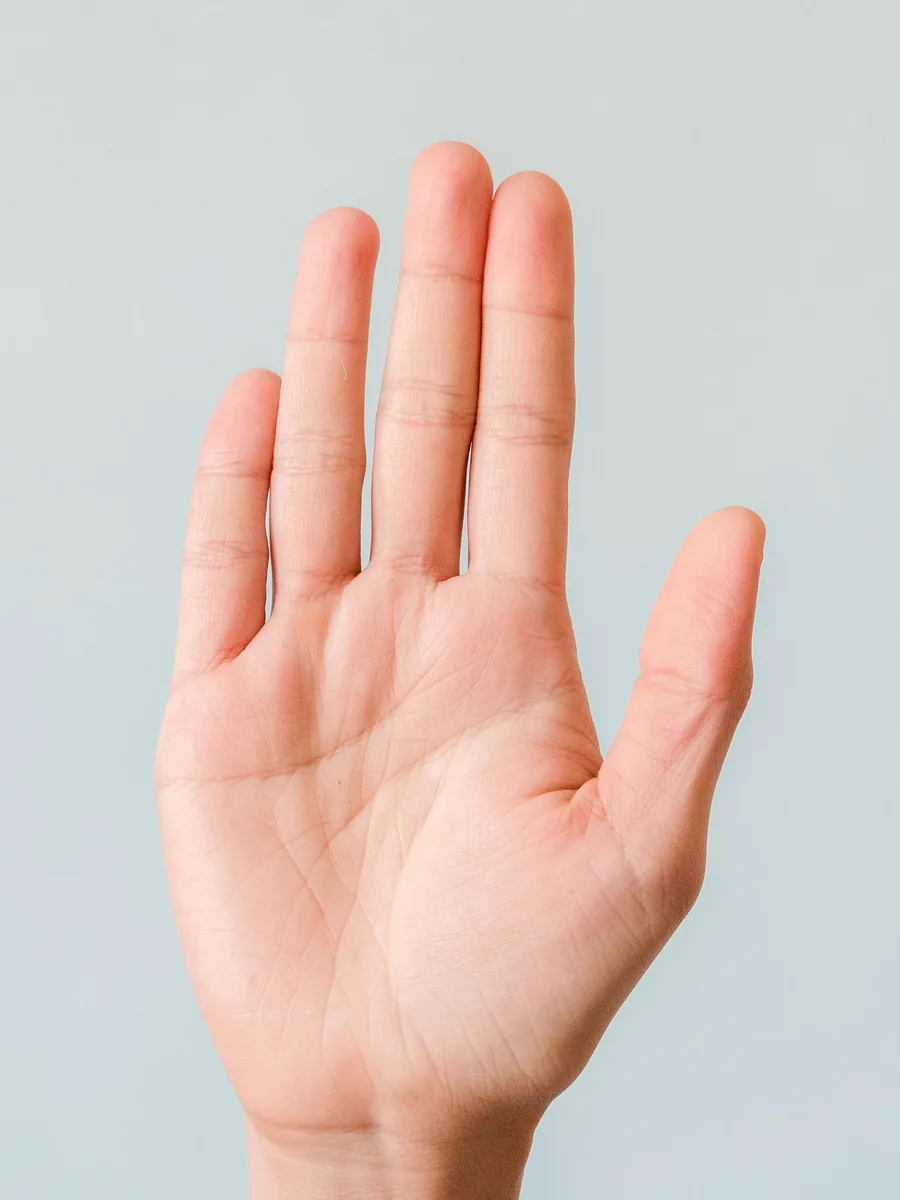
A real palm photo (Kevin Malik, Pexels), traced by the real PalmSays scanner. Your reading is made from your own photo.
Dotted lines are finger guides, not palm lines. The solid dot marks where the head line starts, the ring where it ends.
Where is the head line on your palm?
Straight, or sloping down? That one detail is what the books read first in a head line.
- Find your heart line first: the top long line under your fingers.
- Just below it, find the long line that starts on the thumb side, between the thumb and index finger. That is your head line.
- Follow it across your palm and notice which way it runs.
Our Android app is coming soon, with 2 free readings. The scan on this website opens soon too.
On this page
- Head line types and their meanings
- How to tell the head line from the heart line
- Two head lines?
- Education line (vidya rekha)
- Marks on the head line
- Head line in the left and right hand, for women and men
- When the heart and head lines join
- Check yourself: head line quiz
- Myths about the head line
- Head line: questions people ask
- Sources for this head line guide
Head line types and their meanings
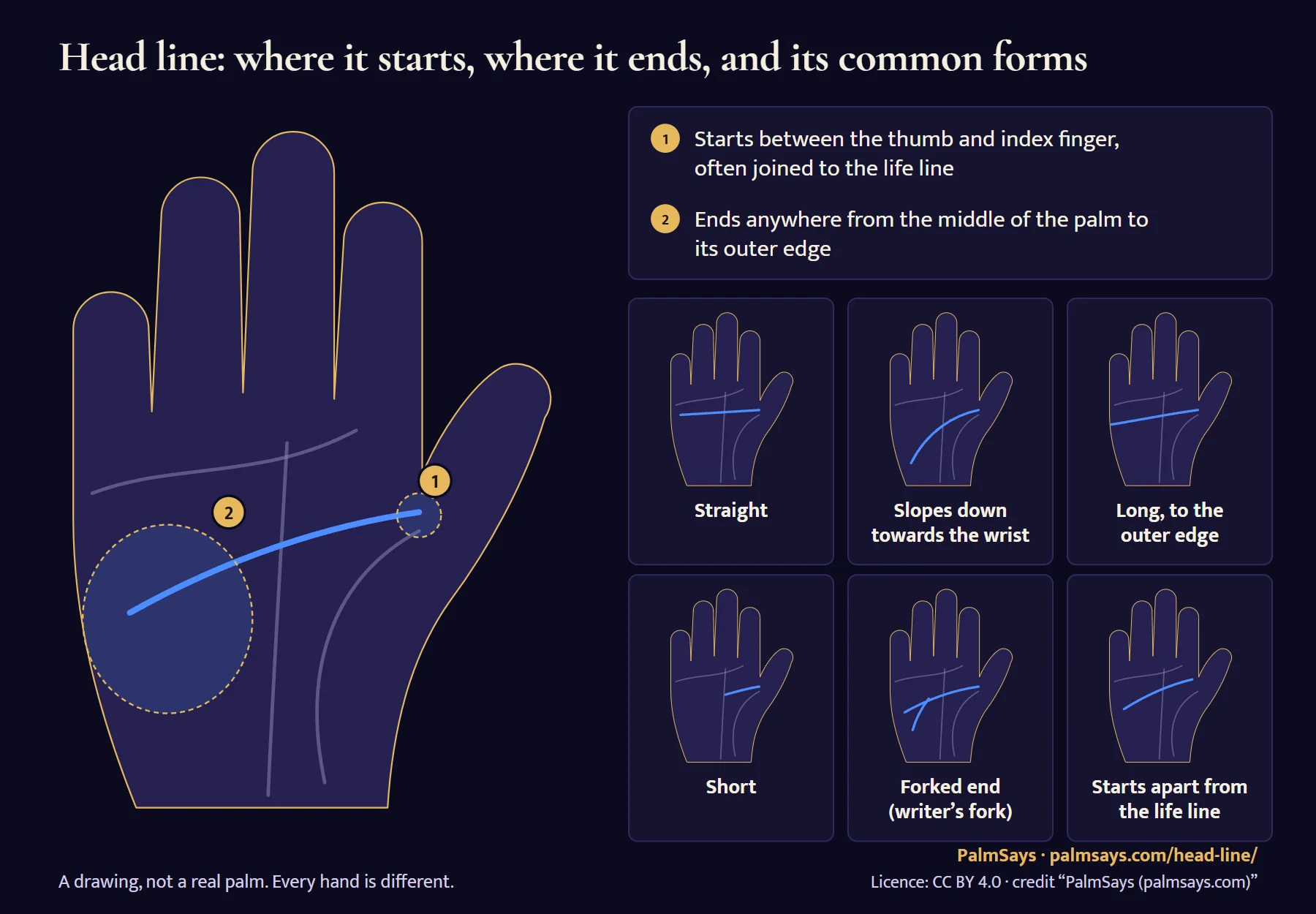
Readers look at four things: how straight or sloping the line is, how long it is, where it starts (joined to the life line or not) and where it ends. Your head line may fit several cards at once.
Read any line with 4 questions
Joined to the life line at the start? Straight or sloping at the end?
Nearly to the outer edge, or stopping mid-palm?
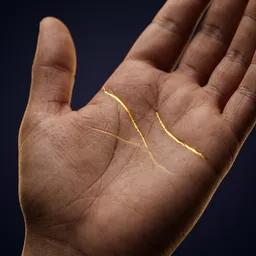
Deep and even, faint, or like a row of links?
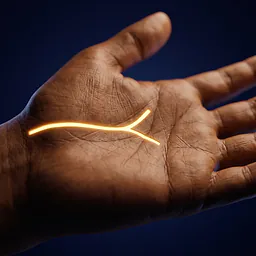
A fork at the end, or a gap?


AI-made 3D pictures. The glow shows the idea; it is not a reading.
Where does your head line start and end?
Side by side, at one scale
- Joined to the life line
- Not joined
- Straight
- Gently sloping
- Steeply sloping
Drawings of the forms the books describe, not real palms.
Head line joined to the life line
The more common form. The books differ: careful and sensitive, or witty and even-tempered.
Do you have this? Does your head line start joined to your life line, near the thumb?
What the books say
The more common form, and one where the traditions differ. Cheiro and several others read a sensitive, careful mind that weighs other people’s advice before its own, with self-reliance that grows later; Frith adds a shyness often hidden behind a quick manner. Dale’s Indian Palmistry reads good wit, an even temper and a sharp practical mind.
Source: Cheiro (1916, 1900); William G. Benham (1900); Henry Frith (1895); Mrs J. B. Dale (1895)
Head line not joined to the life line
Independent thinking and quick judgement, with a streak of daring.
Do you have this? Is there a small gap between the starts of your head and life lines?
What the books say
Independent thinking and quick judgement, with a streak of mental daring: at its best with a clear purpose to aim at. The books add that this goes with impulsiveness, so second thoughts are often the better ones. A very wide gap is read as boldness that can run ahead of careful thought.
Source: Cheiro (1916, 1900); Katharine St. Hill (1893); Henry Frith (1895)
Straight head line
Practical common sense: a mind that prefers the concrete.
Do you have this? Does your head line run fairly straight across your palm?
What the books say
Practical common sense: a mind that prefers the concrete and can be relied on to carry a decision through. Several books add settled opinions: once a view is formed, it tends to stay. One reads a line with no curve at all as unyielding, which we take as a caution, not a verdict.
Source: Cheiro (1900, 1916); William G. Benham (1900)
Gently sloping head line
Imagination kept in hand, with logic and imagination in balance.
Do you have this? Does your head line slope gently downwards as it crosses?
What the books say
Imagination kept in hand: creative thinking used when it is wanted, on a practical footing. The books call it level-headed, with logic and imagination in balance so neither runs the show alone.
Source: Cheiro (1916, 1900); Comte C. de Saint-Germain (1900)
Deeply sloping (curved) head line
A strongly imaginative, idealistic mind, at its best when inspired.
Do you have this? Does your head line curve steeply down towards the lower outer palm?
What the books say
A strongly imaginative, idealistic mind that does its best work when inspiration carries it. The books point it towards artistic, literary or intellectual work, and read a line ending low on the outer palm as a pull towards the unusual. Old books attach darker claims to an extreme slope; those are refused here.
Source: Cheiro (1900, 1916); Adolphe Desbarrolles (1859); Leo Markun (1927)
Wavy head line
Attention that comes and goes; decisions that take a while to settle.
Do you have this? Does your head line wander up and down as it crosses your palm?
What the books say
A head line that wanders up and down as it crosses. Cheiro’s rule for any wavy line is uncertainty and a lack of decision, and Cheiro’s Language of the Hand says a wavy line weakens what the line shows. On the head line, that reads as attention that comes and goes, and choices that take a while to settle. It is not a measure of intelligence, and a bent palm can make a line look wavy in a photo.
Source: Cheiro (1916, 1900)
Cheiro’s books, and Benham for the outer edge, also read where the head line starts and ends. The PalmSays app uses these readings:
- Starting under the index finger: ambition joined to judgement, a mind drawn to organising and taking charge.
- Starting inside the life line, on the thumb side: a sensitive mind that feels friction with other people keenly.
- Ending under the middle finger: depth of thought, with an interest in music or questions of faith.
- Ending under the ring finger: a wish to be noticed and known for your ideas.
- Curving up towards the little finger: a mind drawn to commerce and science. This is an attitude to money, never a forecast of it.
- Ending on the outer edge of the palm, fairly level: practical ideas and the balanced middle course. Cheiro adds strong will and quiet determination when the line starts joined to the life line.
How long is your head line?
Side by side, at one scale
- Long
- Short
Drawings of the forms the books describe, not real palms.
Long head line
Wide mental reach: able to follow big, complex subjects a long way.
Do you have this? Does your head line run nearly to the outer edge of your palm?
What the books say
Wide intellectual reach: able to take on large, complex subjects and follow them a long way. When the long line is also unbroken, the books read sound judgement and a steady mind; when it is long and straight, a logical mind that is careful with resources.
Source: Cheiro (1900); Leo Markun (1927); Katharine St. Hill (1893); Henry Frith (1895)
Short head line
A practical, hands-on mind that focuses closely. Not low intelligence.
Do you have this? Does your head line stop around the middle of your palm?
What the books say
A practical, hands-on mind, most at home with concrete tasks and able to focus closely on one specialty. One old book reads a very short line far more darkly; that reading is refused here.
Source: Cheiro (1900); Leo Markun (1927)
How clear is your head line?
Side by side, at one scale
- Deep and clear
- Faint
- Chained
Drawings of the forms the books describe, not real palms.
Chained or faint head line
Ideas that shift before they settle, or a mind that ranges widely.
Do you have this? Up close, is your head line made of tiny links, or thin and faint?
What the books say
A chained line is read as ideas that shift before they settle, so decisions take longer. A faint line, lying on the surface rather than cut deep, as a mind that ranges more than it concentrates. Neither is a measure of intelligence, and claims about the mind’s health are refused.
Source: Cheiro (1900, 1916)
A deep, clearly marked head line is read as concentration and a retentive memory: thinking that goes deep rather than wide. Dale reads a clear, unbroken line as a cheerful, inventive turn of mind.
Does your head line break, fork or branch?
Side by side, at one scale
- Forked
- Broken
- Branch rising
Drawings of the forms the books describe, not real palms.
Forked head line (the writer’s fork)
Two ways of thinking at once: the practical and the imaginative.
Do you have this? Does your head line split into two branches near its end?
What the books say
Two ways of thinking at once, the practical and the imaginative. That gives range and tact, and can make choosing harder: the old advice is to trust your first impulse. When one branch dips towards the lower outer palm, Cheiro reads a talent for imaginative writing and storytelling, hence the name.
Source: Cheiro (1916, 1900); Leo Markun (1927); William G. Benham (1900); Katharine St. Hill (1893)
Broken head line
Not a warning: the line’s qualities carry on where the ends overlap.
Do you have this? Is there a gap in your head line, with the two pieces overlapping?
What the books say
Cheiro’s rule for any broken line is that the break interrupts what the line shows at that point, and that where the two ends overlap its qualities carry on. So no separate trait is read from the break. Older books attach darker claims; they are refused here.
Source: Cheiro (1916)
Branches from the head line
A branch takes the quality of the mount it reaches: towards the index finger, ambition.
Do you have this? Does a small line rise from your head line towards one of your fingers?
What the books say
Cheiro’s Language of the Hand reads a branch from the head line by where it goes: it takes on the qualities of the mount it runs to. A branch rising towards the index finger (the mount of Jupiter) he reads as pride and ambition to lead; a branch rising to meet the heart line, as a strong attraction or affection that pulls on the mind. A branch dipping towards the lower outer palm is the writer’s fork, above.
Source: Cheiro (1900)
Length is never read as intelligence. A short head line is read as a focused, practical mind.

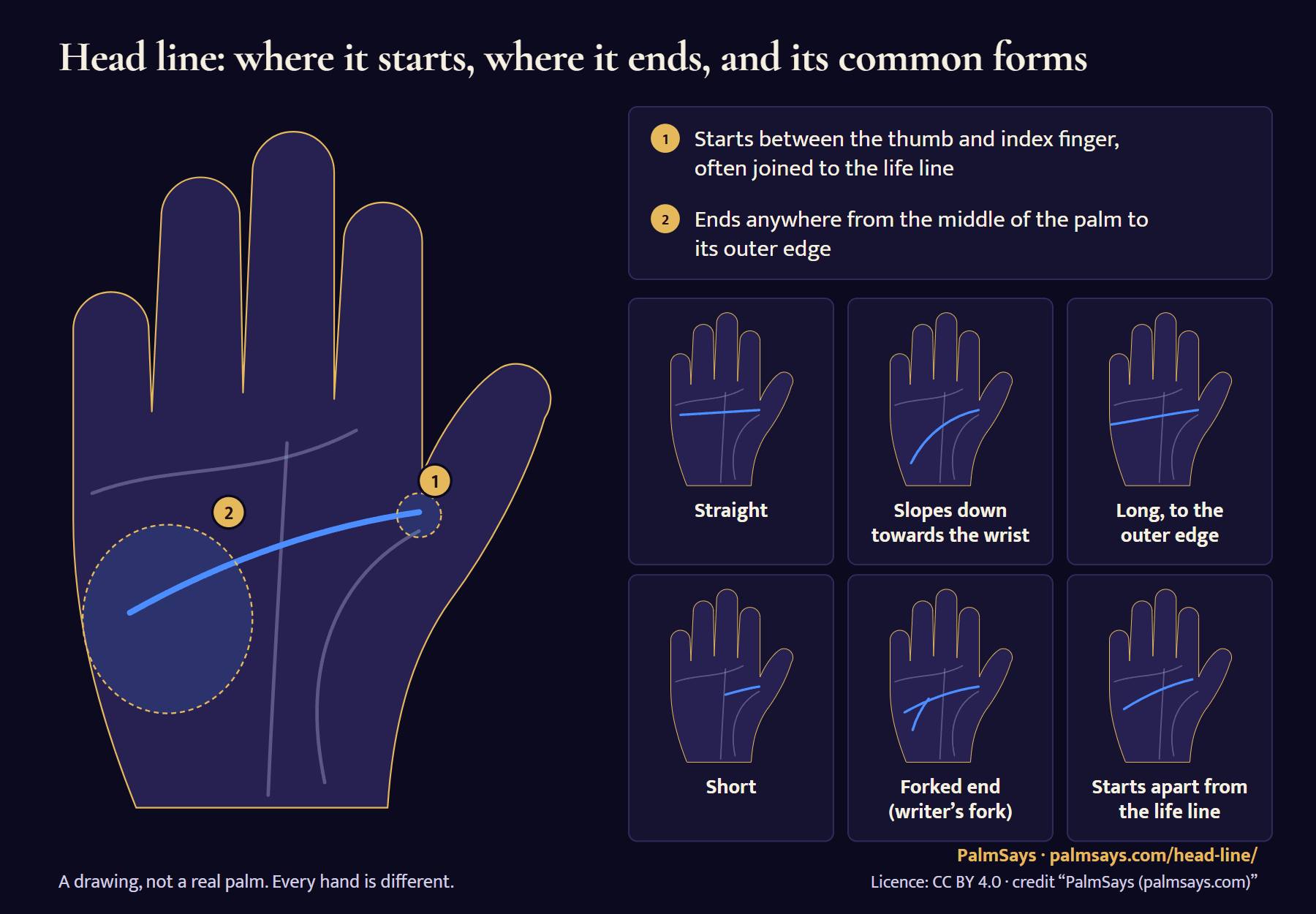
How to tell the head line from the heart line
The head line runs across the middle of your palm, below the heart line. To find it and tell the two apart:
Where is it? Three looks
1 Name your fingers.
2 Skip the finger creases. The heart line is the first long line below them.
3 Just below the heart line, from between the thumb and index finger.
- Find the heart line first: the top long line, just under your fingers.
- Look at the edge of your palm between the thumb and the index finger. The head line starts there, often joined to the life line for a short way.
- Follow it across the palm. It runs fairly straight, or slopes down towards the lower outer edge.
People also call it the mind line or brain line. In Hindi it is मस्तिष्क रेखा (mastishk rekha).
Head line or heart line? The heart line starts from the little-finger edge and sits higher, just under the fingers. The head line starts from the thumb side and sits lower. If you only see one straight line across the top half of your palm, read about when the heart and head lines join.
Heart or head line?
Follow the line back to where it starts.
At the little-finger edge: It is the heart line.
Between the thumb and index finger: It is the head line.
Only one line across the top half of your palm? When the heart and head lines join
The quadrangle: the space between the head line and heart line
The space between the head line and the heart line has its own name in palmistry: the quadrangle. Cheiro’s Palmistry for All (1916) reads it as your attitude towards other people:
- Even in width, not narrowing at either end: balance of judgement, a level head.
- Very narrow: narrow, fixed views.
- Very wide: views so open that judgement can suffer.
On most hands the width changes along the palm, so look at the space as a whole, in even light. The heart line guide explains how Cheiro reads a heart line that sits very low, almost touching the head line.
Can’t find your head line?
A palm with no head line at all is very rare. Benham writes that he saw one only once, and that the line is present in almost every hand. If you can’t find yours, check for one crease across the palm where the heart and head lines have merged (the simian line), or for a faint line in low light. The books give no reading for a missing head line, so we don’t invent one.
Two head lines?
Some palms show a second line running alongside the head line. That is a double head line, which is uncommon and different from a fork. Our guide to the double head line explains how to tell them apart.
Side by side, at one scale
- A fork: one line splits
- Two head lines
Drawings of the forms the books describe, not real palms.
Education line (vidya rekha)
Some readers today talk of an “education line”, विद्या रेखा (vidya rekha). The classical books we use don’t name such a line. The English books read thinking style from the head line itself, and Indian texts such as Jain’s Samudrik Shastra (1927) link learning to a small barleycorn-shaped mark instead. That mark is far too small for a phone photo. Either way, no line can predict exams, a degree or success.
Marks on the head line
A good photo shows the head line’s breaks, forks and branches, and the cards above cover those. Islands, chains of tiny loops, dots, crosses, stars and squares are usually only a few pixels wide in a phone photo, so an honest reading leaves them out rather than guessing.
Head line in the left and right hand, for women and men
The head line is read the same way for everyone; there is no separate head line for women or men. Compare both hands:
- Your writing hand is read as the life you are making: how you think now.
- Your other hand is read as what you started with.

the life you are making

what you started with
A difference between the two is read as a change in how you think. Which hand to read explains the traditions in full.
When the heart and head lines join
Sometimes the heart and head lines form one straight crease across the palm instead of two lines. Palmistry calls it the simian line; doctors call it a single palmar crease, which is usually a normal variation. Benham classes a single line sitting where the head line should be as a head line. The simian line guide gives the medical facts first, then what the books say.
Check yourself: head line quiz
Three quick questions. Pick an answer to see if you are right. New to palmistry? Start with the 7 steps of a palm reading.
Myths about the head line
- MythA long head line means you are clever, and a short one means you aren’t.
- Reality
Length is read as the range of a thinking style, not its power. A short line is read as a focused, practical mind.
- MythA broken head line means a breakdown or an accident.
- Reality
The books that make claims like this are refused. Cheiro’s rule for any broken line is that the qualities carry on where the ends overlap, and a crease or shadow can make a line look broken in a photo.
- MythThe education line shows how far you’ll study.
- Reality
The classical books don’t name an education line, and no line can predict exams or degrees.
Head line quick facts
- Hindi name
- मस्तिष्क रेखा (mastishk rekha)
- Other names
- The mind line or brain line. Older English books call it the line of head or the cerebral line; Dale’s Indian Palmistry (1895) calls it the Liver Line. All names: palmistry terms.
- Where it sits
- Across the middle of the palm, below the heart line. It starts on the thumb side, often joined to the life line.
- What the tradition reads in it
- Thinking style: how you take in the world, weigh ideas and make decisions.
- Which hand
- Look at both. Tradition reads your writing hand as the life you are making. Which hand to read
Head line: questions people ask
What does the head line mean in palmistry?
It is read for your thinking style: whether you lean to the practical or the imaginative, and how you weigh ideas and decide. The books describe tendencies. Nothing in the line measures how clever you are.
What is a forked head line (the writer’s fork)?
A head line that splits into two branches near its end. The books read it as two ways of thinking at once, practical and imaginative. When one branch dips towards the lower outer palm, Cheiro reads a talent for imaginative writing, which is where the name comes from.
What does it mean when the head line and life line are joined?
It is the more common form. Cheiro and several other books read a careful, sensitive mind that weighs others’ advice before its own. Dale’s Indian Palmistry reads it differently: good wit and an even temper. We show both.
What does it mean if the life line and head line are not joined?
A gap between their starts is read as independent thinking and quick judgement, with a streak of daring. The books add a caution: second thoughts are often the better ones.
Does a short head line mean low intelligence?
No. The books read a short head line as a practical, hands-on mind that focuses closely on one thing. Length is never read as intelligence.
Is there an education line in palmistry?
Not in the classical books we use. Some readers call a head line or one of its branches the education line, but no line can predict exams, degrees or success.
Can you have two head lines?
Yes, though it is uncommon. A second line running alongside the head line is called a double head line, which is different from a fork. See two head lines on your palm.
Sources for this head line guide (14 books and studies)
- Cheiro, Palmistry for All (1916). Part I, ch. II: The Line of Head (incl. Double Lines of Head, and the head and heart lines running together); ch. XVII: Different Classes of Lines (wavy lines); ch. XVIII: The Great Triangle and the Quadrangle.
- Cheiro, Cheiro’s Language of the Hand (1900). Part II, ch. III: In relation to the lines (a wavy line); ch. V: The Line of Life, pp. 79–85; ch. VII: The Line of Head, pp. 87–90 (branches to the mounts).
- Cheiro, Cheiro’s Guide to the Hand (1900). Ch. XI: The Line of Life, pp. 71–72; ch. XII: The Line of Head, pp. 79–82.
- Leo Markun, What You Should Know About Palmistry (1927). The section on the Line of the Head.
- Mrs J. B. Dale, Indian Palmistry (1895). The Liver Line (the old name for the head line); The Line of Life.
- Henry Frith, Practical Palmistry (1895). The Head Line, pp. 65–68.
- Edward Heron-Allen, A Manual of Cheirosophy (1885). Cheiromancy, § 3: The Line of Head, ¶ 582, p. 250.
- Edward Heron-Allen, Practical Cheirosophy (1887). Cheiromancy or Palmistry: the Line of Head, p. 113.
- Adolphe Desbarrolles, Chiromancie nouvelle (1859). Ligne de tête, pp. 220–221. (in French)
- William G. Benham, The Laws of Scientific Hand Reading (1900). Part II, ch. I (how often each line is present); ch. V: The Line of Heart, p. 387 (a head line absent only once); ch. VI: The Line of Head, pp. 426–449. (facts only)
- Albert Raphael, Cheirosophy (1901). The Head Line, pp. 113–115. (facts only)
- Katharine St. Hill, The Grammar of Palmistry (1893). Line of Head (Cerebral), pp. 40–42. (facts only)
- Comte C. de Saint-Germain, The Practice of Palmistry for Professional Purposes (1900). The Line of Head: Direction, Length, Starting Points, Termination, pp. 214–223. (facts only)
- Chhotelal Jain, Samudrik Shastra ya Bhagya Nirnay (1927). The signs on the hand (the barleycorn mark and learning). (facts only, in Hindi)
Meanings on this page are written in our own words from these books. Books whose rights are unclear are used for facts only, never quoted. How we choose sources
See your own head line
Upload one photo of your palm. We trace your lines and show what palmistry says about each one.
- Open palm
- Good light
- Whole hand in the frame
A phone photo shows the main lines and their breaks, forks and branches. Tiny marks such as stars and crosses are too small, so an honest reading leaves them out.
Our Android app is coming soon, with 2 free readings. The scan on this website opens soon too.
Coming soon on Google Play. The Android app is not on Google Play yet. This page will get the link the day it is.
The iPhone app isn’t ready yet. You can keep using this website.
PalmSays is currently listed as Palm Read AI on Google Play. It is the same app.
Or see what the palm reading app for Android reads before you install it.