Lines on your palm and what they mean
The lines on your palm are called the heart line, head line and life line, the three major lines, plus the fate line on many palms. Minor lines vary from hand to hand. Palmistry reads each for character, never dates.
Find your 4 main lines
Every hand is different, but the same four main lines show up on most palms. Here is where to look on yours.
- Hold your hand up in daylight, palm facing you.
- Heart line: the top long line, just under your fingers.
- Head line: across the middle, starting on the thumb side. Life line: around the ball of the thumb.
- Fate line: up the middle towards the middle finger. It is often faint or missing, and that is common.
Our Android app is coming soon, with 2 free readings. The scan on this website opens soon too.
On this page
Palm reading chart: every line at a glance
This chart shows where each line usually runs. Your own lines won’t match it exactly: every hand is different, and many hands don’t have every line.
The heart line is the top line, under the fingers. The head line runs across the middle of the palm, the life line curves round the thumb, and the fate line runs up the middle of the palm. The minor lines have their own chart under minor lines.
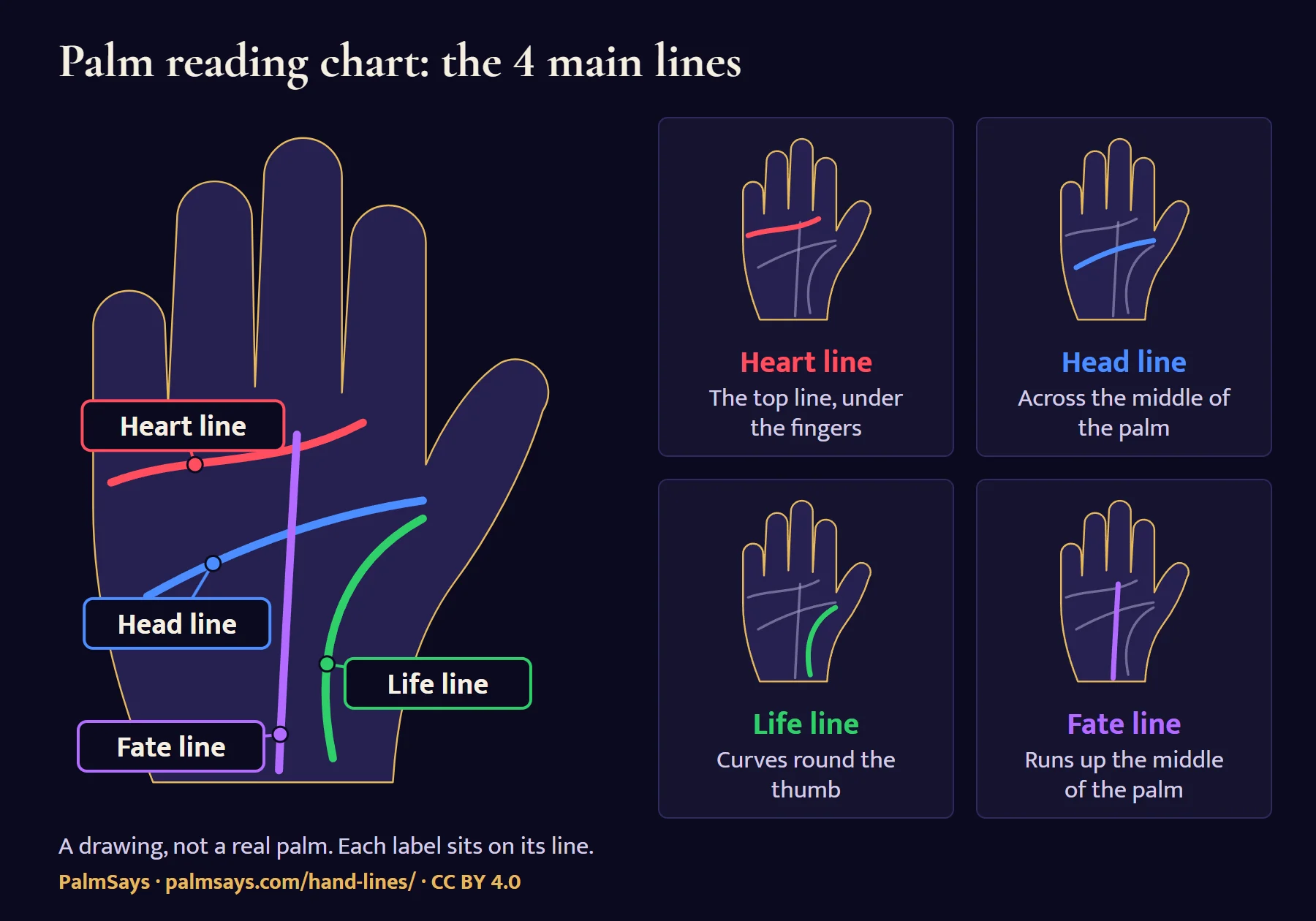

What are the lines on your palm called?
The names below are the ones you will meet in palmistry books and apps, with their other names and the Hindi name. In Hindi the lines of the hand are हाथ की रेखाएं (hath ki rekhayen), and palmistry is हस्तरेखा (Hast Rekha).
| Line | Also called | Hindi |
|---|---|---|
| Heart line | Love line, mensal line | हृदय रेखा (hriday rekha) |
| Head line | Mind line, brain line | मस्तिष्क रेखा (mastishk rekha) |
| Life line | Line of life | जीवन रेखा (jeevan rekha) |
| Fate line | Destiny, career or luck line; line of Saturn | भाग्य रेखा (bhagya rekha) |
| Sun line | Apollo line, line of success | सूर्य रेखा (surya rekha) |
| Mercury line | The old “health line” | बुध रेखा (budh rekha) |
| Marriage lines | Relationship lines, lines of affection | विवाह रेखा (vivah rekha) |
| Children lines | No other name | संतान रेखा (santan rekha) |
| Bracelets | Wrist lines | मणिबंध (manibandh)* |
| Girdle of Venus | No other name | शुक्र वलय (shukra valay)* |
| Intuition line | Line of intuition | अंतर्ज्ञान रेखा (antargyan rekha)* |
| Travel lines | No other name | यात्रा रेखा (yatra rekha)* |
| Line of Mars | Inner life line, sister line | मंगल रेखा (mangal rekha)* |
| Ring of Solomon | No other name | गुरु वलय (guru valay)* |
| Via lasciva | No other name | No settled Hindi name |
* Hindi names marked with a star are common in Hindi palmistry writing but still wait for a check by our Hindi reviewer. Every name, with a one-line meaning, is also in our palmistry terms glossary.
How many lines are on your palm?
There is no fixed number. Almost every palm has the three major lines, and many also have a fate line, so most people count three or four main lines. The minor lines come and go from hand to hand. A palm with fewer lines is not missing anything.
What do the lines on your hand mean?
In palmistry, each line stands for one side of character: feeling, thinking, energy, direction. The books read a line by its length, its shape, where it starts and ends, how clearly it is marked and any breaks, forks or branches. They describe tendencies, not events, and the meanings in PalmSays guides always name the book they come from.
A line is also a crease in the skin. Palm creases form before birth, and doctors call them flexion creases. So “palm crease meaning” has two answers: the medical one (a crease where the hand folds) and the palmistry one (a tradition of reading character from those creases). This site is about the second, and it never claims the first says anything about your future.
The three major lines
Heart line
The heart line is the highest long line across the palm, just below the fingers. It starts on the little-finger edge and runs towards the index or middle finger. Palmistry reads it for emotional life: how you feel, show affection and relate to others. A line that curves up to end under the index finger is read as loyal, steady affection held to high ideals; a short one as feelings shown sparingly, which says nothing about how much is felt. It can’t tell who you will love, or when. Read the heart line guide for every type.
Head line
The head line crosses the middle of the palm, below the heart line, starting on the thumb side and often joined to the life line at first. It is read for thinking style. A straight line is read as practical common sense, a line sloping down towards the outer palm as a strongly imaginative mind, and a fork at the end as two ways of thinking at once, the “writer’s fork”. It is not a measure of intelligence. See what the head line means.
Life line
The life line curves around the base of the thumb, from between the thumb and index finger towards the wrist. The tradition reads it for energy, stability and how you meet change. A wide curve is read as outgoing energy. The most important point is what it doesn’t mean: a short life line is not a short life, and its length is never read as years. The life line guide explains why.
The fate line
The fate line runs up the middle of the palm towards the middle finger, and people also call it the destiny, career or luck line. It is read for direction and work. It is also the major line most often faint, broken or missing, and that is common: a missing fate line is read as a path that isn’t fixed in advance, not as bad luck. A break is read as a change of direction in working life. The fate line guide covers where it starts and ends.
Minor lines
Minor lines are shorter and vary much more from hand to hand. Many palms have only some of them.
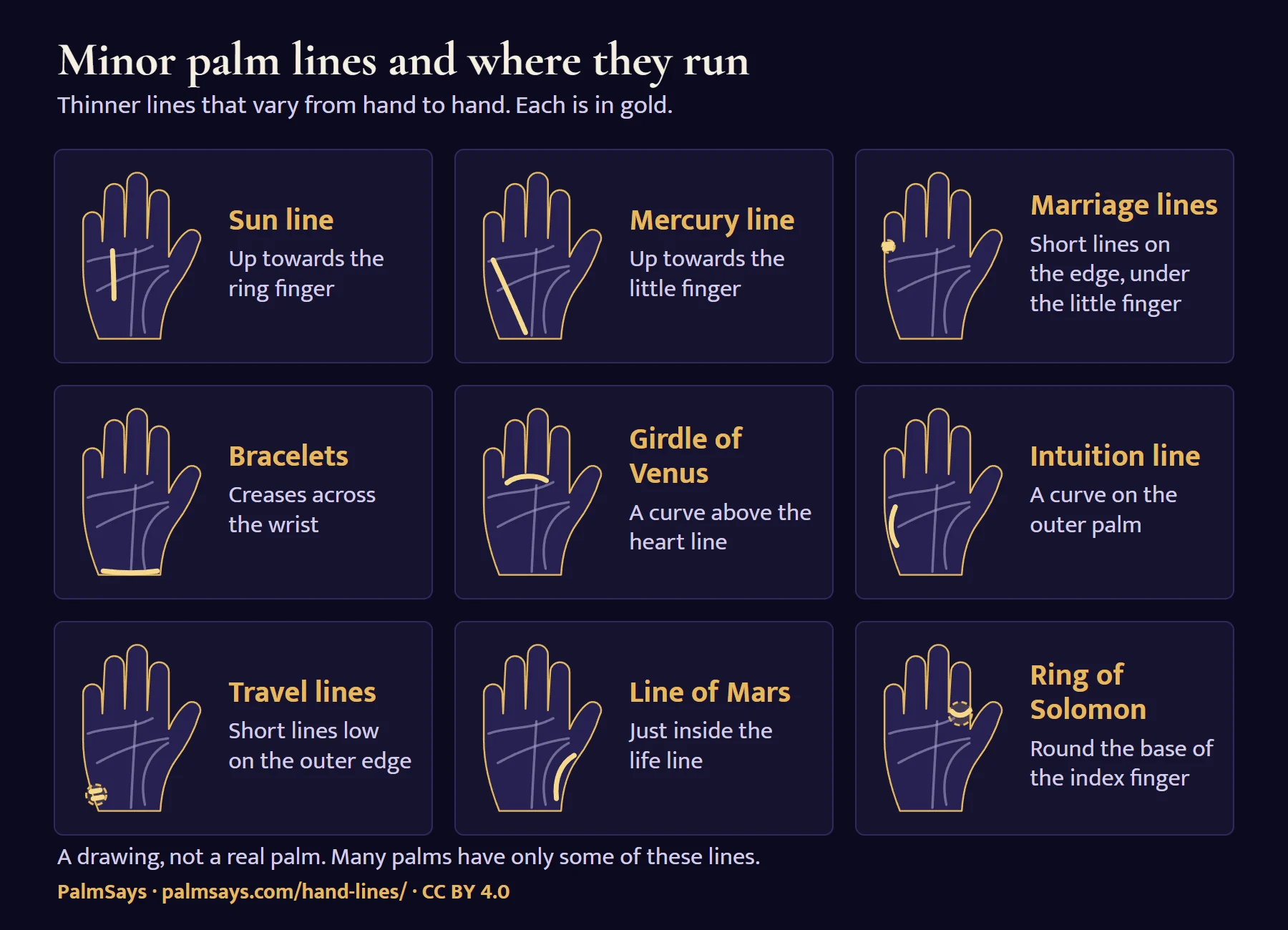
- Sun line (Apollo line): a line rising towards the ring finger. Cheiro reads it as sensitivity to surroundings, where beauty and atmosphere affect how you feel and work. Markun is explicit that a missing sun line is not a sign of hardship. Dale’s Indian Palmistry calls it the Via Solis. Its types are in sun line meaning.
- Mercury line: a line running up towards the little finger. Some old books call it the health line. We never read it as health: palm lines are not a medical test. More in Mercury line meaning.
- Marriage lines: short lines on the outer edge of the palm, under the little finger. Cheiro counts only the long, clear ones as marriages or lasting unions, and says the hand doesn’t record the ceremony itself. No line gives a marriage age, a number of marriages or a divorce: the marriage line, explained honestly.
- Children lines: Cheiro reads fine upright lines just above the marriage lines as children. Whether you have children, or how many, depends on life, health and choice, not on lines. Where the books place them: children lines on the palm.
- Money line (धन रेखा, dhan rekha): the classical books we use don’t describe a separate money line; the name is a newer one. No line predicts money. The money line guide shows which lines people mean by it.
- Bracelets: the creases across the wrist. They are named in the books, but the PalmSays app doesn’t read them.
Cheiro’s Palmistry for All (1916) names six more minor lines. Each is uncommon, and we give his reading in our own words.
Girdle of Venus
A curved line above the heart line, often in broken pieces, running from the base of the index finger round to the base of the little finger. Many palms don’t have one. Cheiro reads it as a highly strung, imaginative nature that lives a great deal in the mind, and says plainly that he never found it to mean what other writers claimed for it.
Intuition line
A curved line on the outer side of the palm, bowing from under the little finger down to the lower outer palm (the mount of the Moon), or lying on that mount alone. Cheiro calls it rare, and reads a very sensitive nature with strong intuition: a feel for how things should be done. He also credits it with dreams that come true. That is his claim, not ours: no line can foretell events.
Travel lines
Short lines on the outer edge of the palm, low down on the mount of the Moon, and fine lines that leave the life line and bend towards that mount. Cheiro reads them as travel and journeys, and a life line that swings out towards the Moon mount as a life of much change and travel. He also dates journeys from them. We don’t, because no line gives a date.
Line of Mars (sister line)
A line running just inside the life line, on the ball of the thumb. Cheiro also calls it the inner life line, and reads it as backing up the life line, with a strong, rather combative temperament. It is the best-known sister line, one line running close beside another; the life line guide calls it the double life line. He reads health into it as well. We leave that out: palm lines are not a health test.
Ring of Solomon
A small curved line around the base of the index finger, on the mount of Jupiter. Cheiro counts it among the marks of mysticism, and reads a wish to master subjects such as the occult. In a photo it is easy to mix up with the creases at the base of the finger.
Via lasciva
A rare curved line low on the palm, joining the mount of the Moon to the ball of the thumb, or running from the lower outer palm into the wrist. Cheiro gives it one of the harshest readings in his book. We don’t repeat it: it judges a person’s character and health, and no palm line can show either.
The PalmSays palm reading app reads the four major lines and measures your hand type and fingers on the photo, and shows where the palm mounts sit. It doesn’t read the sun, marriage, children, Mercury or money lines, or the six rarer lines above, and it says so rather than guessing.
Signs on the lines
Books also describe small signs on or near the lines: islands, chains, dots, crosses, stars, squares, triangles, and in Indian readings the fish (मछली) and trident (त्रिशूल). In a phone photo most of these are only a few pixels wide, far too small to see reliably. What a good photo does show is a line’s breaks, forks and branches, so those are what an honest reading uses. The cross on the palm has its own guide. The star, triangle, square, fish and trident are in lucky signs on the palm, and the M on the palm is read line by line.
Left or right hand?
Look at both hands; they are rarely identical. In palmistry tradition, the hand you write with is read as the life you are making, and the other as what you started with, so the differences between them are part of the reading. Some Indian traditions read a woman’s left hand and a man’s right. Which hand to read explains all of this.
Do palm lines change?
The main creases form before birth: a study of 160 fetuses found most palm creases develop in the womb, independently of the hand’s movements (Kimura and Kitagawa, 1986). The fine lines can look different over the years, and light, skin and how you hold your hand change how any line looks in a photo. The evidence, and what the old books claimed, is in do palm lines change.
What is the rarest palm line?
Books call some forms rare, such as one line straight across the palm (the simian line) or a double head line, but they rarely give numbers. The one form with a medical figure is the single palmar crease, which MedlinePlus puts at about 1 in 30 people. The full list, with a figure only where a study gives one, is in rare palm lines.

Quick facts
- In Hindi
- हाथ की रेखाएं (hath ki rekhayen); the study is हस्तरेखा शास्त्र (hast rekha shastra)
- The major lines
- Heart, head and life, plus the fate line on many palms.
- Minor lines
- Sun, Mercury, marriage and children lines and the bracelets, plus rarer ones such as the girdle of Venus, the intuition line and travel lines. They vary a lot from hand to hand.
- What a phone photo shows
- The major lines and their breaks, forks and branches. Tiny marks and the lines on the side of the hand are hard to see.
- Which hand
- Look at both. Which hand to read
Questions people ask
What are the lines on your palm called?
The major lines are the heart line, head line and life line, and on many palms the fate line. The minor lines include the sun line, the Mercury line, the marriage lines and the bracelets at the wrist.
What are the three major lines in palmistry?
The heart line at the top, the head line across the middle and the life line around the thumb.
Which line is the love line?
The love line is the heart line, the top line across the palm. See what the heart line means.
Are the lines the same on both hands?
Usually not. Your two hands often differ in length, depth and small branches. Palmistry reads the difference too: see which hand to read.
Can one photo show all the lines on my palm?
A clear photo in good light shows the major lines well. The marriage lines sit on the side of the hand, and tiny marks like crosses and stars are too small for most phone cameras.
Sources (7 books and studies)
- Cheiro, Palmistry for All (1916). Part I, ch. II: The Line of Head; ch. III: The Line of Life; ch. IV: The Line of Mars or Inner Life Line; ch. V: The Line of Destiny or Fate; ch. VI: The Line of the Sun; ch. VII: The Line of Heart; ch. VIII: Signs Relating to Marriage; ch. IX: Lines Denoting Children; ch. XI: The Girdle of Venus, the Ring of Saturn, and the Bracelets; ch. XII: The Line of Intuition and the Via Lasciva; ch. XIII: La Croix Mystique, the Ring of Solomon; ch. XIV: Travels, Voyages and Accidents; ch. XVII: Different Classes of Lines.
- Cheiro, Cheiro’s Language of the Hand (1900). Part II, ch. V, VII, X and XI: the lines of life, head, heart and fate; ch. XVI: The Line of Marriage, p. 114.
- Leo Markun, What You Should Know About Palmistry (1927). The sections on the lines and on the Line of Apollo.
- Mrs J. B. Dale, Indian Palmistry (1895). The Via Solis (the old name for the sun line); No. 46, Marriage lines.
- William G. Benham, The Laws of Scientific Hand Reading (1900). Part II, ch. IX: The Lines of Affection, p. 520. (facts only)
- Kimura, S. and Kitagawa, T. (1986). Embryological development of human palmar, plantar, and digital flexion creases. The Anatomical Record, 216(2), 191–197.
- MedlinePlus (US National Library of Medicine) (2025). Single palmar crease.
Meanings on this page are written in our own words from these books. Books whose rights are unclear are used for facts only, never quoted. How we choose sources
See your own lines
Upload one photo of your palm. We trace your lines and show what palmistry says about each one.
- Open palm
- Good light
- Whole hand in the frame
A phone photo shows the main lines and their breaks, forks and branches. Tiny marks such as stars and crosses are too small, so an honest reading leaves them out.
Our Android app is coming soon, with 2 free readings. The scan on this website opens soon too.
Coming soon on Google Play. The Android app is not on Google Play yet. This page will get the link the day it is.
The iPhone app isn’t ready yet. You can keep using this website.
PalmSays is currently listed as Palm Read AI on Google Play. It is the same app.
Or see what the palm reading app for Android reads before you install it.