Palm lines
Do palm lines change over time?
Quick answer
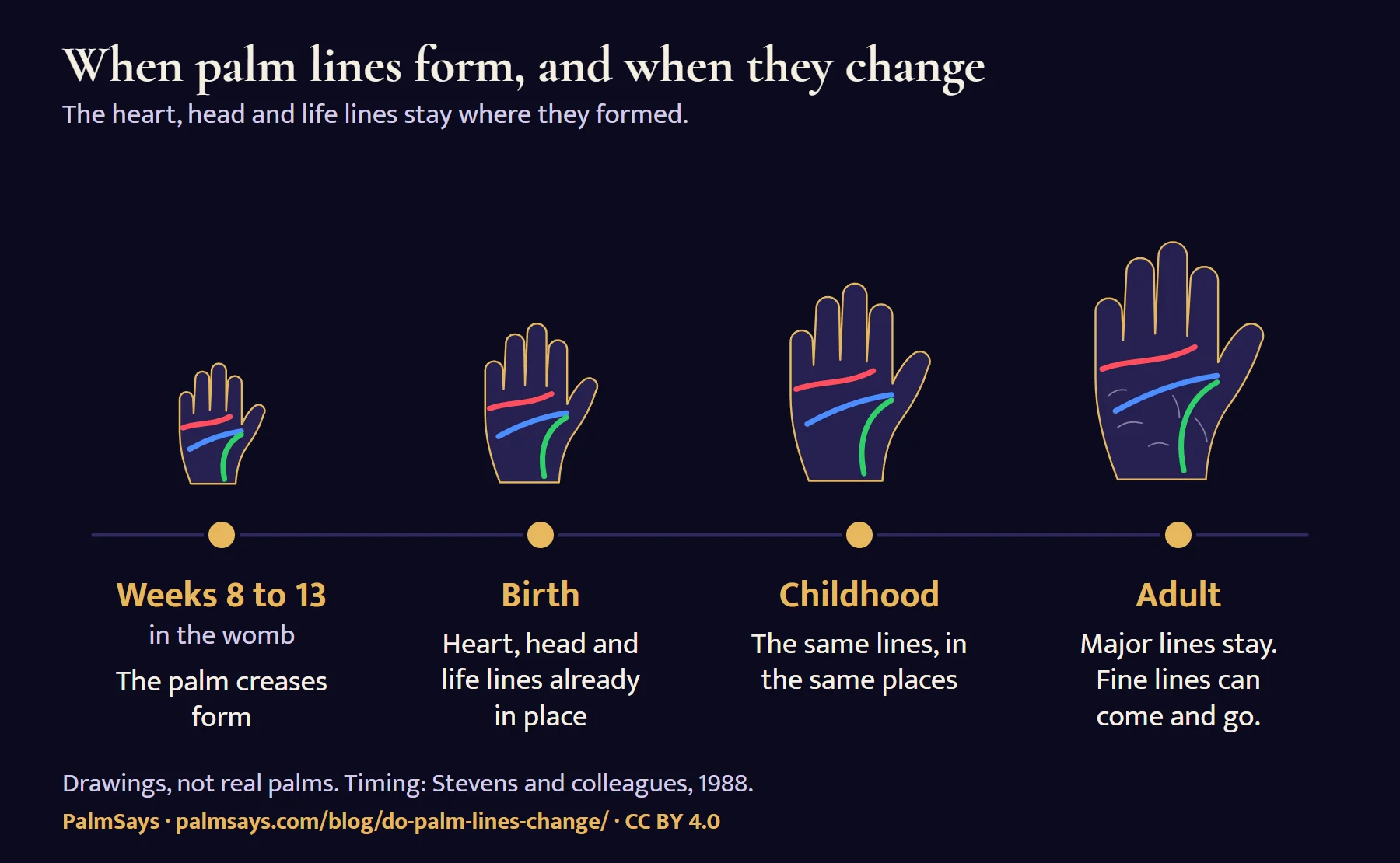
Your major palm lines don’t really change. They form before birth, between about 8 and 13 weeks of pregnancy, and stay for life. Fine lines can come and go, and light and angle change how lines look in photos.
Key takeaways
- The major palm lines form between 8 and 13 weeks of pregnancy.
- Your heart, head and life lines stay in the same place for life.
- Fine lines, line depth and dry skin can change with age.
- Light and angle make the same palm look different in two photos.
Reuse this image
Free to reuse under CC BY 4.0 with credit to PalmSays (palmsays.com). Full-size diagram (PNG, 1800 × 1110)
On this page9 sections
When do palm lines form?
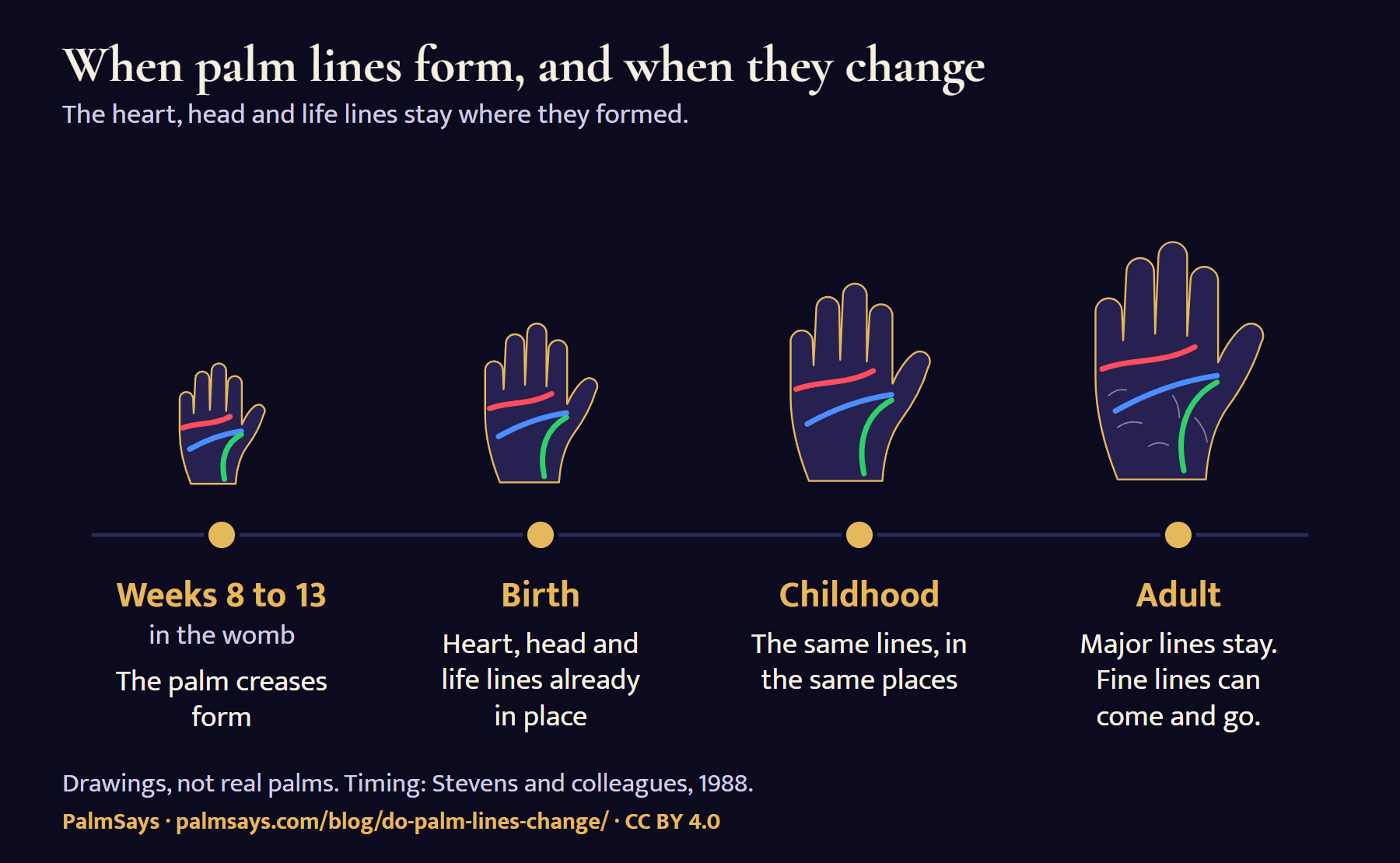
Your palm lines form in the womb, months before you are born. A 1988 study of 100 fetuses found that palm and finger creases develop between 8 and 13 weeks of pregnancy. Palm creases were always visible by 13 weeks (Stevens and colleagues, 1988).
An earlier study of 160 fetuses found that most creases appear together with the small pads on the growing palm. With some exceptions, they form independently of the hand’s movements (Kimura and Kitagawa, 1986). So the lines are not simply folds worn in by use.
Anatomists call these lines flexion creases: places where the skin folds as the hand bends. They are a different thing from the fine ridges of your fingerprints, which have their own science, dermatoglyphics.
The heart, head and life lines are in place before birth, and they stay where they formed.
Do palm lines change with age?
The major lines don’t move or disappear. A 2022 crease study describes palm creases as “unique, permanent, and genetically controlled” (Belay and colleagues, 2022). That matches what you see on an older hand: the same heart, head and life lines, in the same places.
What does change is the skin around them. MedlinePlus notes that with age the outer skin layer thins and loses elasticity, and wrinkles appear. On a palm, that can mean more fine lines, and major lines that look deeper or softer than before.
We found no long-term study that photographed the same palms for decades. So the honest answer is: the major creases stay, and the fine detail around them can shift.
What can change, and what can’t?
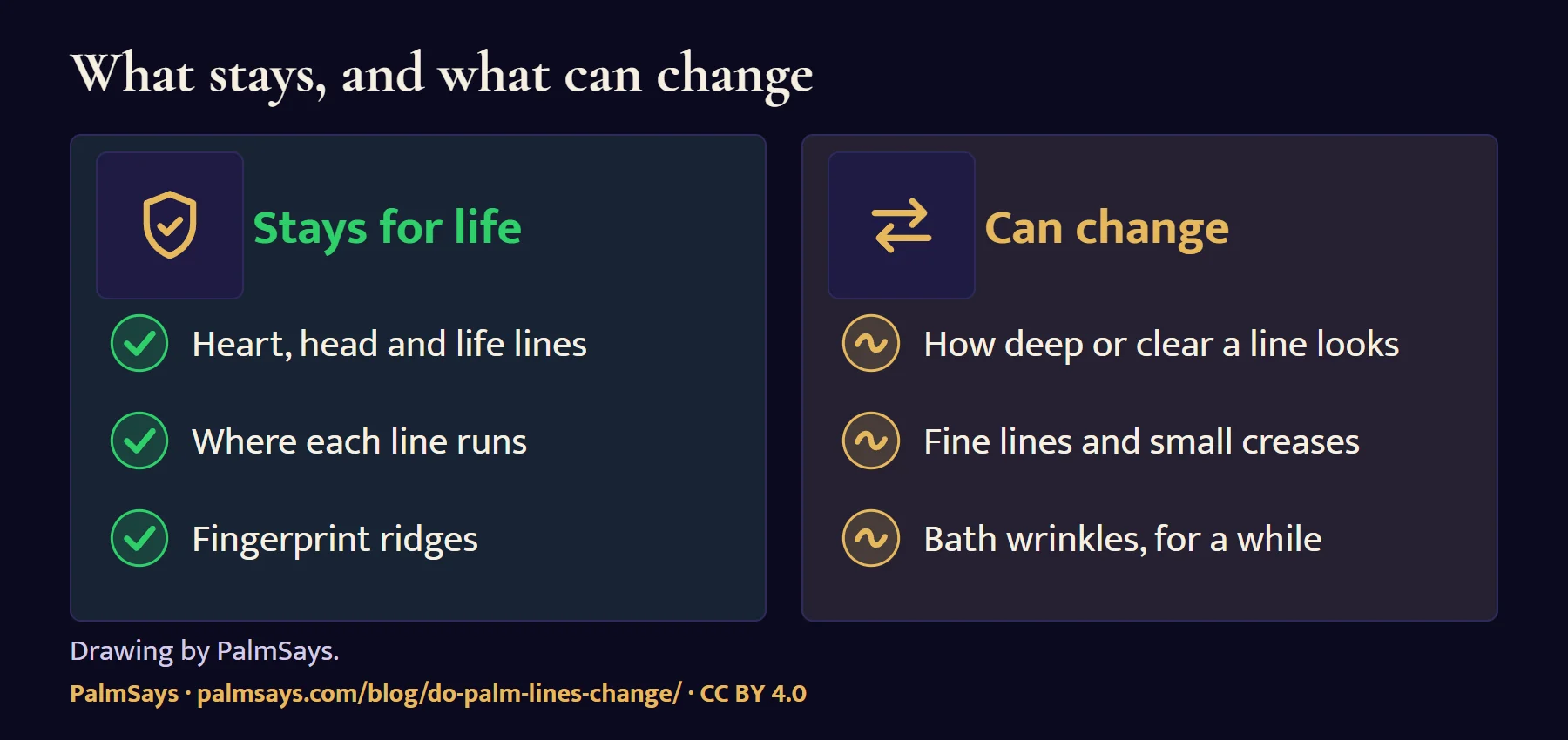
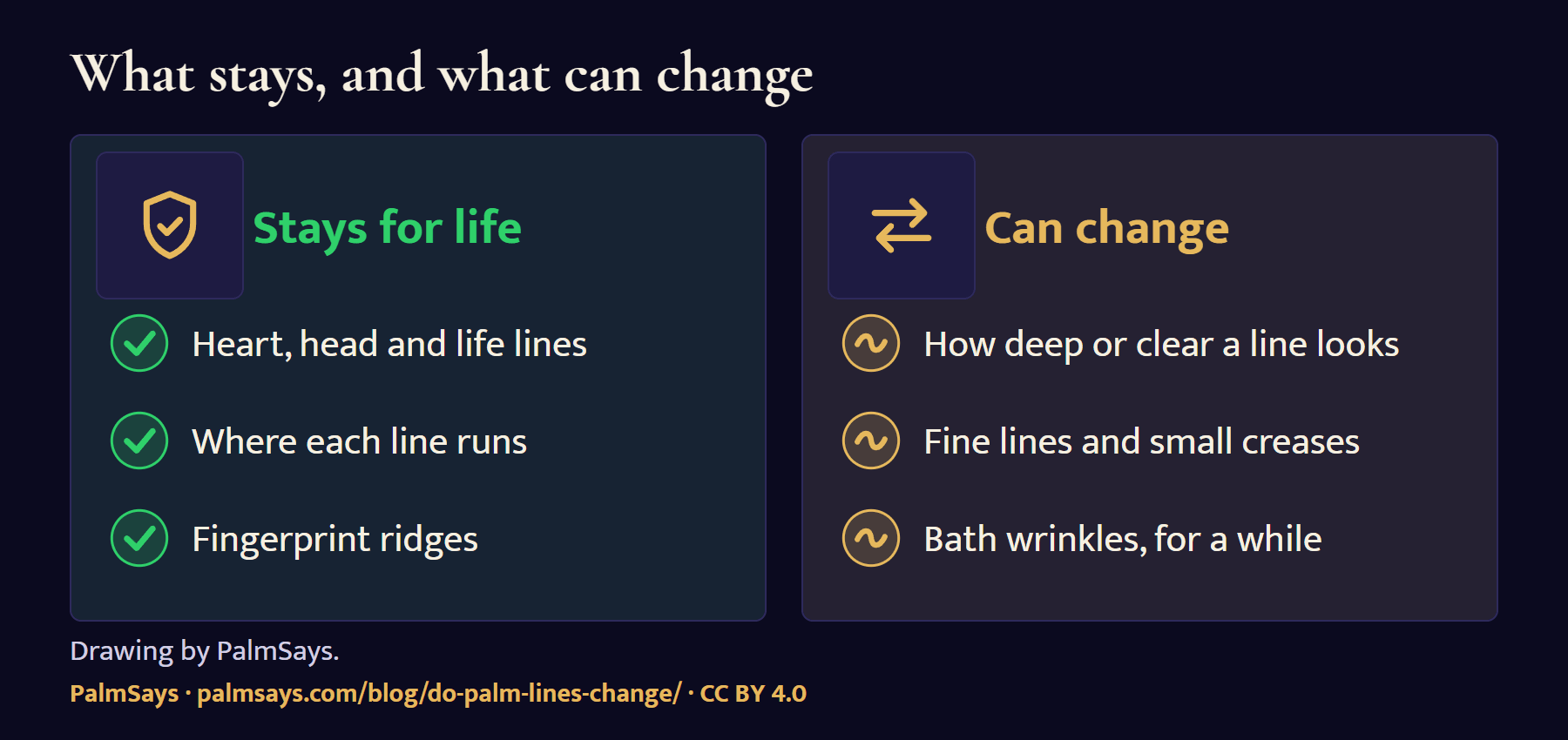
| Part of the palm | Does it change? | Why |
|---|---|---|
| Heart, head and life lines | No, they stay in place | Formed before birth (Stevens, 1988; Kimura, 1986) |
| Their depth and clarity | Can look different | Skin thickness, dryness and age |
| Fine lines and small creases | Can come and go | Ageing skin, dryness, water |
| Wrinkles after a long bath | Yes, for a while | An active nerve response (Kareklas, 2013) |
| Ridge patterns (fingerprints) | No | A separate skin feature |
The bath wrinkles are a good example of a short-lived change. A 2013 study notes that when hands stay in water, the skin wrinkles through an active process controlled by the nervous system. The wrinkles fade, and the palm lines underneath stay the same.
Reuse this image
Free to reuse under CC BY 4.0 with credit to PalmSays (palmsays.com). Full-size diagram (PNG, 1800 × 850)
What do palmistry books say about lines changing?
The old books say lines do change, and they built a reading on it. These are their claims, not measured facts.
Cheiro (Cheiro’s Language of the Hand, 1900) compared both hands. He held that the hand you use most records how you develop, and wrote that “some people change so completely that hardly two lines are alike on both hands”. In Palmistry for All (1916) he adds that two hands that are exactly alike show someone who has changed little from what they were born with.
William Benham (The Laws of Scientific Hand Reading, 1900) tells of a hand he saw with no head line. When he went back about a year later to take a print, a head line had appeared. He gives no photo or print to show it.
This is where the which hand to read tradition comes from. Palmists read the writing hand as the life you are making, and the other hand as what you started with. Science gives no support for the idea that lines track your choices. The is palmistry real page looks at that evidence.
Why do photos of the same palm look different?
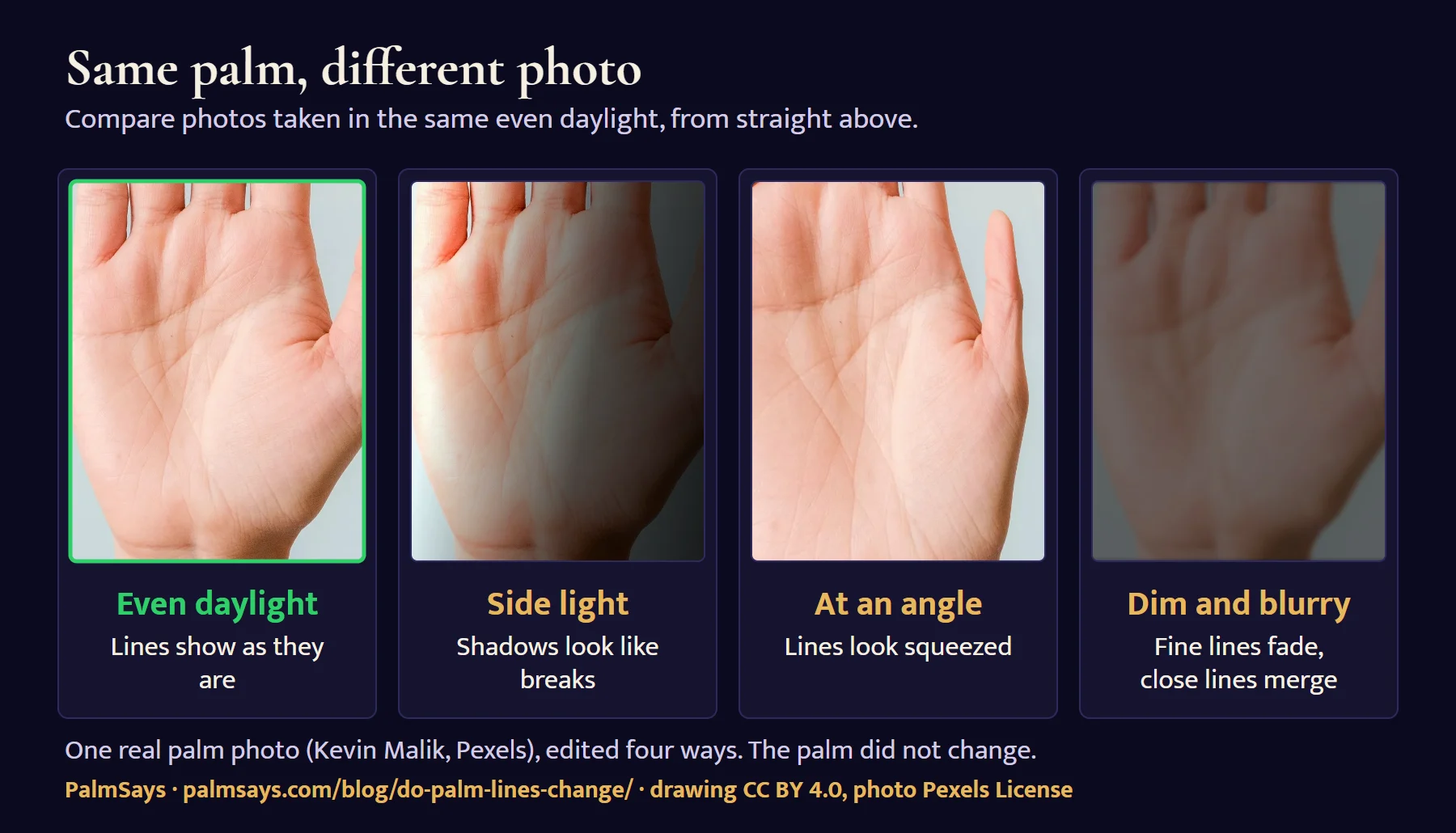
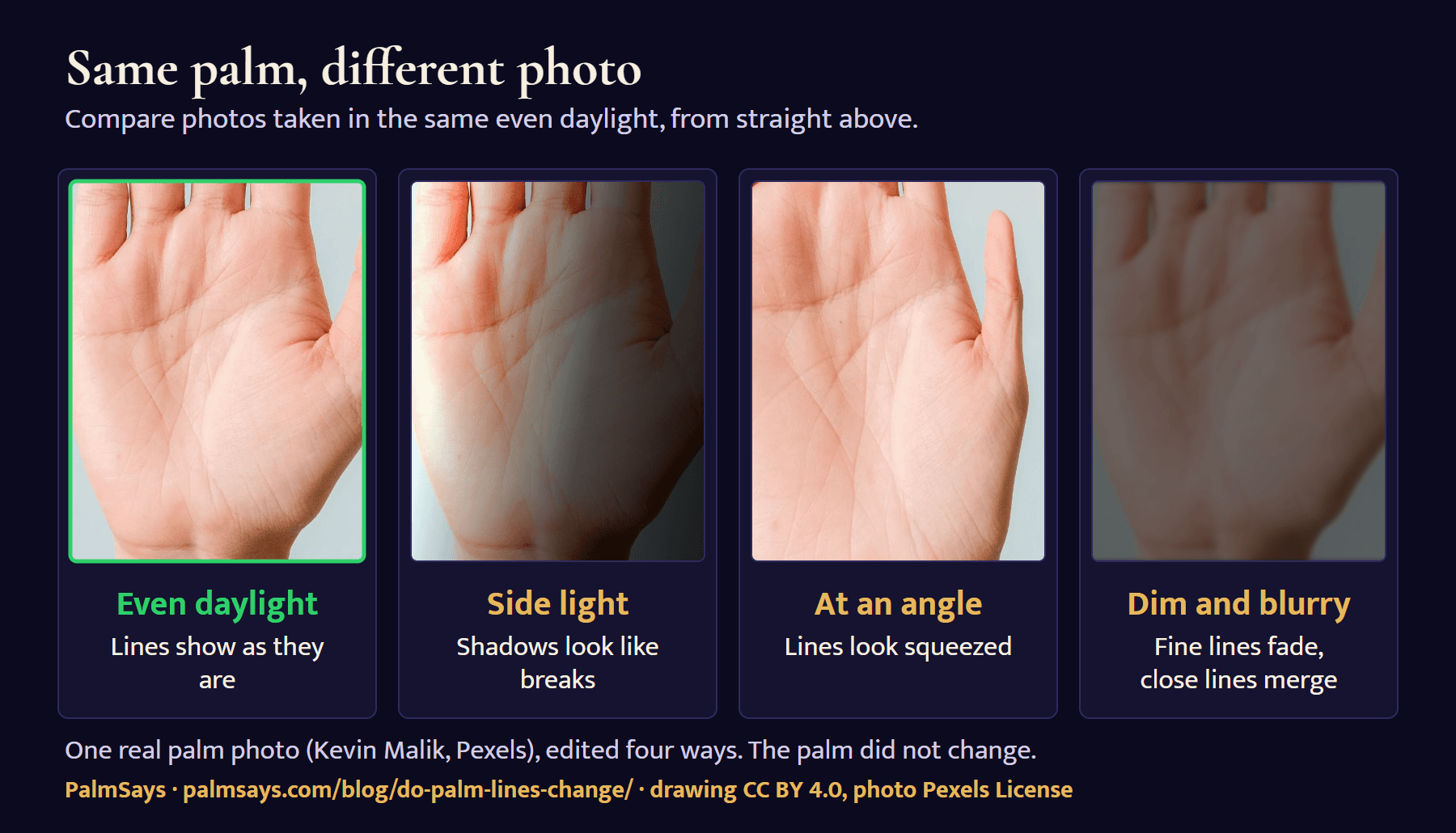
Because a camera records light and shadow, not the crease itself. Most “my lines changed” worries start with two photos taken in different conditions:
- Side light throws shadows that look like breaks, forks or extra lines.
- A bent or cupped hand deepens some creases and hides others.
- A stretched hand flattens fine lines until they almost vanish.
- Distance and blur merge two close lines into one.
- Dry or damp skin changes how much the fine lines show.
- Dim light hides the fine lines first.
- An angled photo squeezes the palm, so lines look shorter and closer together.
Reuse this image
Free to reuse under CC BY 4.0 with credit to PalmSays (palmsays.com). Full-size diagram (PNG, 1800 × 1030)
To compare fairly, photograph the same hand in the same even daylight, open flat, from straight above. Then compare the two photos side by side.

Can a palm scanner tell if your lines changed?
Not reliably, and ours doesn’t try. The PalmSays app traces the heart, head, life and fate lines on each photo you take. Two scans of the same hand can trace a line a little differently, because the light and angle differ.
So the app never says a line has grown or shrunk. When a line isn’t clear in a photo, it says so instead of guessing. Small marks such as islands, crosses and stars are too fine for most phone cameras, so they stay out of the reading.
So, do palm lines change?
The major lines don’t. They form between about 8 and 13 weeks of pregnancy and stay in place for life. The fine lines, the skin around them and your photos all change, which is why a palm can look different from year to year. For what each major line is read for, start with the lines on your palm.
Questions people ask
Can palm lines change with age?
The major lines stay where they formed before birth. With age the skin gets thinner and more lined, so you may see more fine creases, and some lines can look deeper or fainter.
Can new lines appear on your palm?
Fine surface lines can appear, especially with age or dry skin. No study shows a new major line growing in an adult hand. The old palmists said new lines appear, but that is their claim, not a measured fact.
Why do my palm lines look different in two photos?
Light, angle and how far you stretch your hand change what a camera sees. Side light makes shadows that look like breaks. Take both photos in the same even daylight before you compare them.
Do palm lines change when you lose or gain weight?
We found no study that measures this, so we can’t say. What we know is that the major creases form before birth and stay in the same places.
Does the left hand change and the right hand stay the same?
That is a palmistry idea, not a measured fact. Cheiro read the writing hand as the one that changes with your life. Both hands keep their main creases from before birth.
Sources (8 books and studies)
- S. Kimura and T. Kitagawa (1986). Embryological development of human palmar, plantar, and digital flexion creases. The Anatomical Record, 216(2), 191–197.
- C. A. Stevens, J. C. Carey, M. Shah and G. P. Bagley (1988). Development of human palmar and digital flexion creases. The Journal of Pediatrics, 113(1), 128–132.
- D. G. Belay, M. G. Worku, M. A. Dessie, Y. Asmare and M. Taye (2022). Prevalence of palmar crease patterns and associated factors among students at University of Gondar, Northwest Ethiopia. Anatomy & Cell Biology, 55(2), 161–169.
- MedlinePlus, U.S. National Library of Medicine (2024). Aging changes in skin. MedlinePlus Medical Encyclopedia (reviewed July 2024).
- K. Kareklas, D. Nettle and T. V. Smulders (2013). Water-induced finger wrinkles improve handling of wet objects. Biology Letters, 9(2), 20120999.
- Cheiro, Cheiro’s Language of the Hand (1900). Part II, ch. IV: The Right and Left Hands, pp. 77–78.
- Cheiro, Palmistry for All (1916). Part I, ch. XVII: Different Classes of Lines and Right and Left Hands.
- William G. Benham, The Laws of Scientific Hand Reading (1900). Part II, ch. V: The Line of Heart, p. 387 (a head line that appeared within about a year). (facts only) Rights unknown: facts only, in our words.
Meanings on this page are written in our own words from these books. Books whose rights are unclear are used for facts only, never quoted. How we choose sources
See your own lines
Upload one photo of your palm. We trace your lines and show what palmistry says about each one.
- Open palm
- Good light
- Whole hand in the frame
A phone photo shows the main lines and their breaks, forks and branches. Tiny marks such as stars and crosses are too small, so an honest reading leaves them out.
Our Android app is coming soon, with 2 free readings. The scan on this website opens soon too.
Coming soon on Google Play. The Android app is not on Google Play yet. This page will get the link the day it is.
The iPhone app isn’t ready yet. You can keep using this website.
PalmSays is currently listed as Palm Read AI on Google Play. It is the same app.
Or see what the PalmSays palm reading app reads before you install it.
Keep reading
AI readings
Can ChatGPT read your palm?
Palm lines
What are the rarest palm lines?



Guides on this topic:Lines on your palmIs palmistry true?Which hand to readPalm photo checkerAll blog posts