Palm lines
What are the rarest palm lines?
Quick answer
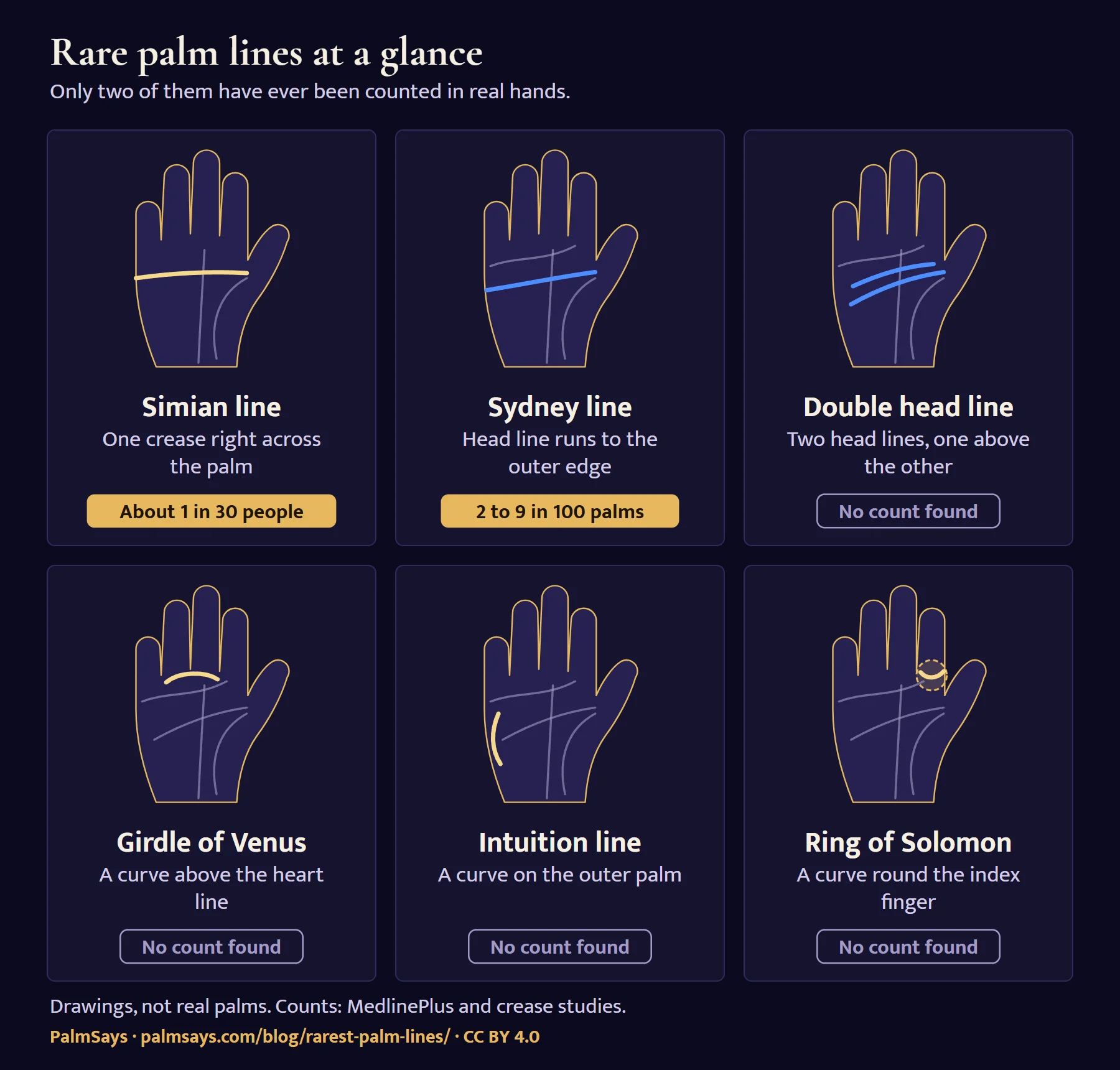
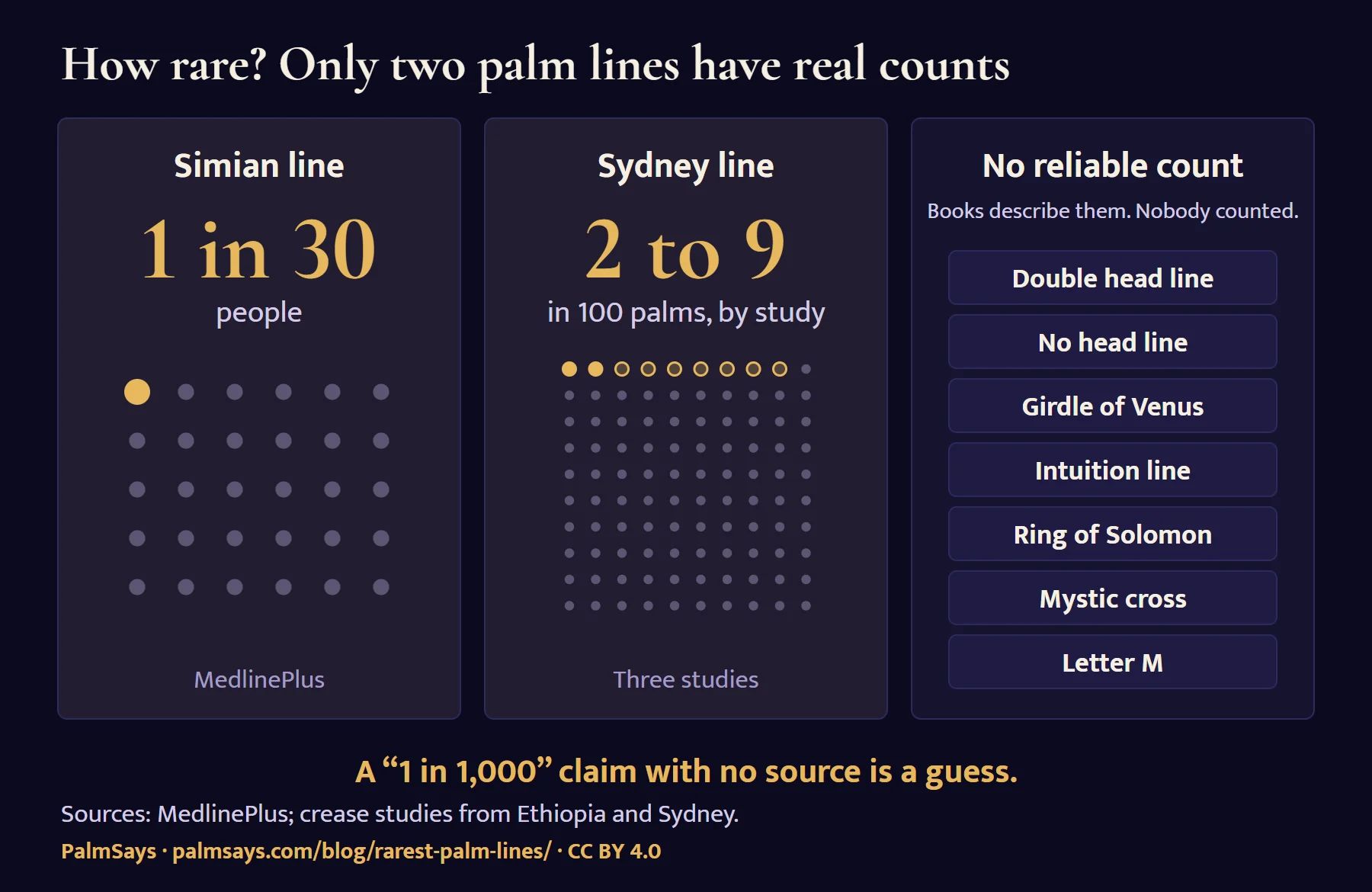
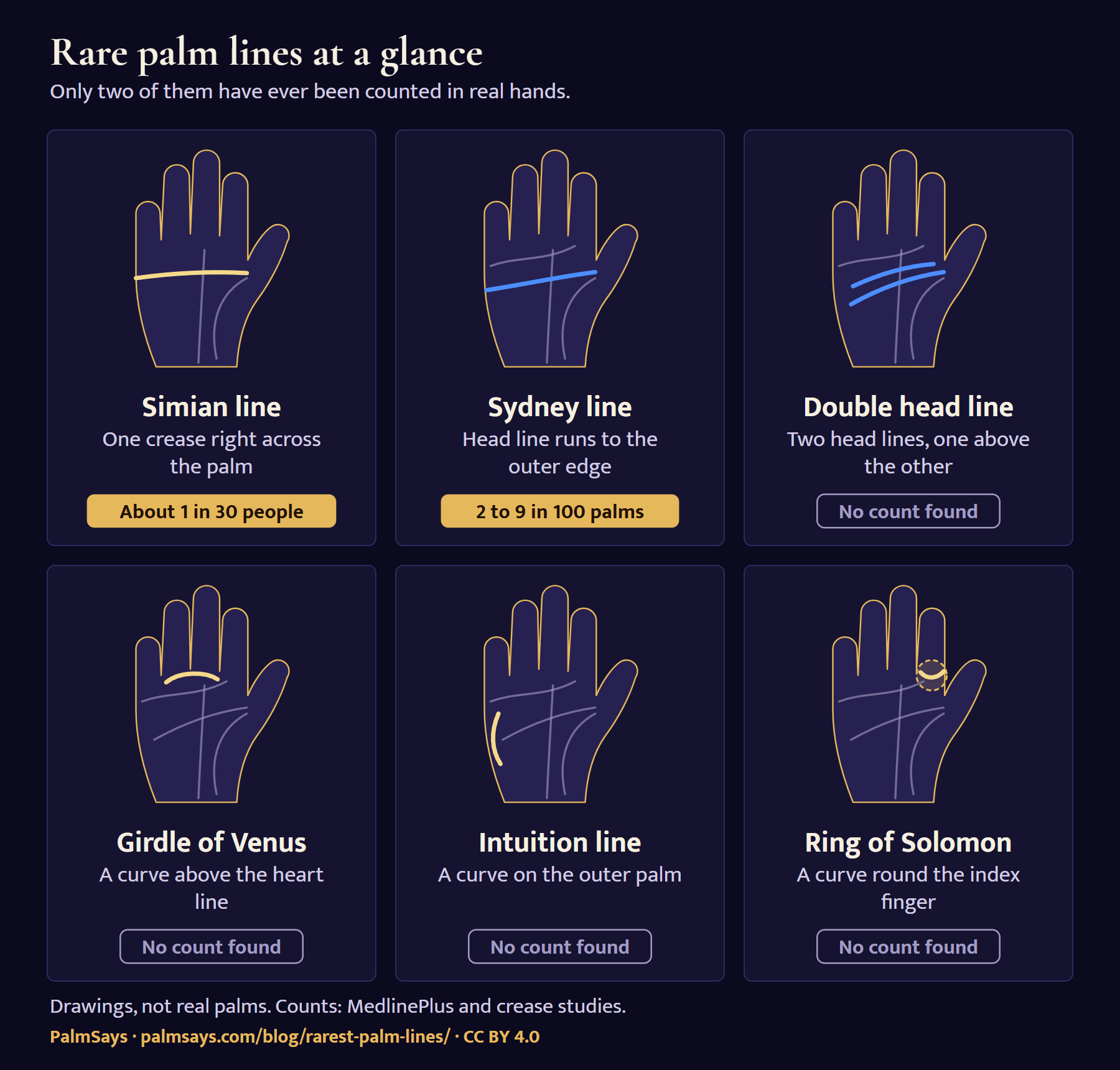
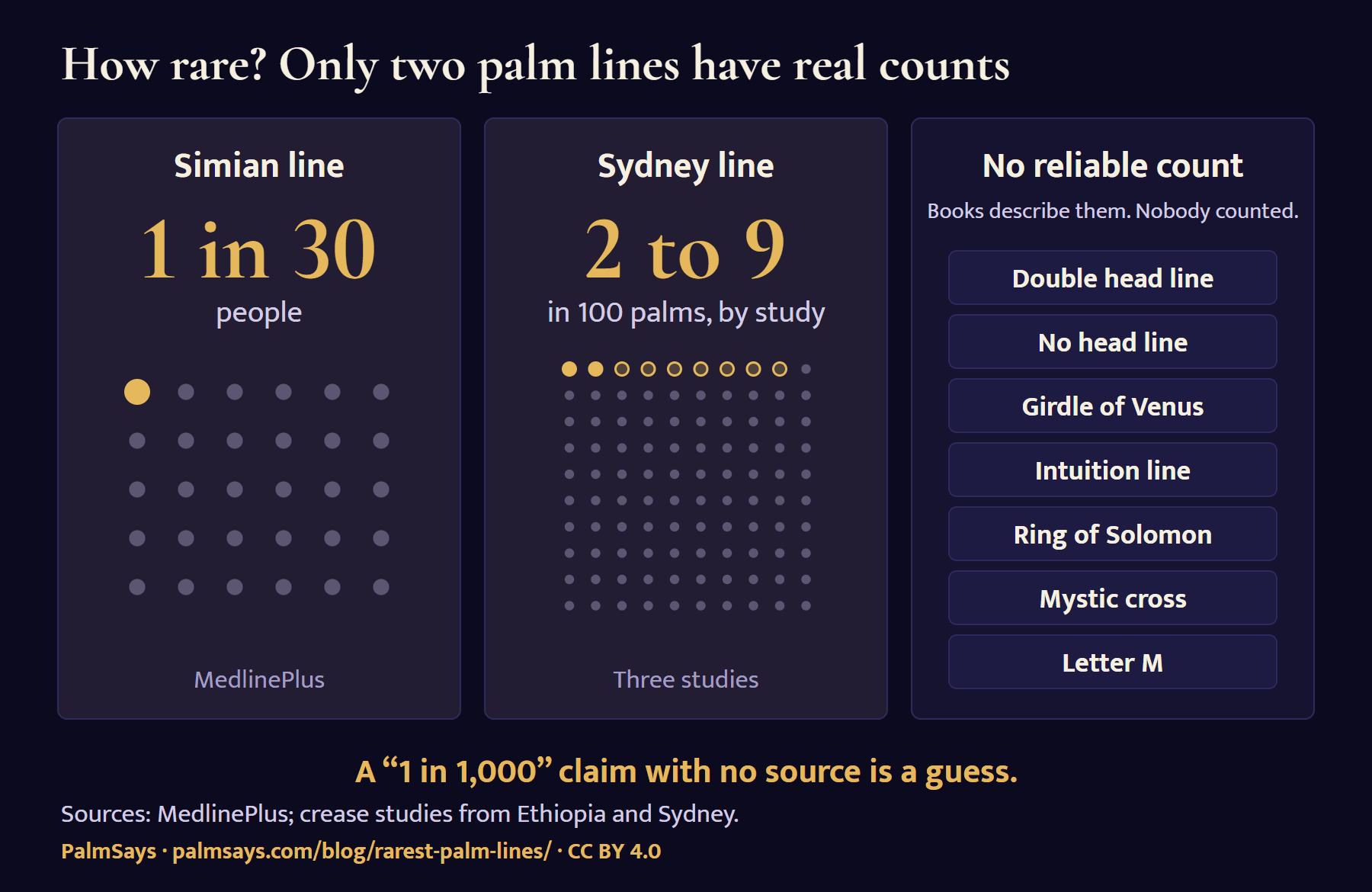
No study ranks palm lines by rarity. Two unusual creases have measured figures: the simian line, in about 1 in 30 people, and the Sydney line, in 2 to 9 of 100 palms. Other rare lines have no count.
Key takeaways
- No study ranks palm lines by how rare they are.
- The simian line appears in about 1 in 30 people.
- The Sydney line shows up on 2 to 9 of 100 palms.
- Other rare lines have no published count, so treat rarity claims as guesses.
Reuse this image
Free to reuse under CC BY 4.0 with credit to PalmSays (palmsays.com). Full-size diagram (PNG, 1800 × 1720)
On this page11 sections
Which palm lines are rare?
Only two unusual creases have been counted in real hands: the simian line and the Sydney line. For every other “rare” line, the old palmistry books describe it but never count it. This table sorts what is known from what is only said.
| Line or mark | Where it sits | How common | Our guide |
|---|---|---|---|
| Simian line | One crease right across the palm | About 1 in 30 people (MedlinePlus) | Simian line |
| Sydney line | Head line running to the palm’s outer edge | 2 to 9 of 100 palms, by study | This post |
| Double head line | Two head lines, one above the other | No figure; Cheiro: as rare as the simian line | Double head line |
| No head line | No line across the middle | No figure; Benham saw it once | This post |
| Girdle of Venus | A curve above the heart line | No figure | Girdle of Venus |
| Intuition line | A curve on the outer palm | No figure | Intuition line |
| Ring of Solomon | A curve round the index finger’s base | No figure | Ring of Solomon |
| Mystic cross | A small X between heart and head lines | No figure | Mystic cross |
| Letter M | Made by the four major lines | No figure | M on the palm |
“No figure” means we found no study and no book that counts it. Lists online that call a line “1 in 1,000” give no source, so we don’t repeat them.
Is the simian line rare?
It is unusual, not rare. A simian line is one straight crease across the palm in place of separate heart and head lines. MedlinePlus, the US National Library of Medicine’s encyclopedia, says it appears in about 1 in 30 people, and that males are twice as likely as females to have it.
Single studies give other numbers, because they count palms, not people, and look at one group. A 2019 study of 636 palms of students in Addis Ababa found it on 6.3% of them. That spread is normal for crease studies.
A simian line is usually a normal variation. On its own it is not a diagnosis, and doctors look at it only together with many other signs. For any worry, see a doctor. The simian line guide gives the medical facts first, then what the books read.
What is a Sydney line?
A Sydney line is a head line that runs all the way across the palm to its outer edge, while the heart line above it looks normal. Doctors first described it in Sydney, Australia, in 1968, which is how it got its name. It is a medical name, so the classical palmistry books don’t use it.
It has been counted, and the numbers vary by group:
- 1.9% of palms in a 2022 study of 1,664 palms at the University of Gondar, Ethiopia.
- 3.5% of palms in the 2019 Addis Ababa study.
- 9% in an earlier study in Sydney, as the 2022 paper reports it.
Doctors noted it in studies of some conditions, such as Down syndrome. But it also turns up in healthy students in these studies, so a crease by itself says nothing about your health. A palmist would read it as a very long head line.
Is a double head line rare?
It is uncommon, and nobody has counted it. A double head line is two separate head lines across the middle of the palm, one above the other. Cheiro’s Palmistry for All (1916) only says it is “as rarely found” as one line right across the hand.
He reads it as a mind with two sides, able to carry a great deal of mental work. Don’t confuse it with a fork, where one line splits at the end. The double head line guide shows how to tell them apart.
Can a palm have no head line or no heart line?
Yes, but a palm with no head line at all is the rarest form the books describe. William Benham (The Laws of Scientific Hand Reading, 1900) wrote that he had seen a head line missing only once. He saw many more hands without a heart line.
Before you decide a line is missing, check for one crease across the palm. Benham classed a single crease in the head line’s place as a head line, with the heart line absent. Most “missing” lines turn out to be a simian line, or a faint line hidden by poor light.
Which minor lines are uncommon?
Cheiro’s Palmistry for All names a set of smaller lines that many palms don’t show. He gives no counts for any of them. We give his readings in our own words, and leave out his harsh ones.
Girdle of Venus
A curved line above the heart line, often in broken pieces, from the base of the index finger round to the little finger. Cheiro reads a highly strung, imaginative nature. He says he never found it to mean the crude things other writers claimed.
Intuition line
A curve on the outer palm, from under the little finger down towards the mount of the Moon. Cheiro says it is seldom found outside a few hand types, and reads a sensitive, intuitive nature. He also credits it with dreams that come true; no line can foretell events.
Ring of Solomon
A small curve round the base of the index finger. Cheiro counts it among the marks of an interest in mysticism. In a photo it is easy to mistake for the creases at the finger’s base.
Double life line and double heart line
A second line running just inside the life line is the line of Mars, which Cheiro calls the inner life line: the double life line. Two heart lines side by side are also uncommon; the double heart line is read for a capacity for deep affection.
Cheiro also names a ring of Saturn under the middle finger and calls it “very seldom found”. His reading of it is a forecast of harm, so we don’t repeat it.
Are the mystic cross and the M on the palm rare?
Nobody knows. No book and no study we could find counts either one.
The mystic cross is a small X between the heart and head lines, usually under the middle finger. Cheiro reads it as an interest in mysticism, not a power. The M is made by the heart, head, life and fate lines meeting, so it is not a separate line at all. The M on the palm guide shows why some hands show a full M and others don’t.
Why do rare-line lists online disagree?
Because almost none of them cite a count. Three things make the claims spread:
- The books describe, they don’t count. Cheiro and Benham wrote from their own hand readings, with words like “seldom” and “rarely”.
- Studies count palms in one group. The Sydney line ranges from about 2 to 9 in 100 palms, depending on who was studied.
- Photos mislead. Side light, a bent palm or a shadow can make one line look like two, or hide a faint one.
Reuse this image
Free to reuse under CC BY 4.0 with credit to PalmSays (palmsays.com). Full-size diagram (PNG, 1800 × 1170)
So treat any “only 1% of people have this line” claim as a guess unless it names its study.
Does PalmSays read rare lines?
No. The PalmSays app traces the heart, head, life and fate lines on your photo and measures your hand type and fingers. It has no rules for the simian line, the Sydney line or the minor lines above, and it marks a line it can’t see clearly instead of guessing. For a rare line, your own eyes in daylight are the best check, with the lines on your palm guide beside you.
Questions people ask
What is the rarest line on the palm?
No study ranks them. In the old books, a palm with no head line at all is the rarest form: Benham wrote that he saw it only once. Among lines that have been counted, the Sydney line and the simian line are the unusual ones.
Is a simian line rare?
Not very. MedlinePlus puts it at about 1 in 30 people. It is usually a normal variation and, on its own, not a diagnosis. More in the simian line guide.
Do rare palm lines mean you are special?
No. The books read each line as a leaning in character, never as a special fate. A rare crease is a feature of your skin, and your choices matter more than any line.
Can a phone photo show rare lines?
The long ones, yes: a simian line, a Sydney line or a double head line show up in good light. Small marks such as a mystic cross are often too fine for a phone photo, so check them on your own hand in daylight.
Does the PalmSays app read rare lines?
No. The app traces the heart, head, life and fate lines and measures your hand type and fingers. It has no rules for the simian line, the Sydney line or the minor lines, and says so instead of guessing.
Sources (6 books and studies)
- MedlinePlus, U.S. National Library of Medicine (2025). Single palmar crease. MedlinePlus Medical Encyclopedia.
- Mekbeb Afework (2019). Prevalence of the different types of palmar creases among medical and dental students in Addis Ababa, Ethiopia. Ethiopian Journal of Health Sciences, 29(3), 391–400.
- D. G. Belay, M. G. Worku, M. A. Dessie, Y. Asmare and M. Taye (2022). Prevalence of palmar crease patterns and associated factors among students at University of Gondar, Northwest Ethiopia. Anatomy & Cell Biology, 55(2), 161–169.
- S. G. Purvis-Smith (1972). The Sydney line: a significant sign in Down’s syndrome. Australian Paediatric Journal, 8(4), 198–200.
- Cheiro, Palmistry for All (1916). Part I, ch. II: The Line of Head, Double Lines of Head, pp. 31–32; ch. XI: The Girdle of Venus, the Ring of Saturn, and the Bracelets; ch. XII: The Line of Intuition and the Via Lasciva; ch. XIII: La Croix Mystique, the Ring of Solomon.
- William G. Benham, The Laws of Scientific Hand Reading (1900). Part II, ch. V: The Line of Heart, p. 387 (a head line absent only once; many hands without a heart line). (facts only) Rights unknown: facts only, in our words.
Meanings on this page are written in our own words from these books. Books whose rights are unclear are used for facts only, never quoted. How we choose sources
See your own lines
Upload one photo of your palm. We trace your lines and show what palmistry says about each one.
- Open palm
- Good light
- Whole hand in the frame
A phone photo shows the main lines and their breaks, forks and branches. Tiny marks such as stars and crosses are too small, so an honest reading leaves them out.
Our Android app is coming soon, with 2 free readings. The scan on this website opens soon too.
Coming soon on Google Play. The Android app is not on Google Play yet. This page will get the link the day it is.
The iPhone app isn’t ready yet. You can keep using this website.
PalmSays is currently listed as Palm Read AI on Google Play. It is the same app.
Or see what the palm reading app for Android reads before you install it.
Keep reading
AI readings
Can ChatGPT read your palm?
Palm lines
Do palm lines change over time?


Guides on this topic:Lines on your palmSimian lineDouble head lineCrosses on the palmAll blog posts