Career palmistry: what your palm lines say about work
Career palmistry reads the hand for how you like to work. The books look at the fate line, the head line, the sun line, the mounts and the hand’s shape. They describe a working style; no line chooses your job.

A real palm photo (Kevin Malik, Pexels), traced by the real PalmSays scanner. Your reading is made from your own photo.
Which parts of your palm does career palmistry read?
Start with the line up the middle of your palm. Does yours run strong, faint, or not at all?
- Hold your hand up in good light, palm facing you.
- Find the fate line running up the middle towards your middle finger. Note where it starts and where it ends.
- Look at your head line: does it run straight across, or slope down towards the wrist?
- Then look at the shape of your hand: a square palm or a long one, short fingers or long ones.
Our Android app is coming soon, with 2 free readings. The scan on this website opens soon too.
On this page
- What is career palmistry?
- Which palm lines are read for career?
- What is the business line in palmistry?
- Does hand shape show the right job?
- Mounts and fingers in a career reading
- Can palmistry tell you which job to choose?
- Career palmistry for women and men
- Can a phone photo show your career lines?
- Check yourself: career palmistry quiz
- Myths about career palmistry
- Questions people ask
- Sources
What is career palmistry?
Career palmistry is the part of palm reading that looks at work. People call the fate line the career line, but the books read more than one line for work. They read several parts of the hand together, each for a side of how you work.
Cheiro gives the reason in his own words: “A single sign in itself only shows the tendency” (Cheiro’s Language of the Hand, 1900, Part II, ch. III). So a career reading is a set of prompts about your working style, not a job offer.
The PalmSays app works the same way. It reads your fate and head lines for how you approach work, as tendencies, and leaves out every promise the old books make.
Career palmistry describes how you like to work. It can’t choose your job, and palm lines don’t decide your income.
The lines career palmistry reads (drawings)
- Fate line
- Head line
- Sun line
- Mercury line
Drawings of the forms the books describe, not real palms.
Which palm lines are read for career?
What does your fate line say about work?
The fate line runs up the middle of the palm towards the middle finger. Cheiro writes that it relates to “the people who influence our career” and to our success or failure (ch. XI). The PalmSays app keeps the part about how you work:
Side by side, at one scale
- From the wrist
- From mid-palm
- From the outer edge
- To the ring finger
- No fate line
Drawings of the forms the books describe, not real palms.
| Your fate line | What it is read for at work |
|---|---|
| Runs straight up from the wrist | Responsibility that arrives early: a sense of duty to work that starts young |
| Starts in the middle of the palm | The self-made pattern: what you build comes from your own persistence |
| Rises from the outer edge, low down | A path shaped by other people: work where the public, patrons or partners matter |
| Rises from the ball of the thumb | Close relationships and strong feelings weigh on your choices about work |
| Ends under the index finger | Ambition that looks for a position of trust and leading others |
| Bends towards the ring finger | Effort drawn to visible, public-facing work, where being recognised matters |
| Ends under the little finger | Effort drawn to trade, business or skilled technical work |
| Deep and clear | A steady, routine-shaped working life |
| Broken | A working life that changes direction at least once |
| Two fate lines | Cheiro reads two careers, or two kinds of work at once |
| No fate line | Work that follows your choices and circumstances, not one fixed track |
A missing fate line is common and not a bad sign. Cheiro writes that people without one are “often very successful”, and Benham (1900) notes the line is absent in the hands of many successful people. Each form has its own card in fate line meaning.
What does your head line say about work?
The head line is read for how you think, and so for the kind of work that suits your mind. Cheiro’s Language of the Hand reads it like this:
- Straight across the palm: practical common sense, a mind that likes concrete things and carries a decision through.
- Sloping gently down: imaginative work, such as music, painting, writing or invention.
- Ending under the little finger: a mind drawn to commerce and science, with a growing interest in what money is worth.
- Starting apart from the life line and running straight to the outer edge: a natural organiser, drawn to lead shared efforts.
Cheiro also reads a forked end on the outer palm as a gift for writing. The head line meaning guide has every form, with a drawing of each.
What does your sun line say about work?
The sun line rises towards the ring finger. The app reads it as sensitivity to surroundings: beauty, order and atmosphere affect how well you work. A sun line that forks near the top is read as effort spread across more than one kind of work at once.
Older books called it the line of success and promised fame from it. We leave that out, as the app does. More in sun line meaning.
What is the business line in palmistry?
No classical book we use names a business line. We searched them for “business line”, “line of business” and “line of commerce”, and found none. The name is used loosely today, for different lines.
The books do have readings close to it, and they point to different places:
- Benham (1900) reads the Mercury line, which runs towards the little finger, as a guide to business. His reason is that it shows a clear head.
- Cheiro reads a branch of the head line rising towards the little finger as a bent for commerce or science.
- The PalmSays app reads a fate line that ends under the little finger as effort drawn to trade or business.
- Frith (1895) calls the little finger useful to business people, and Markun (1927) reads a long middle section of it the same way.
So if someone shows you your “business line”, ask which line they mean. The money line guide explains the same problem with another popular name.
Does hand shape show the right job?
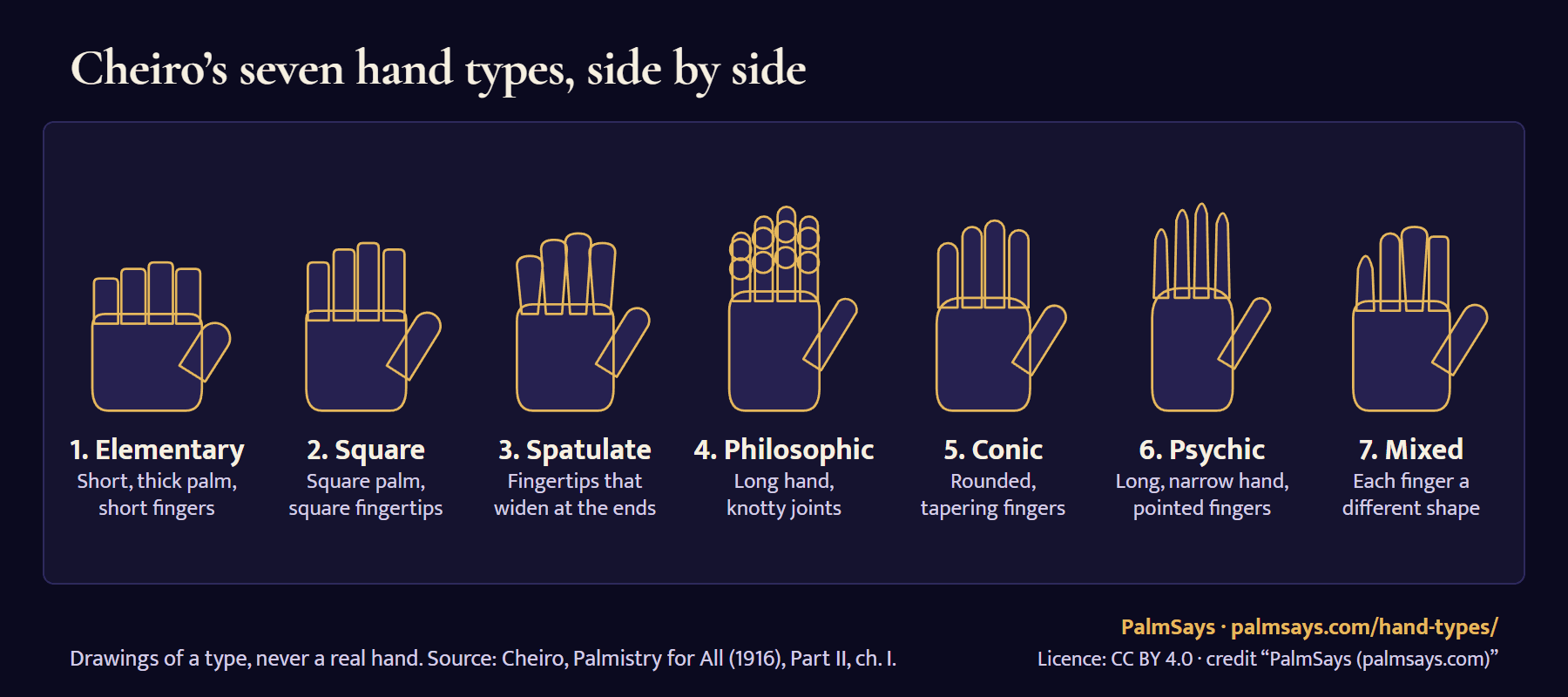
Not the job, but the old books did link hand shapes with kinds of work. Cheiro’s Palmistry for All (1916) and Cheiro’s Language of the Hand (1900) give these, in the language of their time:
| Hand type | How Cheiro describes it at work |
|---|---|
| Square | Practical and methodical; at home in work that needs proof more than imagination, such as business, law, medicine or science |
| Spatulate | Untiring energy and invention; he names explorers, engineers and mechanics |
| Philosophic | Studious and thoughtful, drawn to books and ideas |
| Conic | An artistic temperament, sensitive to colour and music |
| Mixed | Versatile, able to turn to many things |
Read these as hints about temperament, not a list of jobs: work has changed a great deal since 1916. Cheiro adds one useful point. The fate line is usually fainter on square and spatulate hands, so a faint fate line there is ordinary.
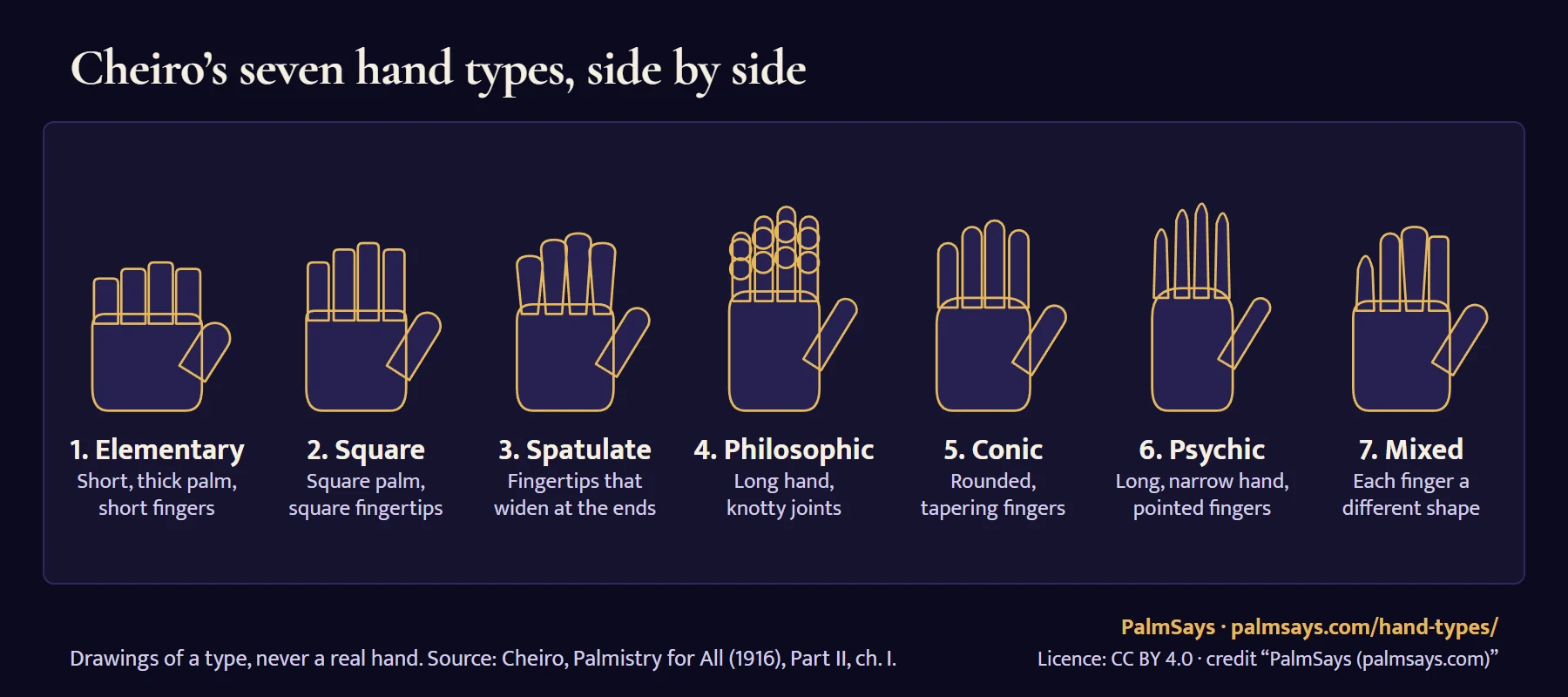
The hand types in palmistry guide explains each shape, and the photo tool below measures yours.

Mounts and fingers in a career reading
The pads under the fingers add detail. A full mount of Jupiter, under the index finger, is read for ambition and a wish to lead and organise. A full mount of Mercury, under the little finger, is read for quick wit and a flair for commerce and science. Cheiro’s 1916 list of Mercury types, from barristers to inventors, shows how the books turned this into jobs.
The little finger itself is read with its mount. Frith (1895) calls it the finger most useful to business people, and Markun (1927) reads a long middle section of it as a head for business. The palm mounts and fingers in palmistry guides cover both.
Can palmistry tell you which job to choose?
No. The old books also divide the fate line into seven-year periods and read dates of success from it (Palmistry for All, Part I, ch. XIX). We don’t: a crease can’t carry a date, and no line can say whether or when success will come.
Cheiro himself wrote that it is “purely a matter of the subject’s will” whether a tendency is overcome (Cheiro’s Language of the Hand, p. 74). So use a career reading as a set of questions you answer yourself:
- Do you work best with a steady routine, or with change?
- Do you like working alone, or in front of people?
- Are you drawn to practical work, or to work that runs on imagination?
Your answers, your skills and your chances decide your career. Your palm can only prompt the questions.
Career palmistry for women and men
The same lines are read the same way for everyone. Searches for “career in palmistry for women” or “job line in a female hand” lead to the same fate, head and sun lines, with the same readings. Some old books split their readings by sex; we don’t. What traditions differ on is which hand to read: see which hand to read.
Can a phone photo show your career lines?
Mostly. The fate and head lines usually show in a good photo, and the PalmSays scanner traces both; the app also measures your hand type from the photo. The sun and Mercury lines are finer and often missing, and the scanner doesn’t trace them. A faint fate line can vanish in flat light, so use bright, even daylight.
Check yourself: career palmistry quiz
Three quick questions. Pick an answer to see if you are right. New to palmistry? Start with how to read palm lines, or look up any word in the palmistry terms glossary.
Myths about career palmistry
- MythYour fate line shows which job you will have.
- Reality
The books read the fate line for how you approach work: early responsibility, your own effort, other people’s influence. None of them can name a job.
- MythNo fate line means no career.
- Reality
Cheiro wrote that people without a fate line are often very successful, and Benham saw the same. A missing fate line is common.
- MythA business line shows who will succeed in business.
- Reality
No classical book names a business line. The readings closest to it describe a bent for commerce, not an outcome.
Quick facts
- Hindi name
- करियर हस्तरेखा (career hast rekha). The fate line is भाग्य रेखा (bhagya rekha).
- Lines it reads
- The fate line first, then the head line and the sun line. Benham (1900) adds the Mercury line.
- Also read
- The mounts of Jupiter and Mercury, the little finger and the shape of the hand.
- What it can’t do
- Choose a job, promise success or a promotion, or give a date.
- Which hand
- Look at both. Tradition reads your writing hand as the life you are making. Which hand to read
- What the app reads
- The PalmSays app traces the fate and head lines and measures your hand type, and reads them for how you work. It doesn’t read the sun or Mercury line.
Questions people ask
Which line shows career in palmistry?
Mainly the fate line, which people also call the career line. The books add the head line, for how you think about work, and the sun line, for how you like your work to be seen.
What is the business line in palmistry?
No classical book we use names a business line. The name is given loosely to different lines today. The nearest older readings are Benham’s Mercury line, read as a guide to business, and a fate or head line that ends under the little finger.
Can palmistry predict my job or career success?
No. The books describe a working style: steady or changing, alone or with the public, practical or imaginative. Which job you do, and how it goes, depends on your choices, skills and chances.
What does no fate line mean for my career?
Nothing bad. Cheiro wrote that people without one are often very successful, and Benham noted the same. The app reads a missing fate line as work that follows your choices, not one fixed track.
Which hand is read for career?
Both. Tradition reads your writing hand as the life you are making and the other as what you started with. More in which hand to read.
Does the PalmSays app read career?
Its report has a part on career and money. The palm reading app reads it from your fate and head lines and hand type, as tendencies, never as a forecast of a job or an income.
Sources (5 books and studies)
- Cheiro, Cheiro’s Language of the Hand (1900). Part I, ch. IV: The Spatulate Hand, p. 32; Part II, ch. III: In Relation to the Lines, p. 74; ch. VII: The Line of Head, pp. 87–90; ch. XI: The Line of Fate, pp. 102–105.
- Cheiro, Palmistry for All (1916). Part I, ch. V: The Line of Destiny or Fate; ch. XIX: How to Tell Time; Part II, ch. I: Seven Types of Hands; ch. VII: The Mount of Jupiter; ch. X: The Mount of Mercury.
- Leo Markun, What You Should Know About Palmistry (1927). The section on the Fate Line; the little finger and its phalanges.
- William G. Benham, The Laws of Scientific Hand Reading (1900). Part II, ch. X: The Line of Saturn, pp. 531–535; ch. XII: The Line of Mercury, pp. 584–586. (facts only)
- Henry Frith, Practical Palmistry (1895). The Phalanges, p. 33 (the little finger and business).
Meanings on this page are written in our own words from these books. Books whose rights are unclear are used for facts only, never quoted. How we choose sources
See your own lines
Upload one photo of your palm. We trace your lines and show what palmistry says about each one.
- Open palm
- Good light
- Whole hand in the frame
A phone photo shows the main lines and their breaks, forks and branches. Tiny marks such as stars and crosses are too small, so an honest reading leaves them out.
Our Android app is coming soon, with 2 free readings. The scan on this website opens soon too.
Coming soon on Google Play. The Android app is not on Google Play yet. This page will get the link the day it is.
The iPhone app isn’t ready yet. You can keep using this website.
PalmSays is currently listed as Palm Read AI on Google Play. It is the same app.
Or see what the PalmSays palm reading app reads before you install it.