Palmistry and astrology
Palmistry vs astrology: what is the difference?
Quick answer
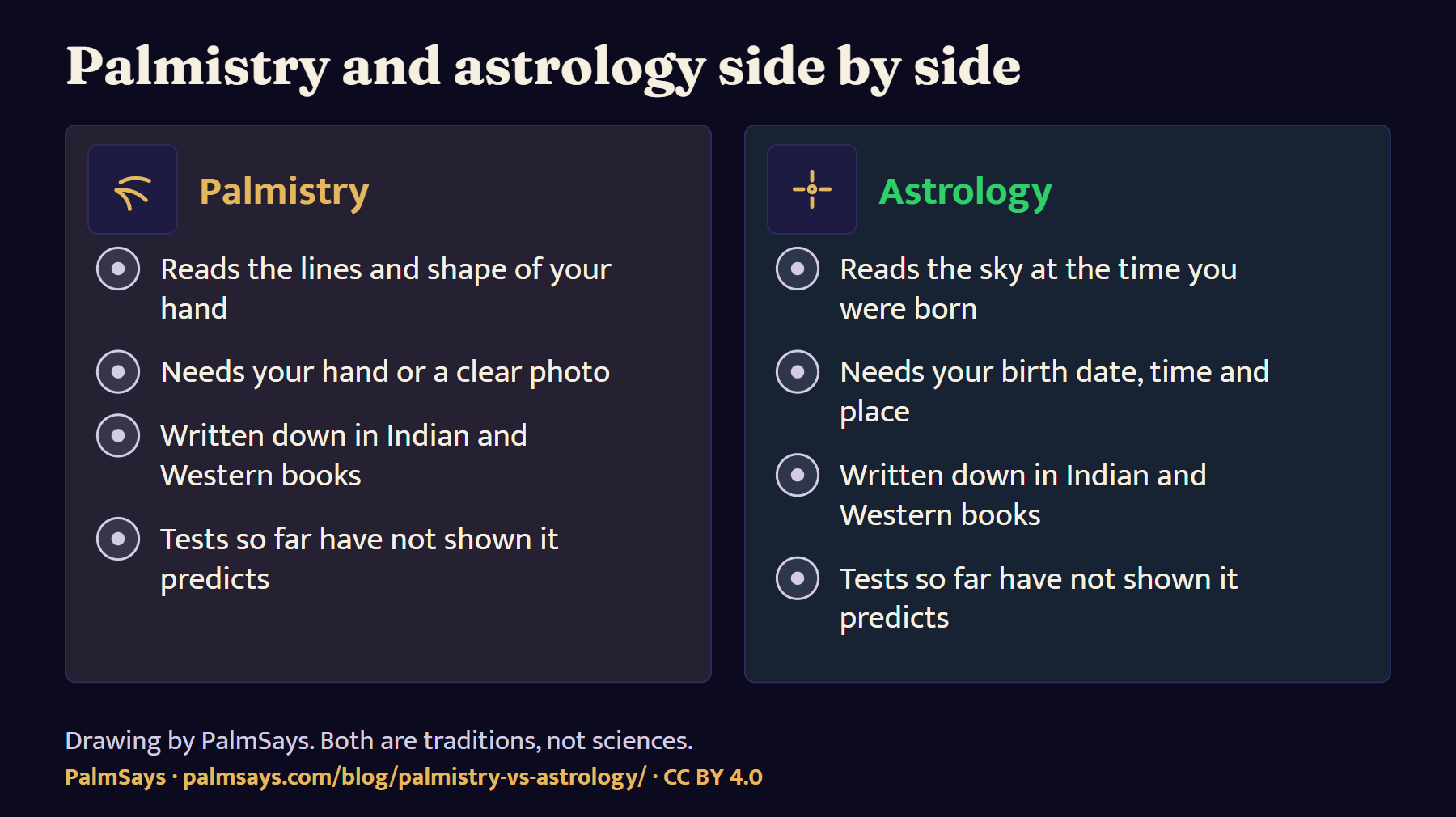
Palmistry reads the lines and shape of your hand. Astrology reads the position of the sky when you were born. They are separate traditions, though old books often mixed them. Tests so far have not shown either predicts.
The full guide: Is palmistry true?

Key takeaways
- Palmistry needs your hand. Astrology needs your birth date, time and place.
- Palmistry borrowed planet names for the mounts of the hand.
- Old palmists split over astrology, and Cheiro changed his own view.
- Neither one has been shown to predict your life in a fair test.
On this page7 sections
How are palmistry and astrology different?
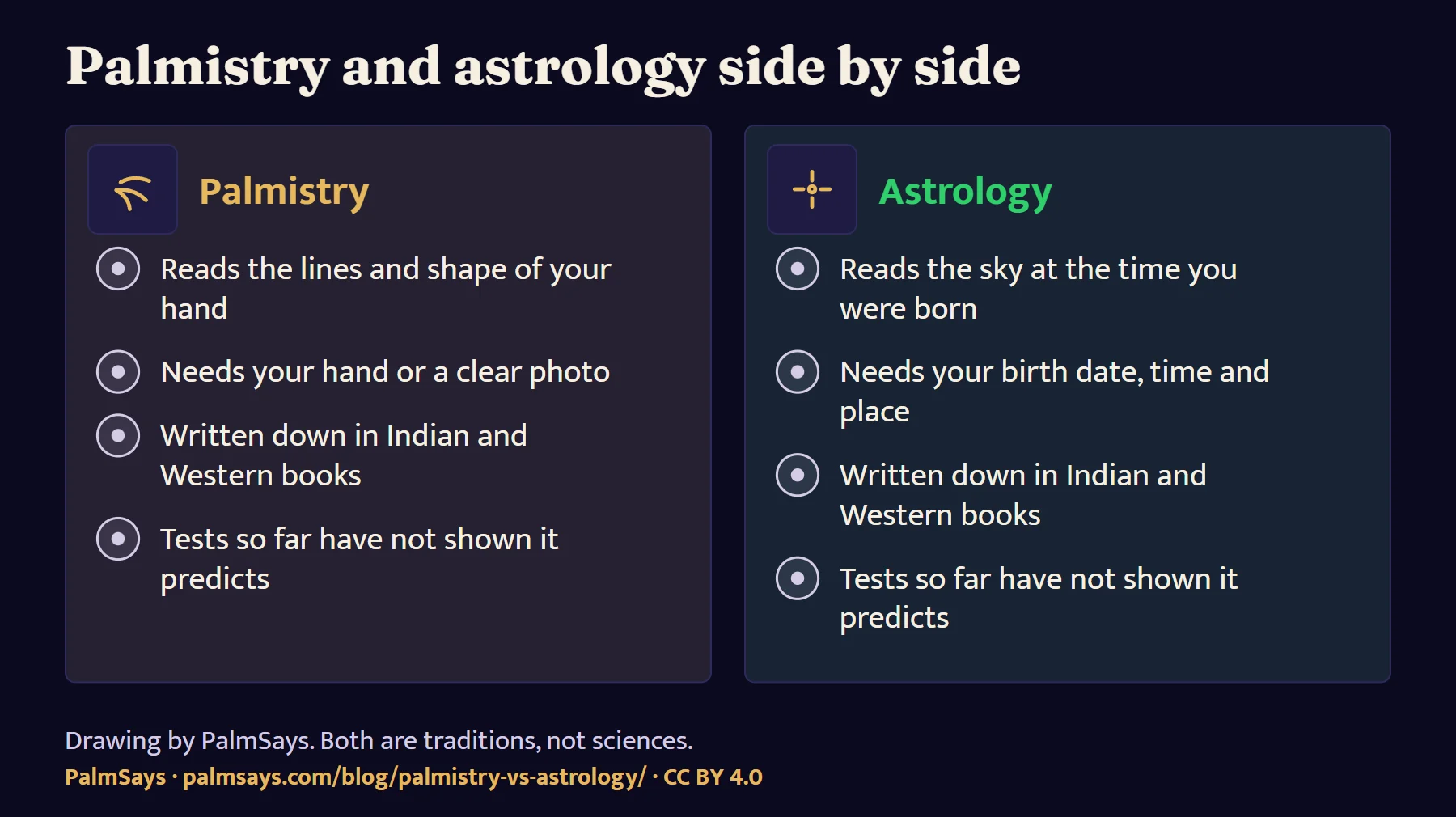
They look at different things and they need different things from you. Palmistry reads your hand. Astrology reads the position of the sun, moon and planets at the moment you were born.
| Palmistry | Astrology | |
|---|---|---|
| What it reads | Lines, mounts and hand shape | The sky at your birth |
| What it needs from you | Your hand, or a clear photo | Birth date, time and place |
| Who does it | A palmist | An astrologer |
| Hindi name | हस्तरेखा (hast rekha) | फलित ज्योतिष (phalit jyotish) |
| Can you check it yourself? | Yes, you can look at your own hand | You need a chart drawn first |
Words add to the confusion. People often say “astrologer” for anyone who tells fortunes, and in India a jyotishi may read your palm too. If you want the names straight, see what a palm reader is called.
Both are old traditions, and for many families they are part of religious and cultural life. This page describes what each one does and what the tests found. It doesn’t judge anyone’s faith.
Why does palmistry use planet names?
Because the old books named parts of the hand after the planets. The pads of your palm are called the mount of Jupiter, the mount of Saturn, and so on. Our guide to the palm mounts shows where each one sits.
So a palm reading can sound like astrology even when no chart is involved. Markun explains the history: “parts of the hand were given astrological names and held to be ruled by the various planets” (1927). A palmist using the word Saturn may only be naming a spot below your middle finger.
A planet name on your palm does not mean anyone has looked at the sky. Ask whether the reader is using your hand, your birth chart, or both.
Did the old palmists want astrology in palmistry?
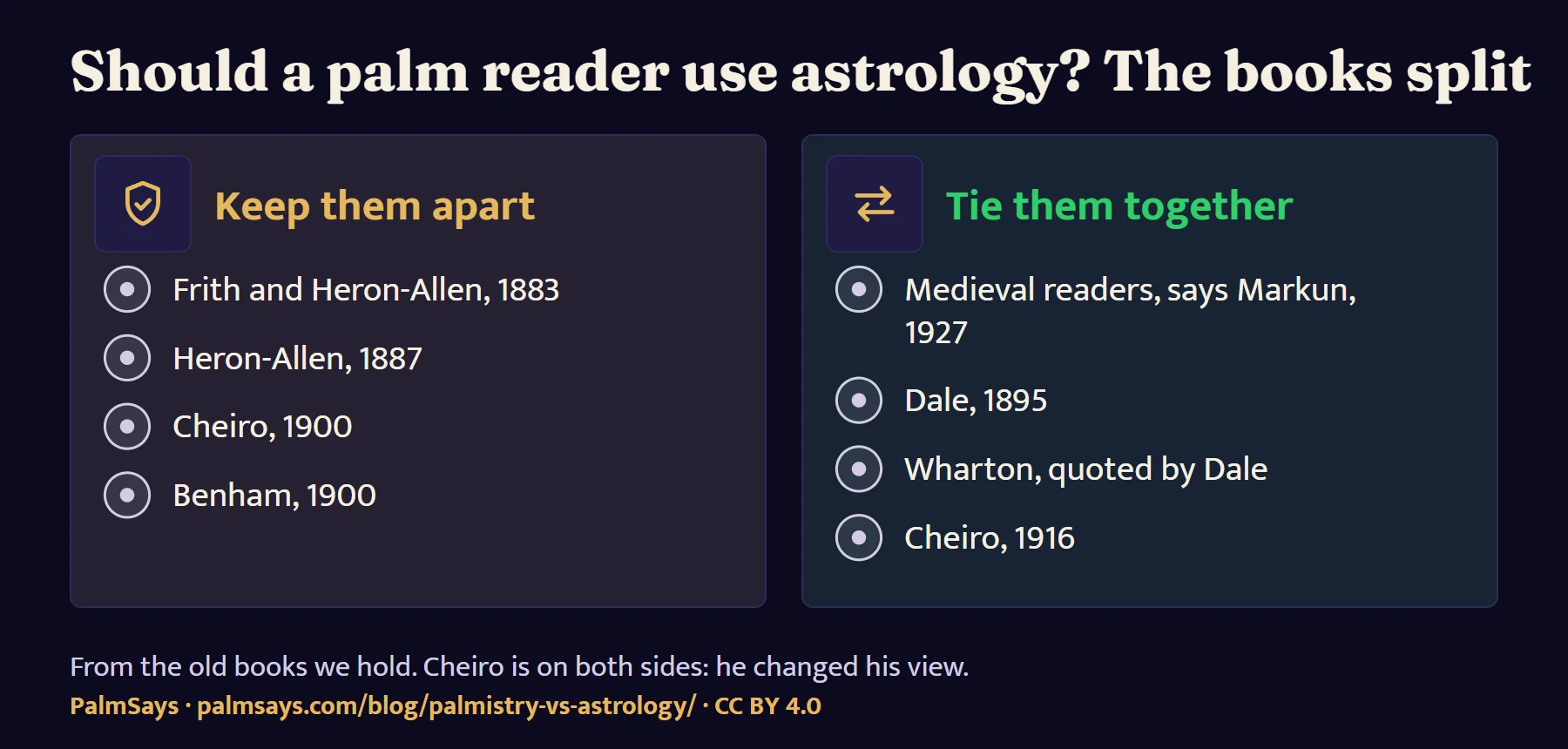
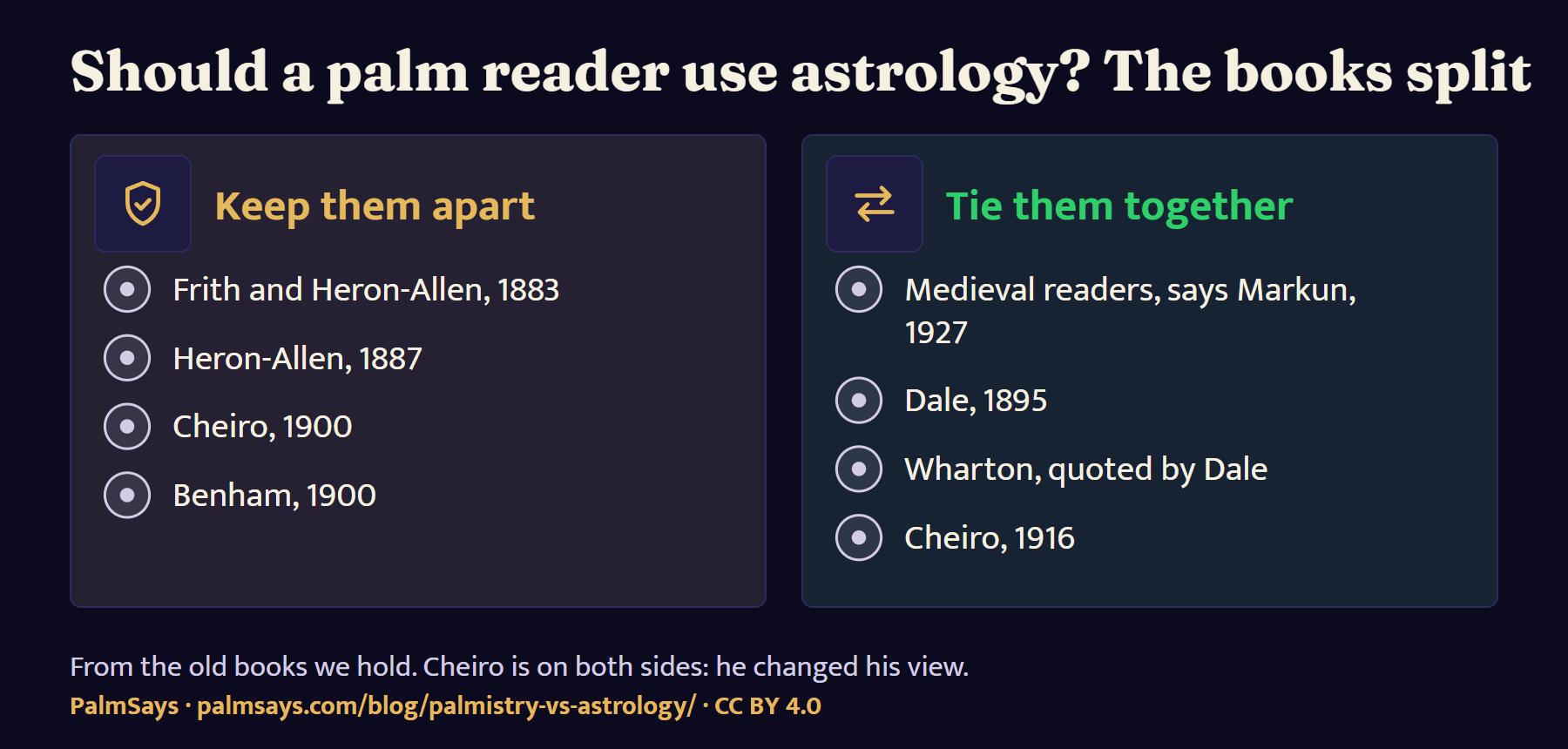
They split, and one famous writer changed sides. These are their positions, not measured facts.
| Book | Their position |
|---|---|
| Frith and Heron-Allen (1883) | “It must not be supposed that we mix astrology and suchlike charlatanism with our Science” |
| Heron-Allen (1887) | The names on the mounts “are not astrological” |
| Cheiro, Language of the Hand (1900) | Uses the names but not “in any sense in relation to what is known as Astrological Palmistry”. He does not deny a link |
| Benham (1900) | Uses the planet names without any astrological meaning |
| Dale, Indian Palmistry (1895) | “A knowledge of astrology will prove an acquisition to the study of palmistry” |
| Cheiro, Palmistry for All (1916) | Now writes of “the close relationship between the two sciences Astrology and Palmistry” |
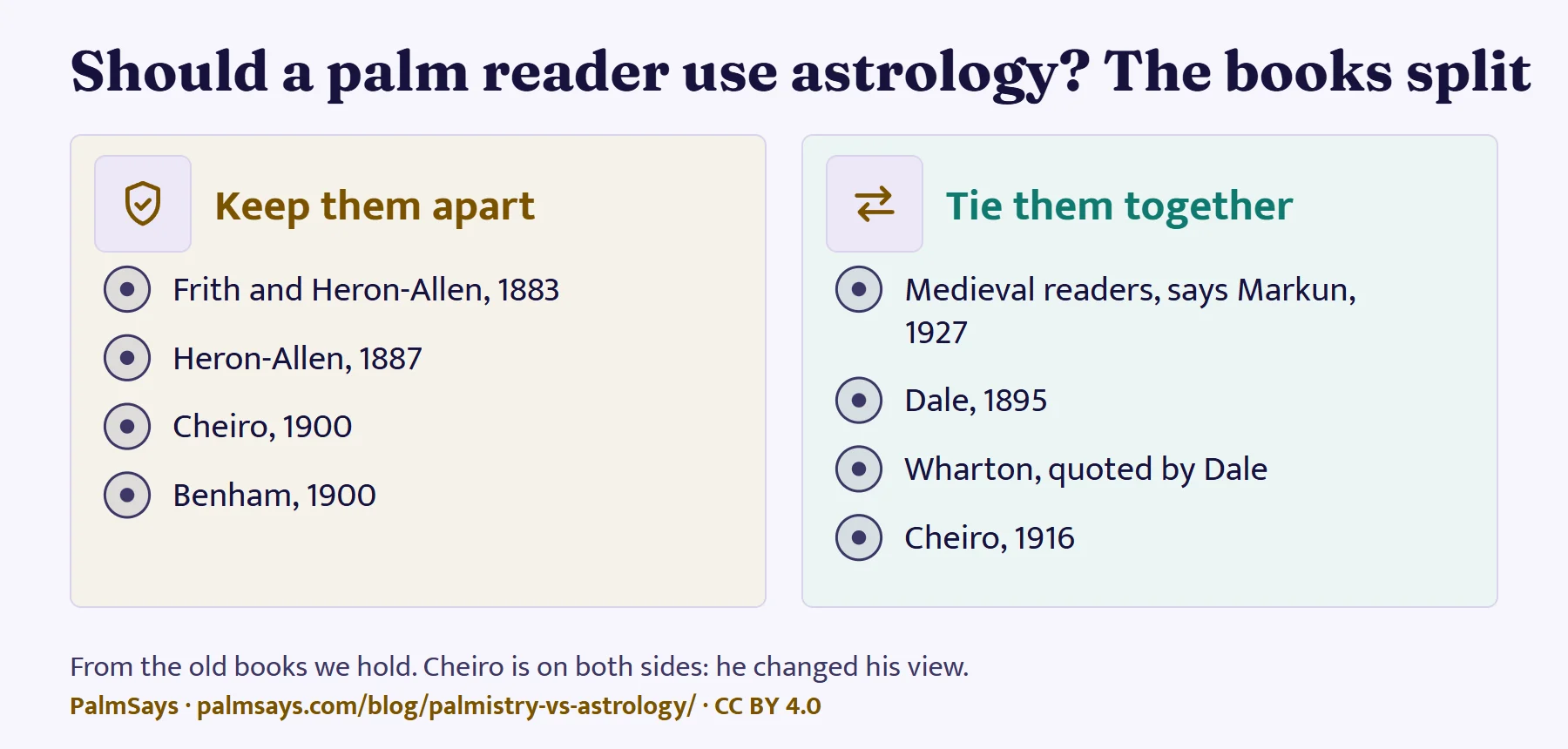
Dale’s book on Indian palmistry goes furthest. It says Geo. Wharton “clearly proves that palmistry can only act in accordance with astrology”. Frith, in 1895, sits in the middle, reporting some signs as “unable to vouch for, although Astrology confirms them”.
Markun was blunter than any of them, calling astrology a “pseudo-science” and saying the planet-name system “makes clear the flimsiness of the occult systems”.
Did you know?
- Cheiro stood on both sides. In 1900 he held his study of the hand to be “in every way complete in itself”. By 1916 he was linking the mounts of Mars to birth dates, such as 21 March to 21 April (Palmistry for All).
- Cheiro kept a door open. Even in 1900 he wrote that “there may be a connection” between the two. He only said he did not need it.
- A palmistry book against astrology. Markun’s 1927 book explains palm readings in detail, then calls astrology a pseudo-science and says following up the planet names is “of no practical value”.
Which is more reliable, palmistry or astrology?
If you searched for which one is more accurate, neither has been shown to predict your life. We found no test that compares the two directly, so nobody can fairly rank them. Each one has been tested on its own.
Astrology. In a double-blind test published in Nature in 1985, Shawn Carlson asked astrologers to match birth charts to personality profiles. He reported that they did no better than chance, and that the astrologers had agreed to the test design beforehand. Critics have since disputed parts of the analysis, so treat it as one test and not the final word.
Palmistry. The best-known tests look at the life line and lifespan. Wilson and Mather (1974) studied 51 people, and Lucas and colleagues (2019) studied 60 donors. Neither found the link palmistry claims. Our page on whether palmistry is real covers these tests and why palm readings can still feel true.
What should you check for yourself?
You can sort most of this out with a question or two.
- Ask what is being read. If a reader asks for your birth time, they are using astrology. That is fine if you know it.
- Look at your own hand. Find the pad under your index finger. Palmists call it the mount of Jupiter. Nothing about it needs a chart. The interactive palm map shows every mount with no photo.
- Ask for a source. A reader should be able to say which book or rule a meaning comes from.
PalmSays reads the hand. Our reading form has optional birth details, and those stay on your device. If you want to see your lines traced on your own photo, you can scan your palm. AI traces your lines; meanings come from a fixed rule set built from classical books.
Questions people ask
What is the difference between palmistry and astrology?
Palmistry reads your hand: its lines, mounts and shape. Astrology reads the sky at the moment you were born. One needs your hand, the other needs your birth date, time and place.
What is the difference between a palmist and an astrologer?
A palmist looks at your hand. An astrologer draws a chart from your birth details. Some people practise both, and in India the word jyotishi is often used loosely for both.
Which is more reliable, palmistry or astrology?
Neither has been shown to predict your life. We found no test that compares the two directly, so nobody can fairly rank them.
Is palmistry part of astrology?
Not by method. Palmistry reads the hand and needs no chart. But it borrowed planet names for the mounts, and some old books tie the two together.
Does a palm reading need my birth date?
A hand reading itself does not. If a reader asks for your birth details, they are adding astrology to it. That is worth knowing, so ask which one they are using.
Sources (11 books and studies)
- S. Carlson (1985). A double-blind test of astrology. Nature, 318, 419–425.
- M. E. Wilson and L. E. Mather (1974). Life expectancy (letter). JAMA, 229(11), 1421–1422.
- Lucas, Dhugga and Henneberg (2019). Predicting longevity from the line of life. Anthropological Review, 82(2), 155–162.
- Cheiro, Cheiro’s Language of the Hand (1900). Part I, on the mounts and their old names.
- Cheiro, Palmistry for All (1916). The closing chapters on the mounts as positive and negative.
- Frith & Heron-Allen, Chiromancy, or the Science of Palmistry (1883). The section on the mounts.
- Edward Heron-Allen, Practical Cheirosophy (1887). The section on the names of the mounts.
- Mrs J. B. Dale, Indian Palmistry (1895). Preface, and the closing section on astrology.
- Henry Frith, Practical Palmistry (1895). The section on the signs of the lines.
- Leo Markun, What You Should Know About Palmistry (1927). Opening history, and the section on the fingers and professions.
- William G. Benham, The Laws of Scientific Hand Reading (1900). Part I, on the names of the mounts.
Meanings on this page are written in our own words from these books. Books whose rights are unclear are used for facts only, never quoted. How we choose sources
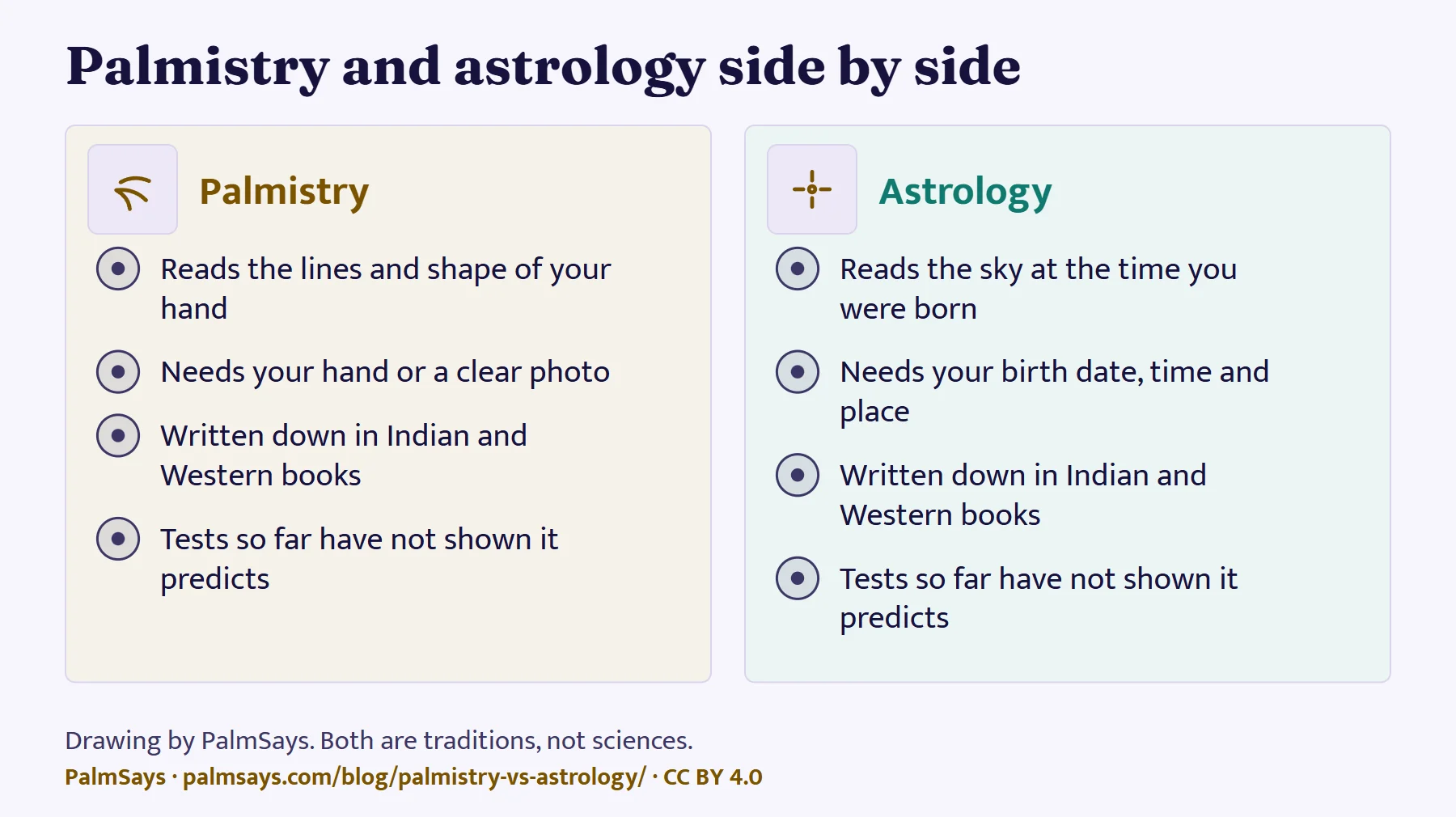
The diagrams in this post are free to reuse under CC BY 4.0 with credit to PalmSays (palmsays.com).Full-size diagram: Palmistry and astrology side by side (PNG, 1800 × 1010)Full-size diagram: Should a palm reader use astrology? The books split (PNG, 1800 × 860)
About the author
See your own lines
Upload one photo of your palm. We trace your lines and show what palmistry says about each one.
- Open palm
- Good light
- Whole hand in the frame
A phone photo shows the main lines and their breaks, forks and branches. Tiny marks such as stars and crosses are too small, so an honest reading leaves them out.
Coming soon on Google Play. The Android app is not on Google Play yet. This page will get the link the day it is.
The iPhone app isn’t ready yet. You can keep using this website.
Or see what the palm reading app for Android reads before you install it.
Keep reading
Palm beliefs
How do palm readers know so much about you?


Guides on this topic:Is palmistry true?Palm mountsHistory of palmistryHow to read palm linesAll blog posts