Palmistry words
What is a palm reader called?
Quick answer
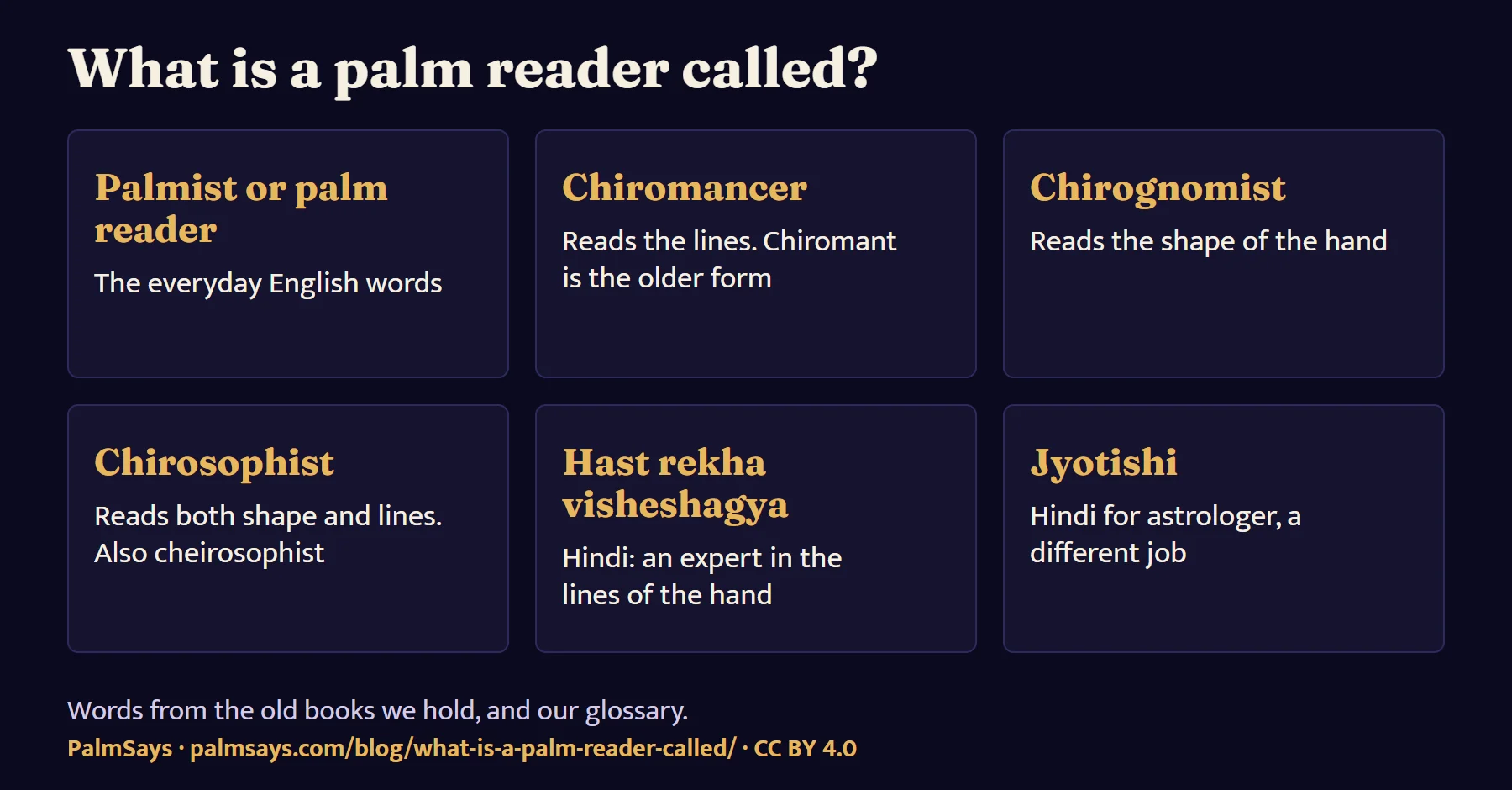
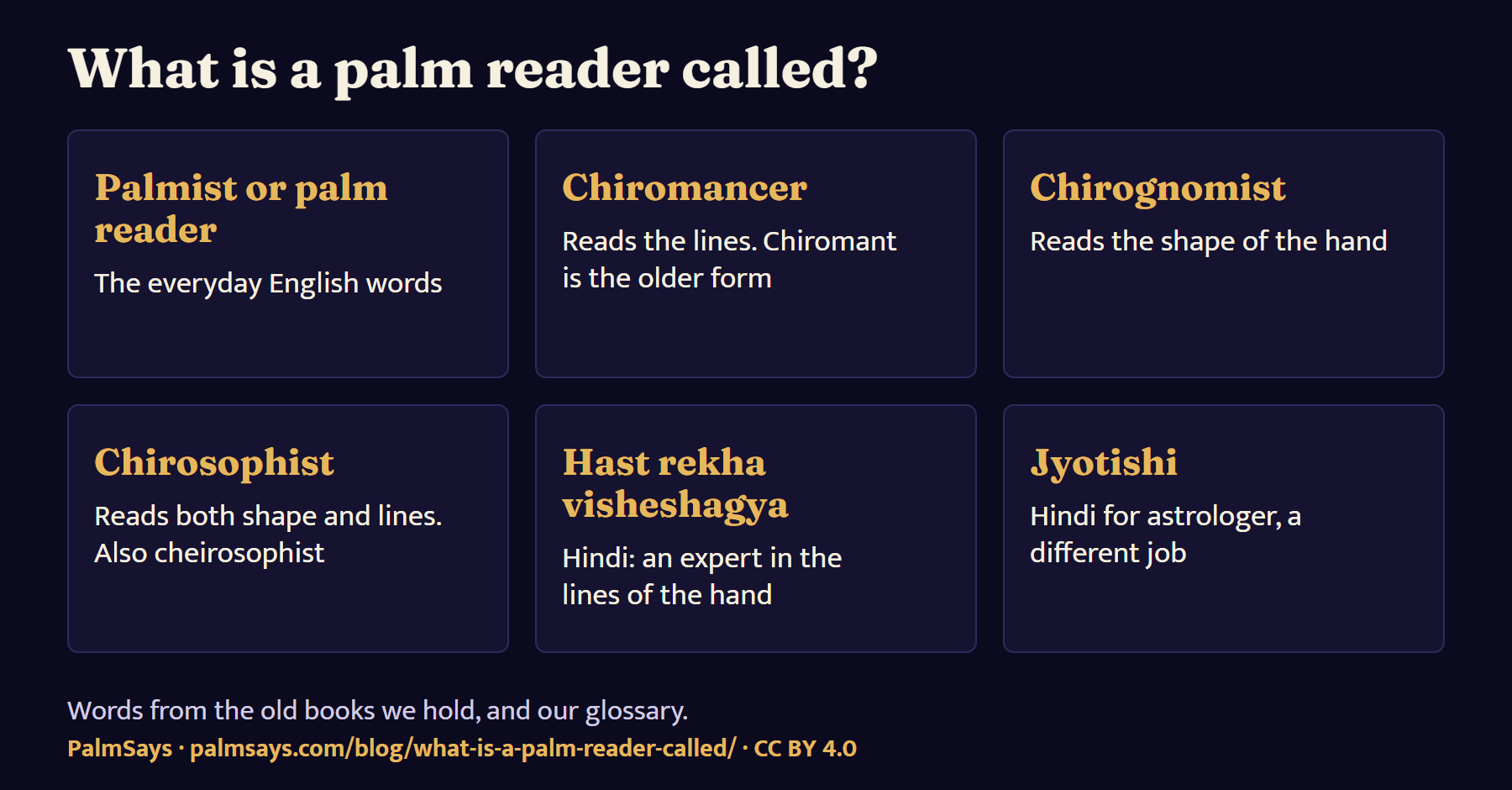
A palm reader is usually called a palmist. The older word is chiromancer. A chirognomist reads the shape of the hand, and in Hindi you may hear hast rekha visheshagya.
The full guide: How to read palm lines

Key takeaways
- Palmist and palm reader are the everyday English words.
- Chiromancer is older, from the Greek words for hand and foretell.
- A chirognomist reads hand shape; a chirosophist reads shape and lines.
- Jyotishi means astrologer in Hindi, which is a different job.
On this page7 sections
What is the everyday word for a palm reader?
The everyday word is palmist. Palm reader and hand reader mean the same thing. All three are plain English, and all three are fine to use.
The word is not new. Eveline Farwell was already using “palmists” in 1886, and in 1914 the Zancigs wrote of preparing a student “for professional work as a Palmist”.
The other names on this page come from old books or from Hindi. You can read about palmistry for years and rarely need them. But they turn up in old texts, so here is what each one means.
What do the older names mean?
Each older name points to a slightly different job. They all grew from Greek words, which is why they look so alike.
| Word | What it means | Where we found it |
|---|---|---|
| Chiromancer, chiromant | Someone who reads the lines. From the Greek for “the hand” and “I foretell” | Frith and Heron-Allen (1883); Markun (1927) |
| Chirognomist | Someone who reads the shape of the hand | Frith and Heron-Allen (1883); Markun (1927) |
| Chirosophist, cheirosophist | Someone who studies both shape and lines | Heron-Allen (1887); Frith (1895) |
| Chirologist | Another word for a palmist, and a rare one | Markun (1927) |
| Palmister | An old form of palmist | Dale (1895) |
The spellings with chei- and chi- are the same words. Authors simply chose differently.
Heron-Allen drew the clearest line, splitting the whole subject into two branches in 1887: cheirognomy, “the science of deducing the characteristics of man from the shape of his hands”, and cheiromancy, which reads the palm. Those are the book’s terms and claims, not an established science.
If you only need one word, use palmist. Everyone understands it, and it makes no claim beyond what the person does.
What do you call a palm reader in Hindi?
The word in our glossary is हस्तरेखा विशेषज्ञ (hast rekha visheshagya), which means an expert in the lines of the hand. Hast is hand and rekha is line.
You may also see these in Hindi palmistry writing:
- हस्तरेखा शास्त्री* (hast rekha shastri): a scholar of hand lines.
- सामुद्रिक शास्त्री* (samudrik shastri): a scholar of Samudrika Shastra, the wider reading of body marks. Palm reading is often described as part of it.
* Common in Hindi palmistry writing, but still waiting for a check by our Hindi reviewer.
One word often gets mixed in: ज्योतिषी (jyotishi). It means astrologer. Some jyotishis read palms as well, but the word itself is about the sky, not the hand. Our post on palmistry vs astrology sets out the difference.
For more Hindi and English words, see the palmistry terms glossary.
Which words did the old books use?
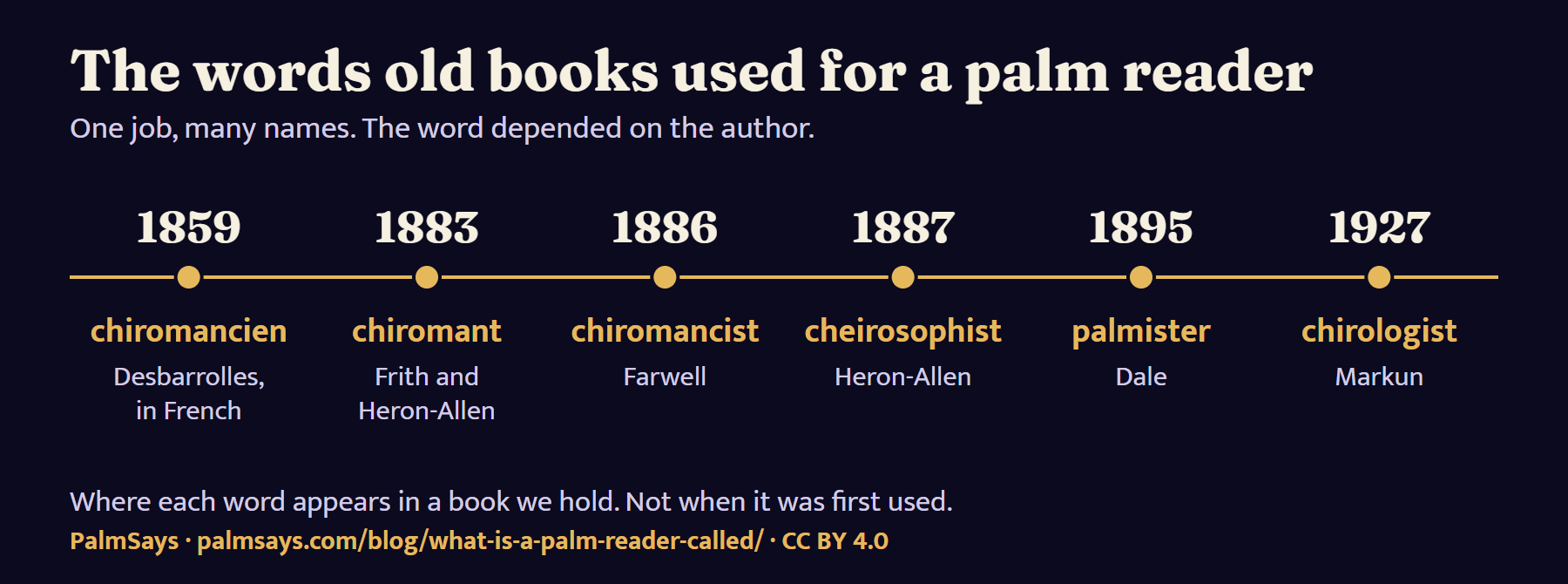
Each author had a favourite, and the books don’t agree on where one word ends and the next begins. The dates below show where a word appears in a book we hold. They don’t show when it was first used.
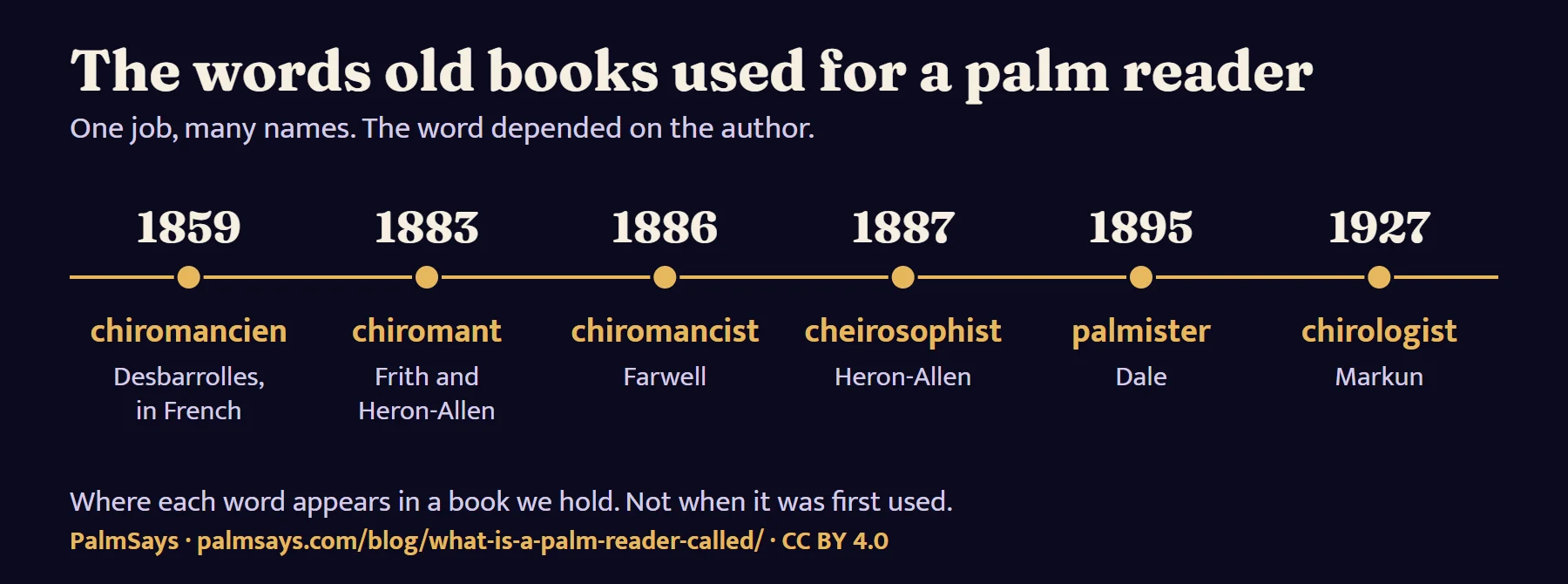
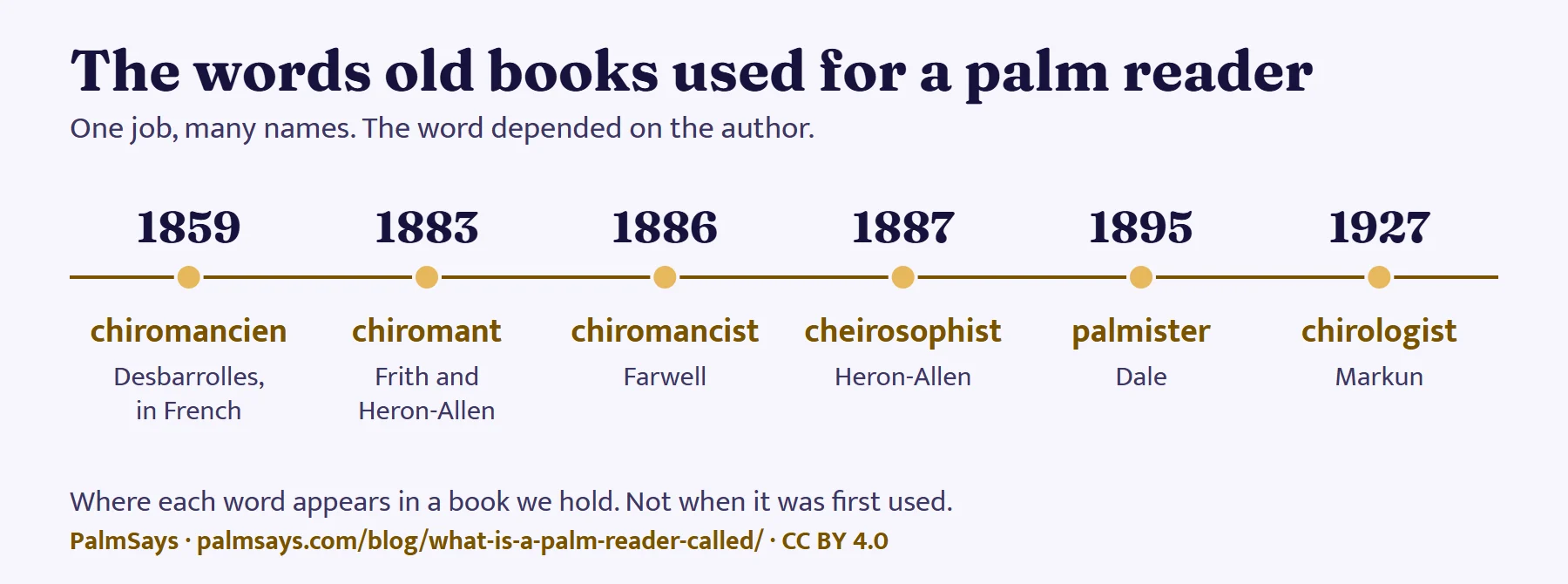
The disagreement is easy to see. In 1883, Frith and Heron-Allen wrote of “Chiromancy, which includes Chirognomy”, so the shape of the hand sat inside chiromancy. Four years later, Heron-Allen made cheirosophy the name for the whole subject, with cheiromancy and cheirognomy as its two parts. Same author, different map.
Markun, writing in 1927 as a sceptic, lumped them all together: “the palmists, the chirosophers, the chirognomists, and the chiromancers”. Cheiro, in 1900, wrote of “cheiromants” and also of palmists.
Did you know?
- The name could be a verb. Frith and Heron-Allen end their 1883 book with advice to “those about to ‘Chiromant’ their friends”. The advice is to be careful and never guess.
- A legal insult. In 1895 Frith complained of magistrates fining “the ‘fortune-teller,’ as they, ignorantly, by authority of an Act of Parliament, term the Chirosophist”.
- The name was a matter of pride. Farwell wrote in 1886 that between “fortune-teller and palmist”, used so loosely, there was a vast difference. The people who read hands cared how they were named.
Does the name tell you anything about the reader?
No. A long Greek word shows a taste in words. It doesn’t show that a reader passed a test, or that a reading is any more likely to be right. No study we found has shown that palm readings predict events, whatever the reader is called. Our page on whether palmistry is real goes through the evidence.
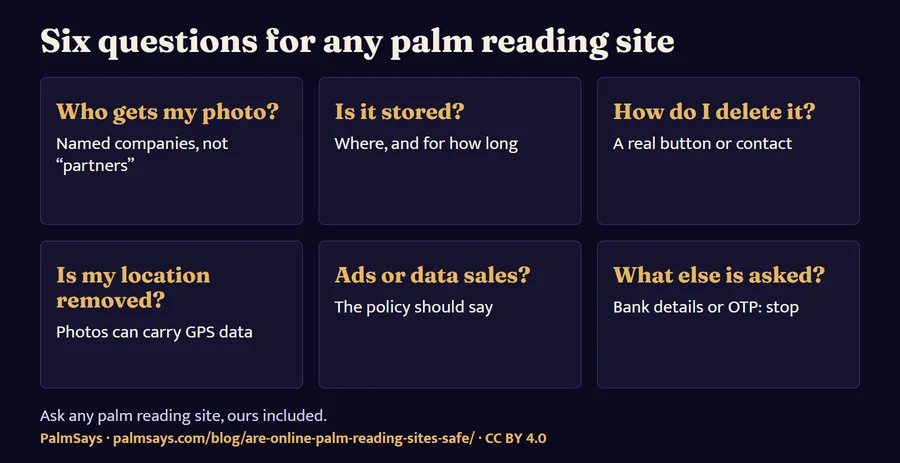
So when you meet a palmist, ask these instead of asking about the title:
- Which line are you reading? They should be able to point to it on your hand.
- Which book or rule does that come from? A reader should be able to say.
- Do you predict health, death or money? Treat those as a reason to walk away.
Our own scan is not a palmist, and we don’t call it one. AI traces your lines; meanings come from a fixed rule set built from classical books. If you want to see what that looks like on your own hand, you can scan your palm. Or try the interactive palm map with no photo at all.
Questions people ask
What is a palm reader called?
A palmist. Palm reader and hand reader mean the same thing. Older books also use chiromancer, chirognomist and chirosophist.
What is the difference between a palmist and a chiromancer?
Today, very little. Chiromancer is the older word, and strictly it points to reading the lines. Palmist is the everyday word for anyone who reads hands.
What is a palm reader called in Hindi?
Our glossary uses हस्तरेखा विशेषज्ञ (hast rekha visheshagya), an expert in the lines of the hand. Hindi writing also uses other words, and some of them are still waiting for a check by our Hindi reviewer.
Is a palmist the same as an astrologer?
No. A palmist reads the hand and an astrologer reads the sky at your birth. Some people practise both, which is why the words get mixed up.
Sources (8 books and studies)
- Frith & Heron-Allen, Chiromancy, or the Science of Palmistry (1883). Introduction (the origin of the word) and the closing advice.
- Edward Heron-Allen, Practical Cheirosophy (1887). Introduction: the two branches of cheirosophy.
- Henry Frith, Practical Palmistry (1895). Introduction.
- Eveline Farwell, Fingers and Fortune (1886). Introduction, and the section on the two hands.
- Leo Markun, What You Should Know About Palmistry (1927). Opening chapters.
- Mrs J. B. Dale, Indian Palmistry (1895). Preface.
- Adolphe Desbarrolles, Chiromancie nouvelle (1859). In French. (in French)
- The Zancigs, Forty Lessons in Palmistry (1914). Preface.
Meanings on this page are written in our own words from these books. Books whose rights are unclear are used for facts only, never quoted. How we choose sources
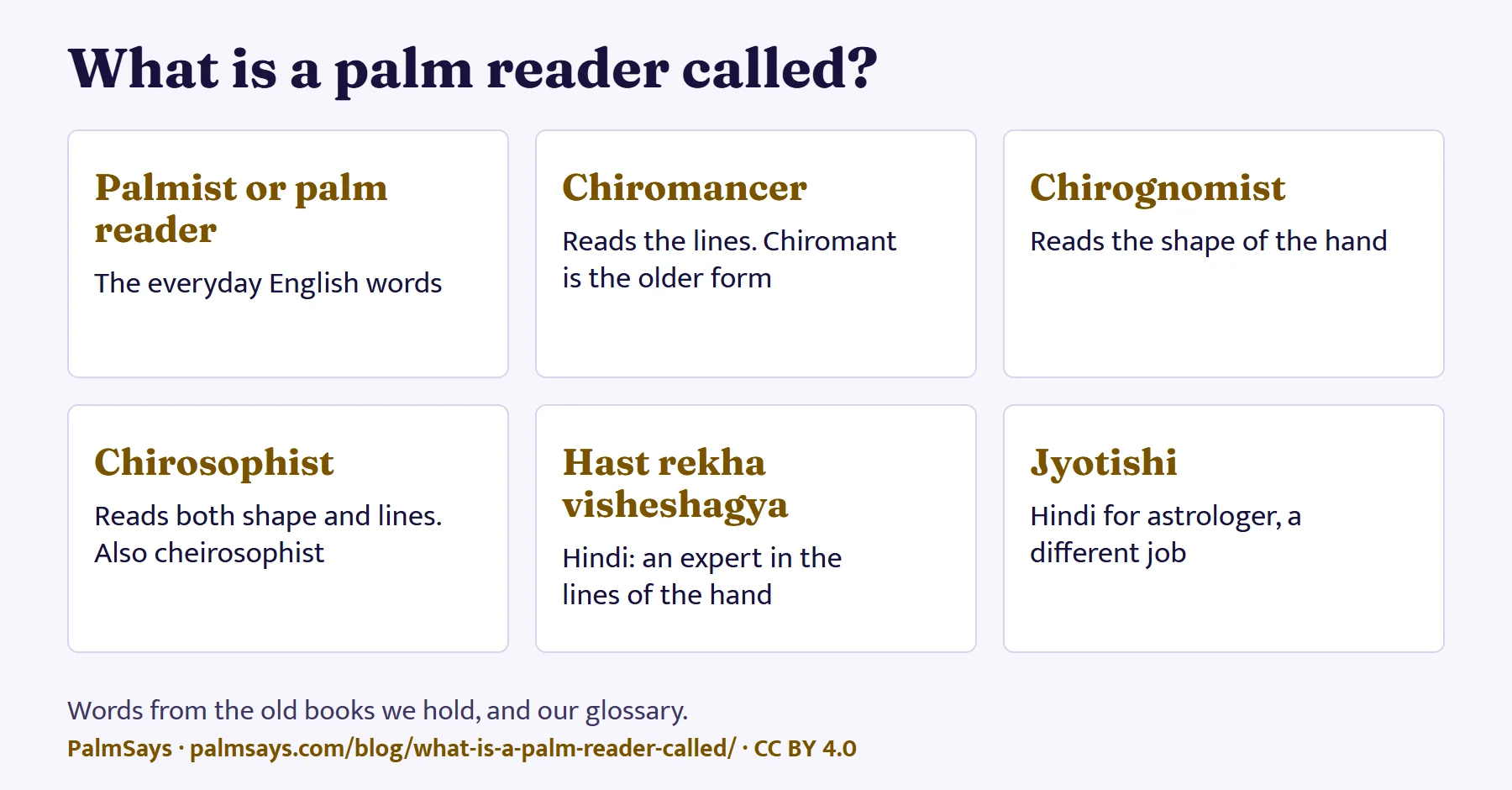
The diagrams in this post are free to reuse under CC BY 4.0 with credit to PalmSays (palmsays.com).Full-size diagram: What is a palm reader called? (PNG, 1800 × 940)Full-size diagram: The words old books used for a palm reader (PNG, 1800 × 670)
About the author
See your own lines
Upload one photo of your palm. We trace your lines and show what palmistry says about each one.
- Open palm
- Good light
- Whole hand in the frame
A phone photo shows the main lines and their breaks, forks and branches. Tiny marks such as stars and crosses are too small, so an honest reading leaves them out.
Coming soon on Google Play. The Android app is not on Google Play yet. This page will get the link the day it is.
The iPhone app isn’t ready yet. You can keep using this website.
Or see what the palm reading app for Android reads before you install it.
Keep reading
Palm beliefs
How do palm readers know so much about you?


Guides on this topic:How to read palm linesPalmistry termsHistory of palmistryIs palmistry true?All blog posts