Palm beliefs
How do palm readers know so much about you?
Quick answer
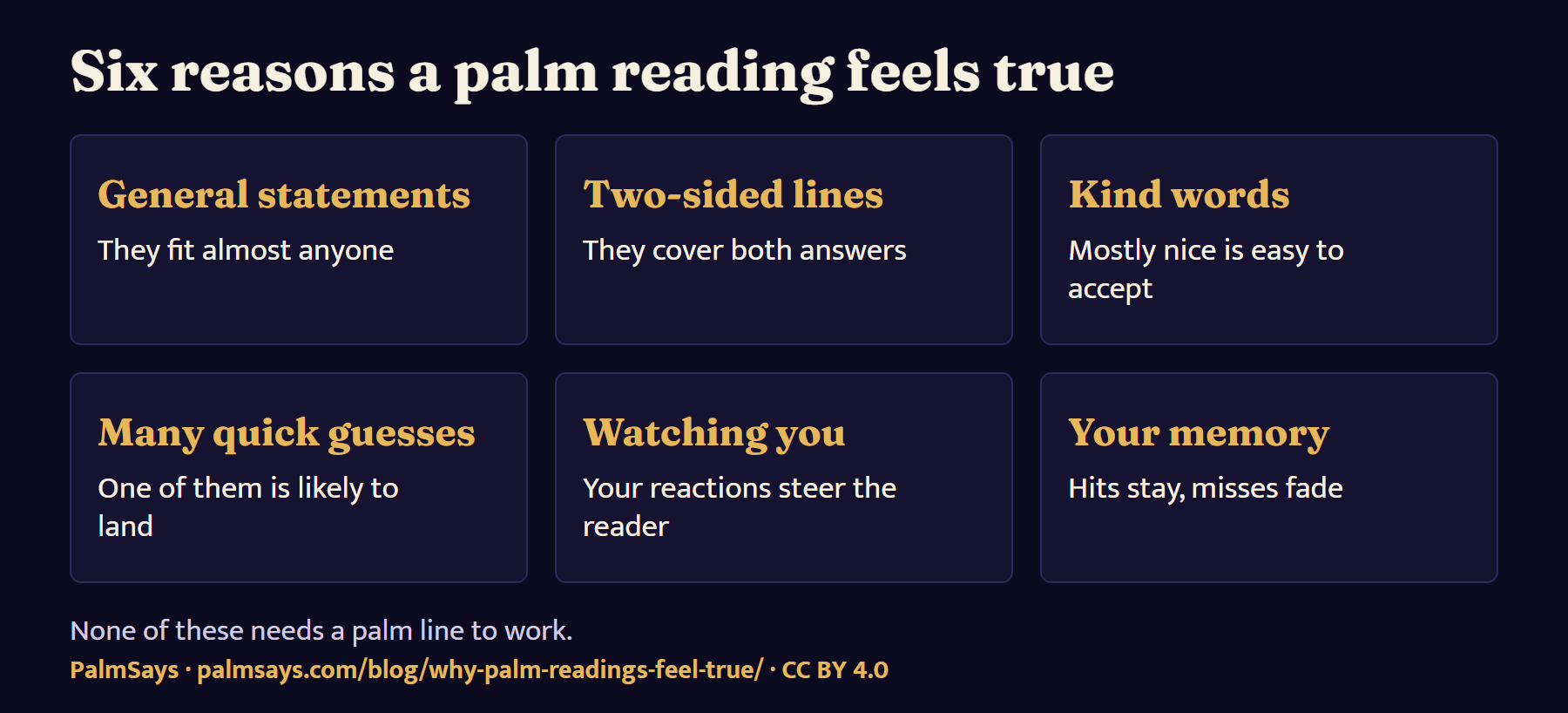
Mostly they don’t. General statements feel personal, readers watch your reactions, and you remember the hits. One palm reader told clients the opposite of what their lines said, and they were just as pleased.
The full guide: Is palmistry true?

Key takeaways
- One palm reader told clients the opposite of their lines, and they stayed pleased.
- General, mostly kind statements feel personal to almost anyone.
- You tend to remember the hits and forget the misses.
- Test a reading by flipping each statement into its opposite.
On this page7 sections
What happened when a palm reader said the opposite?
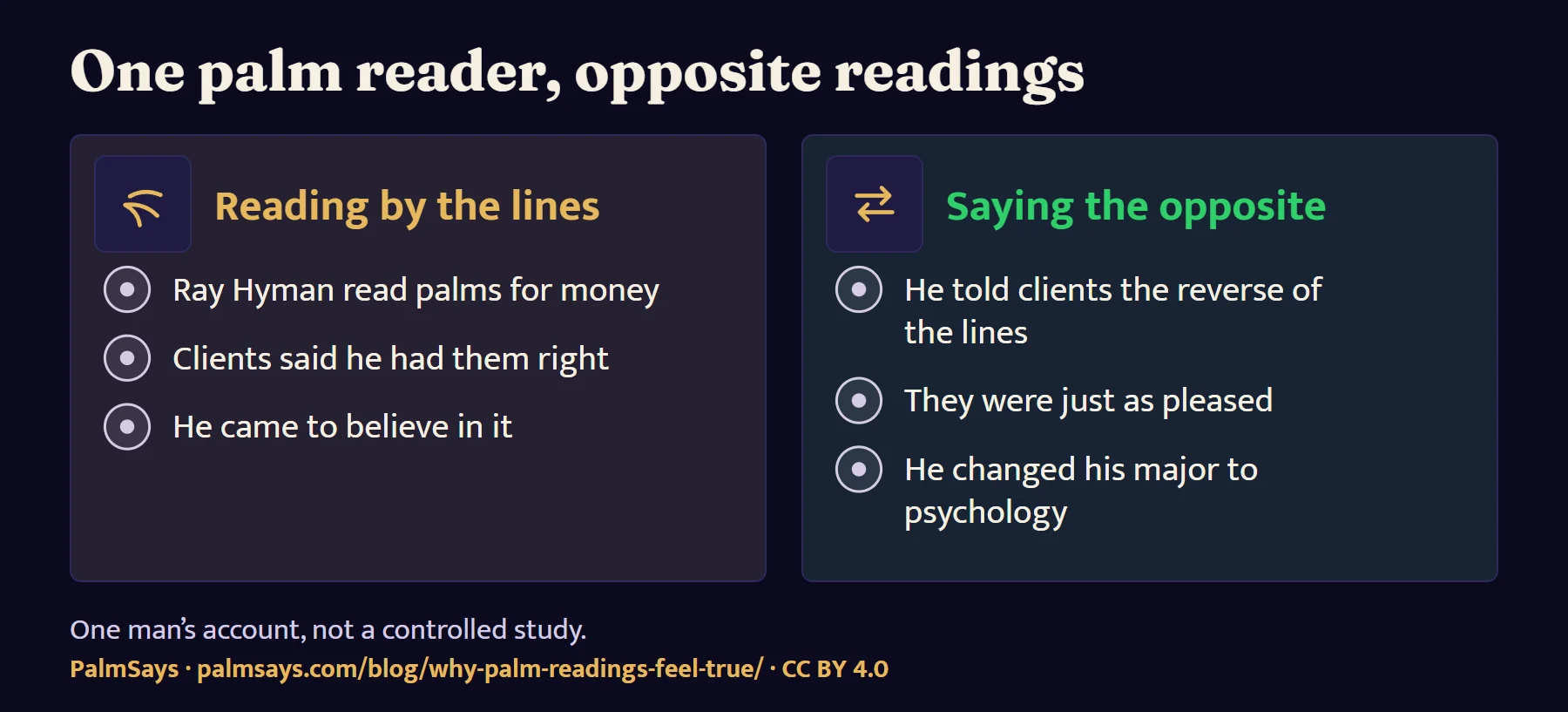
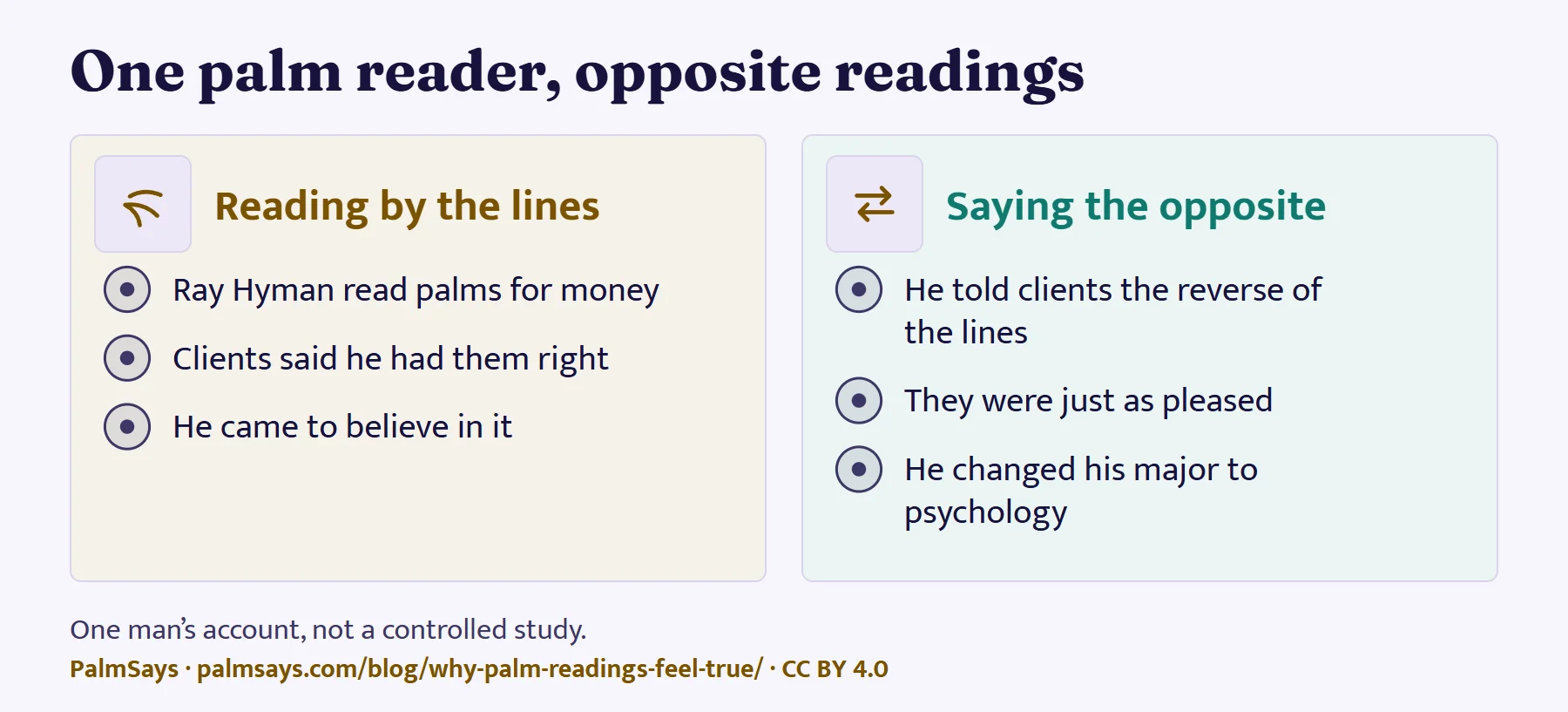
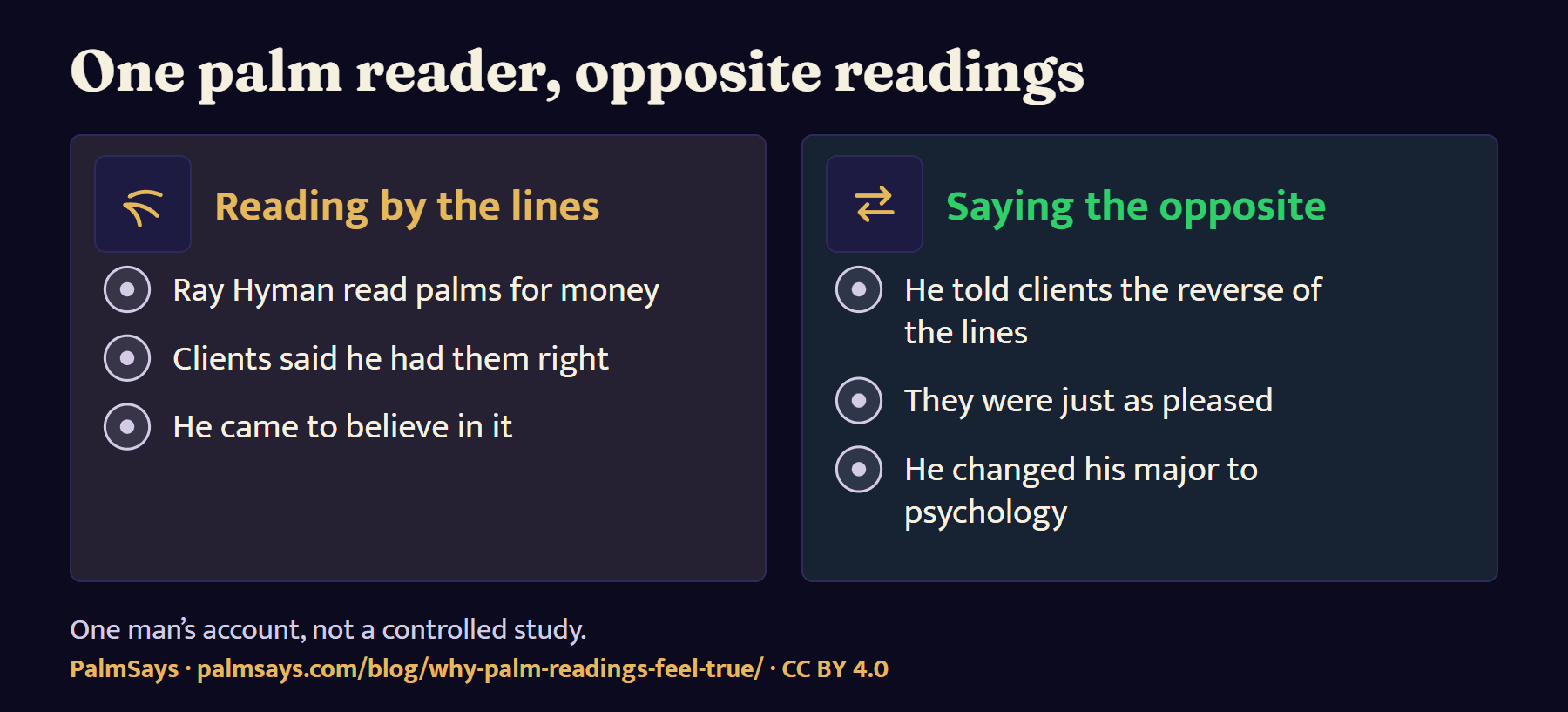
The clients were just as pleased. Ray Hyman read palms for money when he was young, and by college he believed in it completely. Then a friend suggested a test: tell the next client the opposite of what her lines said.
If her heart line said she hid her emotions, he told her she showed them openly. If her head line said she was practical, he told her she was imaginative. He says she was “thrilled”. He tried it on his next few clients, and they reacted the same way.
Hyman’s conclusion was blunt. Whatever was happening in the session, “it had nothing to do with the lines in the hand”. He changed his major from journalism to psychology.
Read this with care. It is one man’s account, told years later, with no control group. We use it because it came from a working palm reader who believed in the lines, and because you can try the same idea at home.
Why do general statements feel so personal?
Because you supply the details yourself. In a classroom test published in 1949, the psychologist Bertram Forer gave 39 students a “personal” description based on a test they had taken. All 39 received the same text, which he had put together from a newsstand astrology book. They rated it about 4.3 out of 5 for how well it fitted.
Our page on whether palmistry is real covers that test in brief. What helps you more is seeing how such sentences are built. Here are the common patterns, with examples we wrote ourselves.
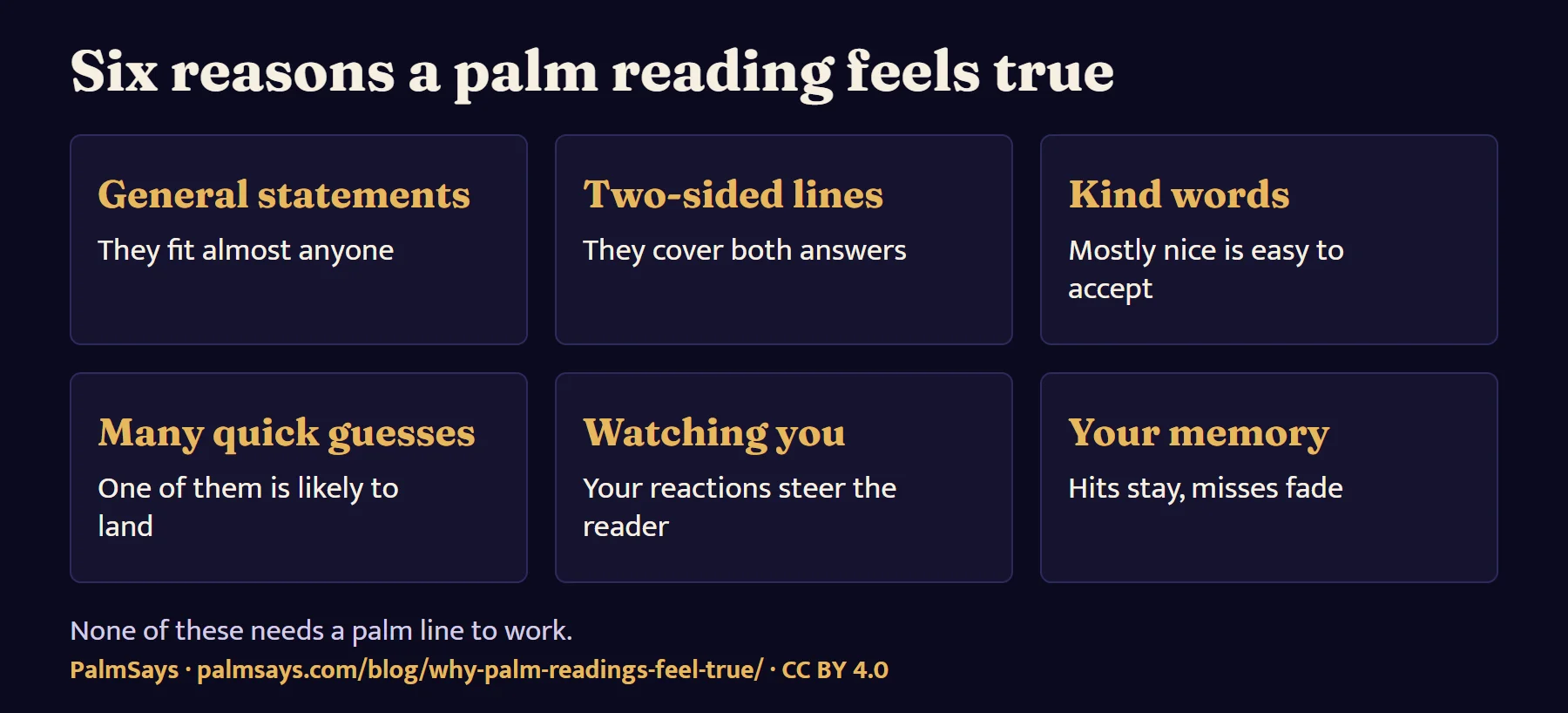
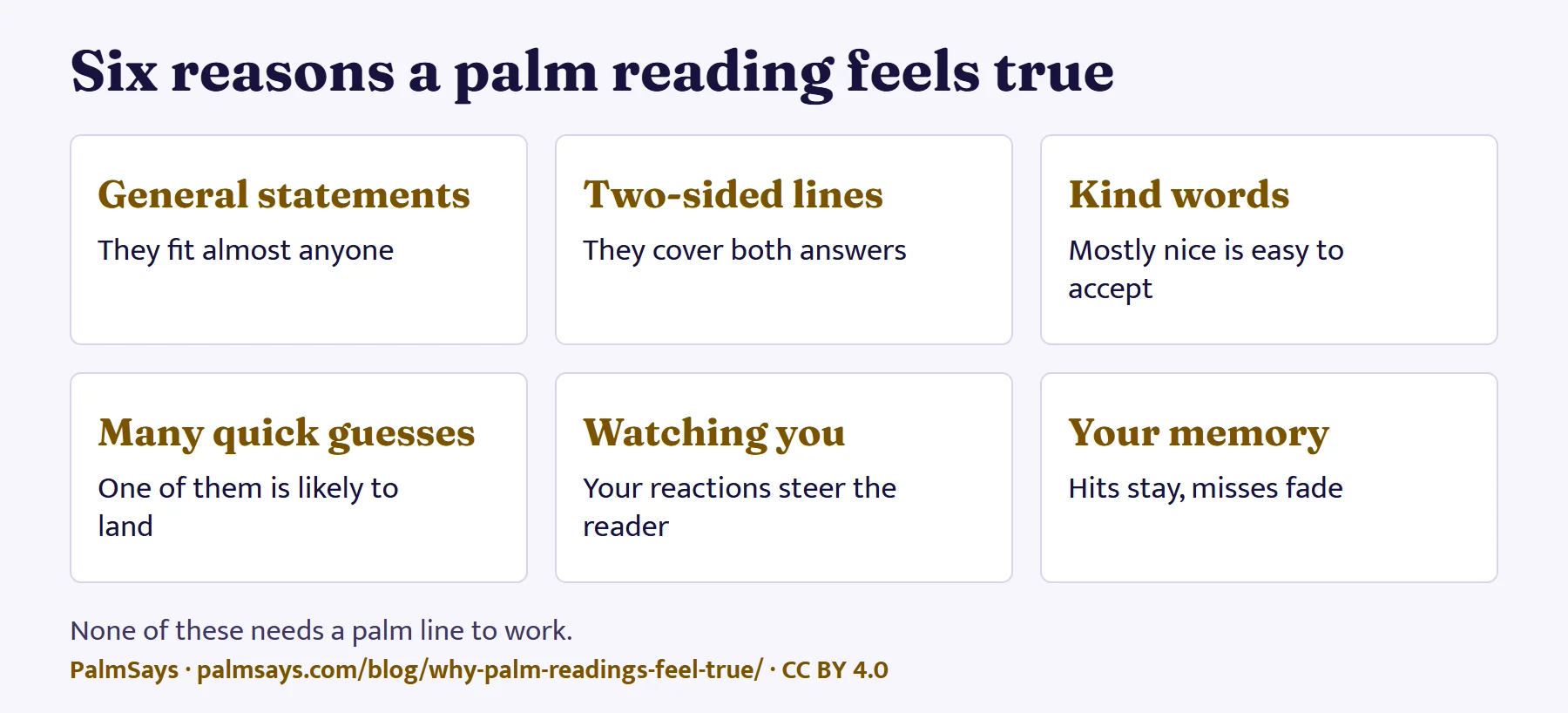
| Pattern | Example | Why it lands |
|---|---|---|
| “At times” | At times you feel sure of yourself, and at other times you doubt | Almost everyone has felt both |
| Two-sided line | You are generous, but you can be firm when it matters | It covers both answers |
| Kind words | People don’t always see how much you give | Most of us want to agree |
| Many quick guesses | I see a move, a family matter, someone older | One of them is likely to land |
Replication studies point to two things that make the effect stronger: more positive than negative statements, and trust in the person giving the feedback. So a warm, confident reader starts with an advantage, whatever your palm looks like.
What can a reader pick up in the room?
A lot. Small changes in your face and body show whether a line of talk is working, and a reader can follow what lands. Cold reading is the name for this, and “shotgunning” is the name for firing many vague statements in the hope that one hits.
Time matters too. Most of a session goes on the hits, while the misses pass quickly. So you leave with a memory of a reader who kept getting it right. You also do half the talking, often without noticing. When you later say “she knew about my job”, ask yourself who mentioned the job first.
An app can’t watch your face. But a written report can still use general statements, and that includes a report from an app like ours. The test below works on any reading.
A reading that feels true has passed a feeling test. It hasn’t passed a test of whether it is true.
For the wider evidence on palmistry itself, start with is palmistry real.
What did the old palmistry books admit?
More than you might expect. These authors believed in the lines, yet they wrote openly about guessing and confidence among other readers.
| Book | What it says |
|---|---|
| Benham (1900) | Faced with public demand, practitioners fell back on a great deal of guessing |
| Benham (1900) | Readers who talk only of the far future do well because people want to believe, and those stories are always pleasant |
| Cheiro, Guide to the Hand (1900) | Of so-called palmists: “A little money to advertise and a good deal of self-assurance” is all they think they need |
| Cheiro, Guide to the Hand (1900) | Clients “never ask for the palmist’s credentials” |
| Mrs Robinson (1911) | Tells beginners not to jump to a hasty conclusion, and says a reader’s reputation matters less than not causing fear |
Each author treats guessing as the other reader’s fault, and none reports a test of his or her own readings.
Did you know?
- The test’s text came from a newsstand. Forer built his “personal” description from an astrology book he found on sale, and his students still rated it highly.
- The name came later. The psychologist Paul Meehl coined “Barnum effect” in 1956, after the showman P. T. Barnum. Forer had called it the “fallacy of personal validation”.
- A palmist compared himself to a judge. In 1895, Frith wrote about a magistrate who warned a prisoner about his future after judging from “the man’s face and his record”. His point: “The honest Palmist says no more than the magistrate.”
How can you test a reading yourself?
It takes about ten minutes, and you need only the reading and a friend.
- Write it down. List each statement the reader made, word for word if you can. Do this before you think it over.
- Flip each one. Turn “you hide your feelings” into “you show your feelings”. If the opposite also feels true, the statement told you little.
- Ask a friend. Read the list aloud and ask whether it fits them. If it does, it isn’t about you in particular.
- Mark what could fail. A statement counts only if it could have turned out false. “You are private at times” can’t fail.
- Count the misses. Put them on the same page as the hits. Memory won’t do this for you.
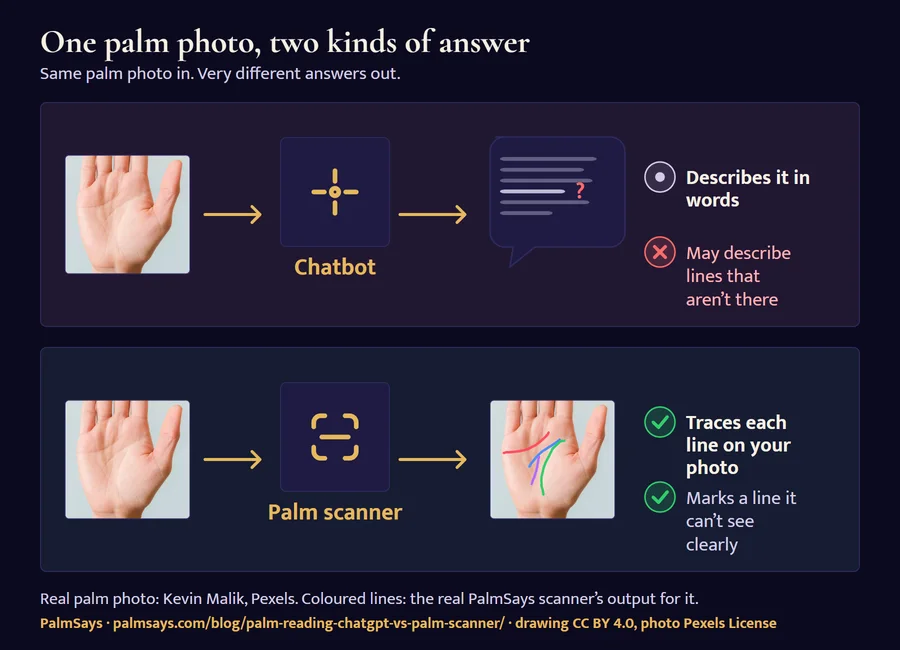
Look at your own palm while you do this. If a reader named a line, find it by a window and ask whether you can see what was described. If you want the lines traced on your own photo, you can scan your palm. AI traces your lines; meanings come from a fixed rule set built from classical books. Then run the same five steps on that report too.
Questions people ask
How do palm readers know so much?
Mostly they don’t know it from the lines. General statements fit most people, a reader in the room can watch your reactions, and you tend to remember what fitted. The reading can feel exact without being so.
Why do palm readings feel so true?
Because you fill in the details yourself. A vague, mostly kind statement feels personal when it is said about you. Psychologists call this the Barnum effect.
Do palm readers tell the truth?
Many of them are sincere. Ray Hyman believed in his own readings for years. Being sincere isn’t the same as being right, and our page on whether palmistry is real covers the tests.
Can a palm reader tell things just by looking at me?
A reader can notice your age, your clothes and your reactions, then steer towards what lands. This is called cold reading. It needs no palm lines at all.
Does this mean a reading has no value?
A reading can still give you something to think about. Treat it as a prompt for reflection, not as a fact about you or your future.
Sources (7 books and studies)
- Wikipedia contributors. Ray Hyman. Wikipedia, read on 5 November 2026. Quotes Hyman’s own account from PBS, “Ask the Scientists”.
- Wikipedia contributors. Barnum effect. Wikipedia, read on 5 November 2026. Reports Forer’s classroom test and the later replications.
- Wikipedia contributors. Cold reading. Wikipedia, read on 5 November 2026.
- William G. Benham, The Laws of Scientific Hand Reading (1900). The introduction on guessing, and the section on age as shown on the lines.
- Cheiro, Cheiro’s Guide to the Hand (1900). The section on so-called palmists and impostors.
- Henry Frith, Practical Palmistry (1895). The passage comparing a palmist with a magistrate.
- Mrs. Robinson, The Graven Palm (1911). The opening advice to beginners.
Meanings on this page are written in our own words from these books. Books whose rights are unclear are used for facts only, never quoted. How we choose sources
The diagrams in this post are free to reuse under CC BY 4.0 with credit to PalmSays (palmsays.com).Full-size diagram: Six reasons a palm reading feels true (PNG, 1800 × 818)Full-size diagram: One palm reader, opposite readings (PNG, 1800 × 817)
About the author
See your own lines
Upload one photo of your palm. We trace your lines and show what palmistry says about each one.
- Open palm
- Good light
- Whole hand in the frame
A phone photo shows the main lines and their breaks, forks and branches. Tiny marks such as stars and crosses are too small, so an honest reading leaves them out.
Coming soon on Google Play. The Android app is not on Google Play yet. This page will get the link the day it is.
The iPhone app isn’t ready yet. You can keep using this website.
Or see what the PalmSays palm reading app reads before you install it.
Keep reading
AI readings
Can ChatGPT read your palm?
Palmistry and astrology
Palmistry vs astrology: what is the difference?


Guides on this topic:Is palmistry true?How to read palm linesAll blog posts