Palm lines
Why are my palm lines different on each hand?
Quick answer
Each hand forms its own creases before birth, so small differences are normal. A 2022 study found most people share the same broad crease pattern on both hands. Old books read meaning into the differences, without any test.
The full guide: Which hand to read

Key takeaways
- In one study, 93.1% of students had the same pattern type on both hands.
- The same pattern type does not mean identical lines.
- The old books read matching and different hands in opposite ways.
- Compare your hands in the same light before you read anything into it.
On this page6 sections
Are your palm lines the same on both hands?
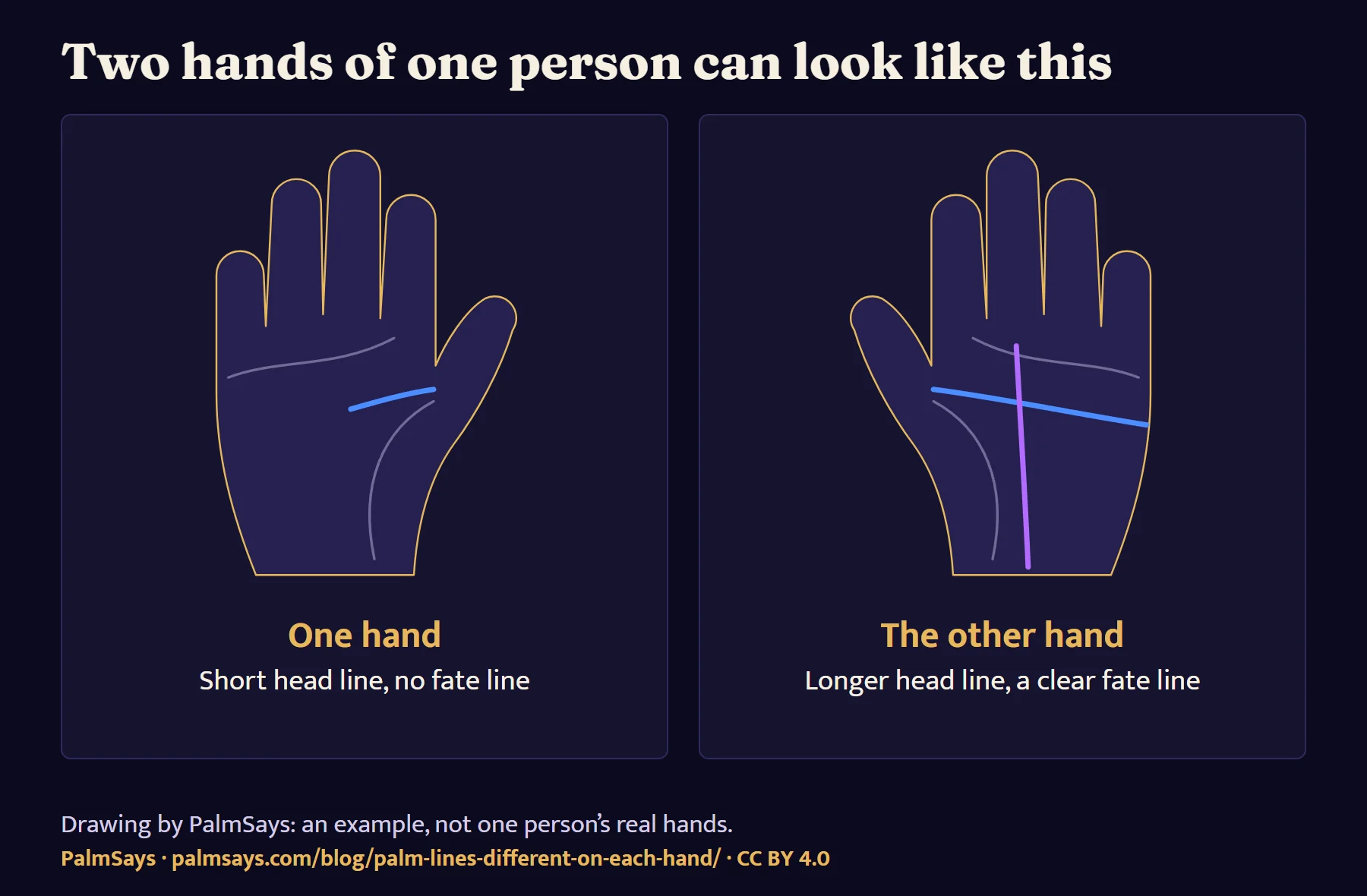
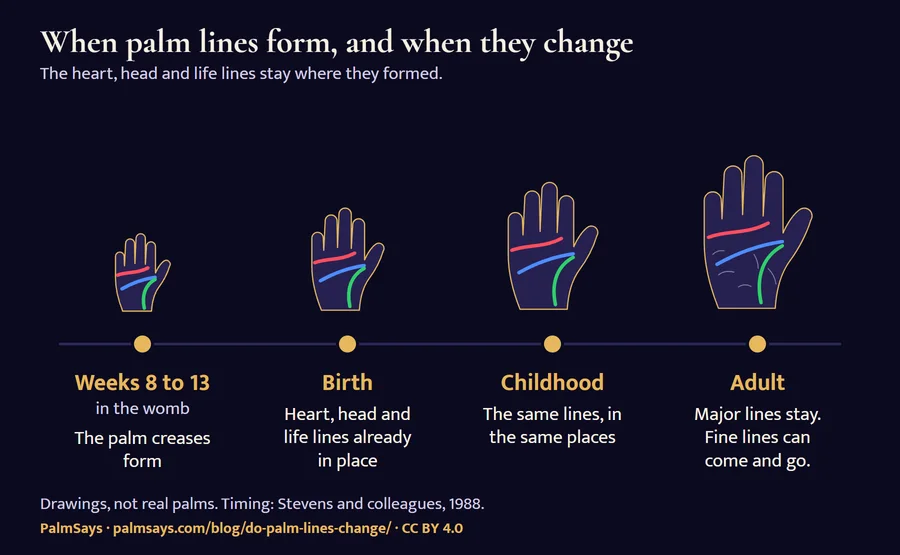
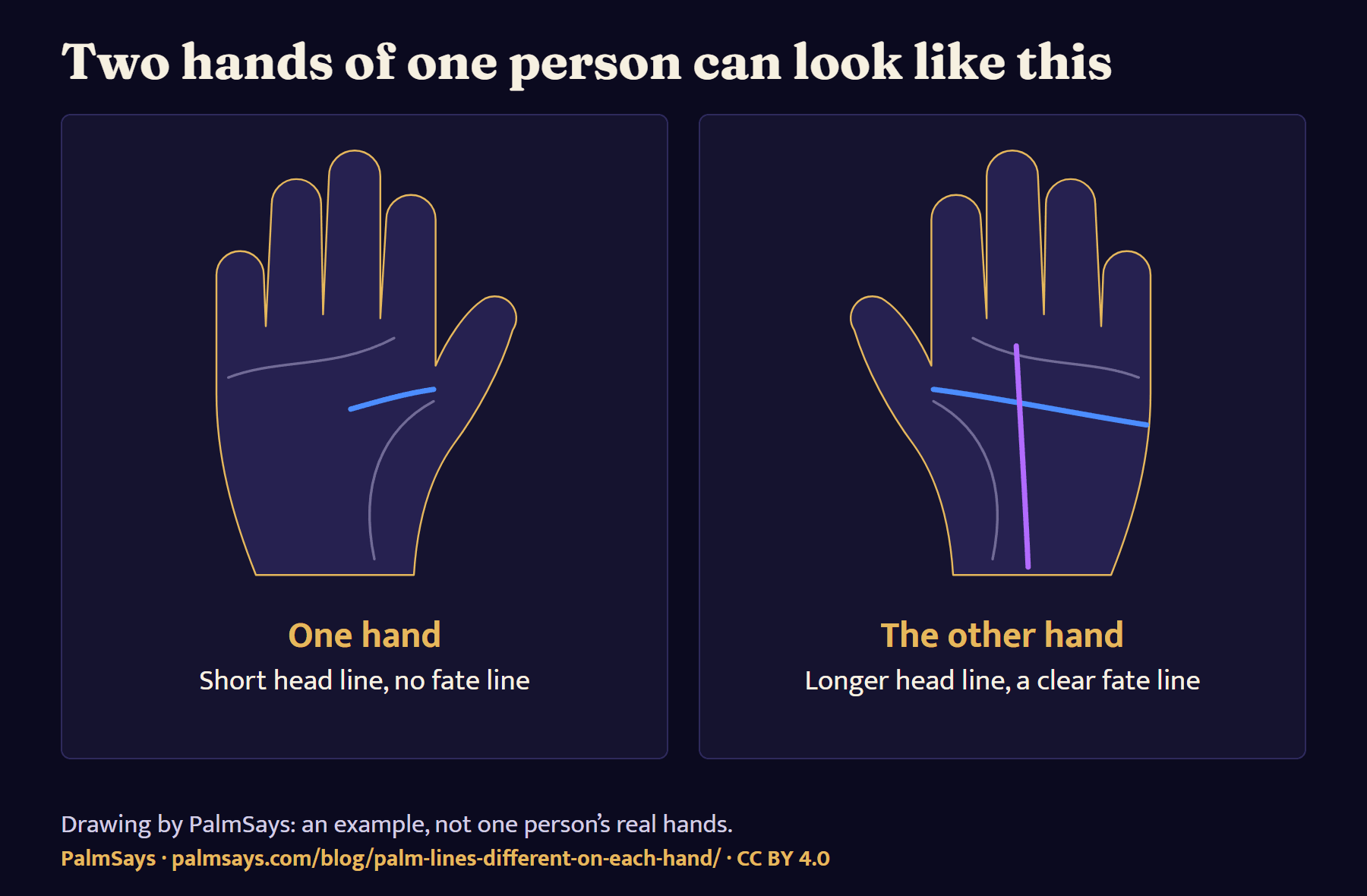
Not exactly. Your two hands are a pair, not copies, and small differences in length, depth and clarity are normal. Palm and finger creases form between about 8 and 13 weeks of pregnancy (Stevens and colleagues, 1988), and each hand forms its own.
The largest figure we found comes from a 2022 study of 832 university students in Ethiopia, covering 1,664 palms. It sorted each palm into a broad pattern type. 93.1% of the students had the same pattern type on both hands (Belay and colleagues, 2022).
Read that number with care. It counts broad types, such as a normal palm or a single crease across the palm. Two hands of the same type can still differ line by line. It also comes from one group of students, so it may not hold everywhere.
We looked for a study that measures left and right palm lines one by one, and we found none. So we can’t tell you how different is “normal” in centimetres.
Could it just be the photos?
Yes, so rule that out first. Different light and a different hand position can make one palm look like two. If you took a photo of each hand at different times, the difference may be in the photos.
Take both photos in the same spot, a minute apart, with each hand held the same way. If one line still looks faint, our post on faint palm lines shows how to tell the photo from the hand. Our post on whether palm lines change explains why two photos never match.
Hand shape can differ as well. Our left and right tool measures that from your photos, on your device.

What do the old books say about two different hands?
Most of them built a whole reading on it. These are their claims, not measured facts. The usual idea is that one hand shows what you were born with and the other shows what you did with it.
| Book | What it says |
|---|---|
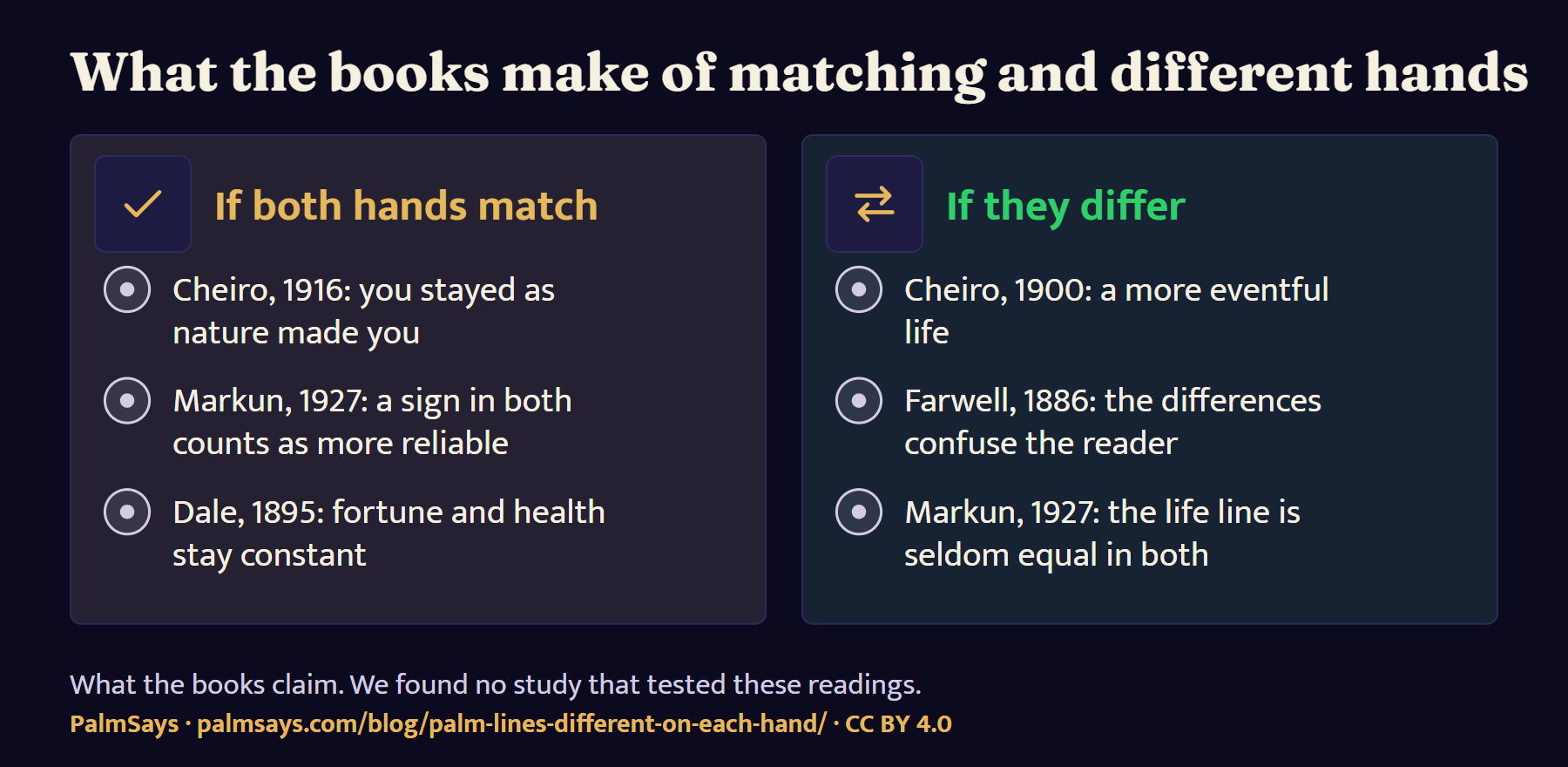
| Cheiro, Language of the Hand (1900) | “The left is the hand we are born with; the right is the hand we make” |
| Farwell (1886) | The same idea, with an admission: “the apparent discrepancies between the two hands constantly confuse the palmist” |
| Benham (1900) | Reading one hand alone explains many failed readings, so read both |
| Zancig (1914) | Look at the left hand first, then base your reading on the right |
| Frith and Heron-Allen (1883) | Read the left first, then correct it from the right |
| Dale, Indian Palmistry (1895) | The right palm for a man, the left for a woman, and “take the hand in which the signs and lines are clearly shown” |
They even disagree about what a match means. If both hands match, Cheiro (1916) says the person “has not developed in any way from what heredity or Nature gave to him”. Markun (1927) reports that a sign in both hands is “considered more reliable”. Dale says matching clear lines “declare a constancy of fortune and health”.
So the same pair of hands gets three different readings. Which hand to read is its own long argument, and our guide to which hand to read covers it.
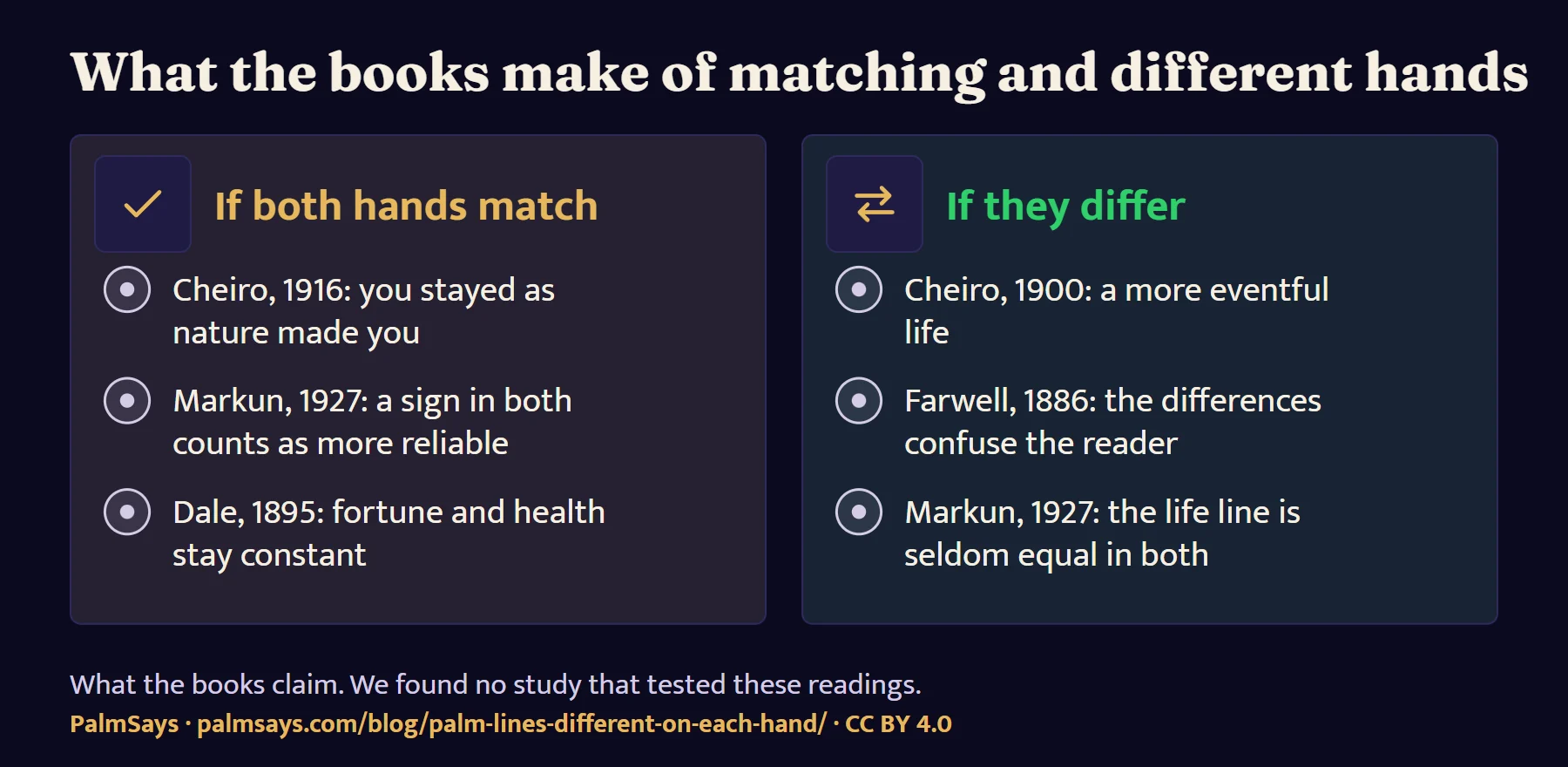
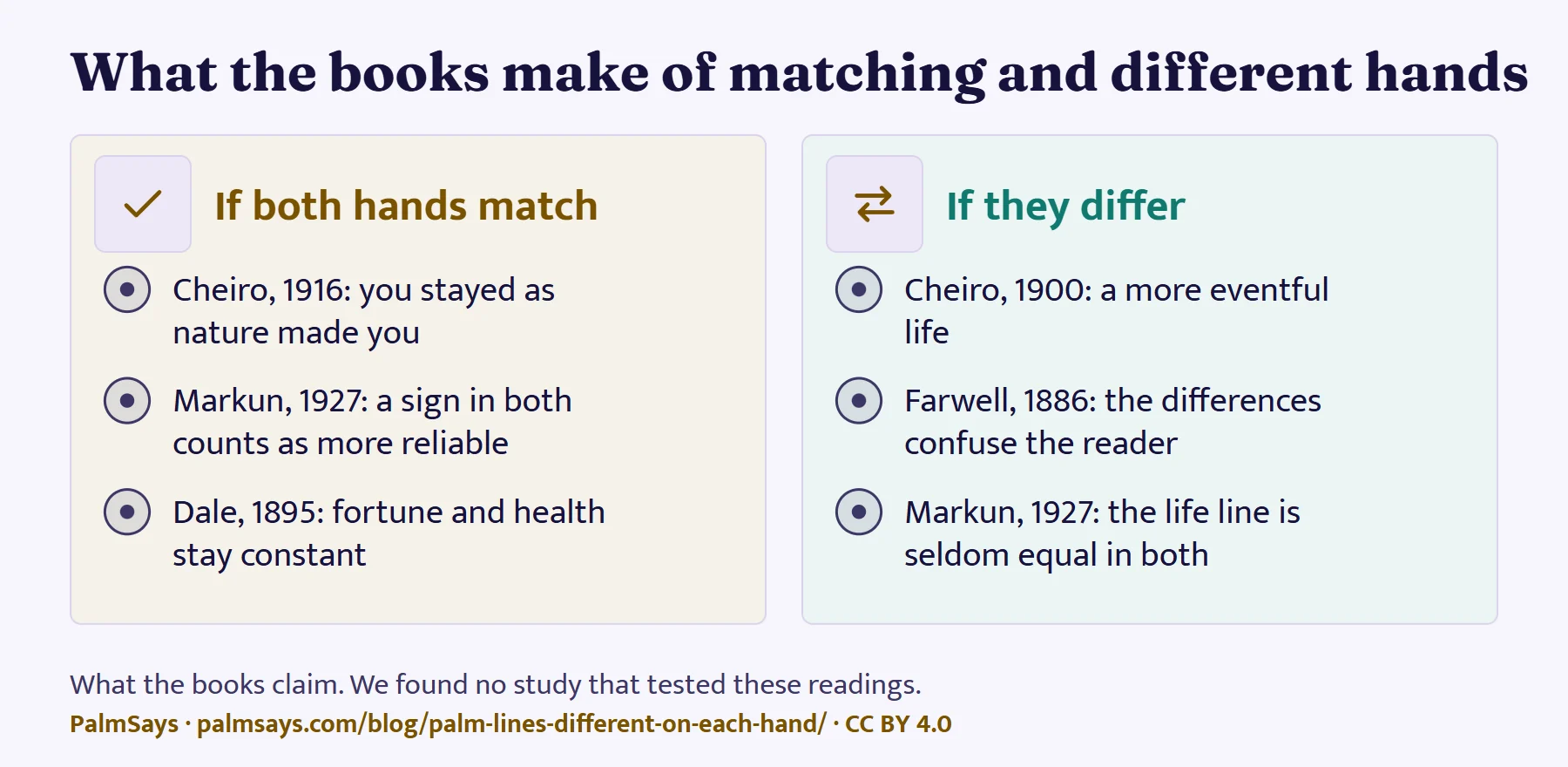
Different lines on each hand are ordinary. The books turned them into a story, and we found no study that tested the story.
Here is a useful detail from Markun on the life line: “the line is seldom of equal length in both hands”. So a reader who says a long life line means a long life has to pick a hand. A palm line can’t tell your lifespan, on either hand. Our page on whether palmistry is real covers the tests.
Did you know?
- Cheiro described both extremes. He wrote that some people change so much that “hardly two lines are alike on both hands”, while in others the difference is “barely perceptible” (Language of the Hand, 1900).
- An old rule went by your birth time. Frith and Heron-Allen (1883) found an “ancient authority” that chose the hand by whether you were born by day or by night. They called the rule “manifestly absurd”.
- Left-handers got their own rule. Cheiro wrote that “left-handed people have the lines more clearly marked on the left hand, and vice versa” (Language of the Hand, 1900). We found no count that shows this.
How do you compare your own two hands?
It takes about five minutes.
- Sit by a window. Hold both hands open, side by side, palms up.
- Start with the heart, head and life lines. Check where each one starts and ends on each hand.
- Then look for a fate line. Many hands show one only faintly, or on one hand only.
- Write down what differs. Length, clarity and any line you find on only one side.
- Stop there. You now have a real observation. Any meaning a book gives it is that book’s opinion.
If you want each line traced for you, you can scan your palm, one hand at a time. AI traces your lines; meanings come from a fixed rule set built from classical books.
Questions people ask
Is it normal to have different palm lines on each hand?
Yes. The two hands are not copies. Most people in a 2022 study had the same broad crease pattern on both hands, but that is not the same as identical lines.
Are palm lines the same on both hands?
Not exactly. Even a palmistry author, Markun, wrote in 1927 that the lines are not exactly the same on both hands. Differences in length and clarity are easy to find.
Why are my life lines different on each hand?
Each hand forms its creases on its own, so they can differ in length and clarity. A palm line can’t tell your lifespan, on either hand.
Which hand should I believe if the lines differ?
Palmists disagree. Our guide on which hand to read sets out their rules. No rule has been tested, so neither hand is more true than the other.
Does a difference between my hands mean something is wrong?
A small difference in palm lines is not a bad sign. If you notice a change in your skin or in how your hand works, ask a doctor. That has nothing to do with palmistry.
Sources (11 books and studies)
- D. G. Belay, M. G. Worku, M. A. Dessie, Y. Asmare and M. Taye (2022). Prevalence of palmar crease patterns and associated factors among students at University of Gondar, Northwest Ethiopia. Anatomy & Cell Biology, 55(2), 161–169.
- C. A. Stevens, J. C. Carey, M. Shah and G. P. Bagley (1988). Development of human palmar and digital flexion creases. The Journal of Pediatrics, 113(1), 128–132.
- Cheiro, Cheiro’s Language of the Hand (1900). Part II, ch. IV: The Right and Left Hands.
- Cheiro, Palmistry for All (1916). Part I, ch. XVII: Different Classes of Lines and Right and Left Hands.
- Cheiro, Cheiro’s Guide to the Hand (1900). The section on the two hands.
- Leo Markun, What You Should Know About Palmistry (1927). The sections on the life line and on signs in both hands.
- Eveline Farwell, Fingers and Fortune (1886). The section on the two hands.
- Mrs J. B. Dale, Indian Palmistry (1895). The section on which hand to examine.
- The Zancigs, Forty Lessons in Palmistry (1914). The opening lessons.
- Frith & Heron-Allen, Chiromancy, or the Science of Palmistry (1883). Introduction, on which hand to read.
- William G. Benham, The Laws of Scientific Hand Reading (1900). Part I, on reading both hands.
Meanings on this page are written in our own words from these books. Books whose rights are unclear are used for facts only, never quoted. How we choose sources
The diagrams in this post are free to reuse under CC BY 4.0 with credit to PalmSays (palmsays.com).Full-size diagram: Two hands of one person can look like this (PNG, 1800 × 1180)Full-size diagram: What the books make of matching and different hands (PNG, 1800 × 880)
About the author
See your own lines
Upload one photo of your palm. We trace your lines and show what palmistry says about each one.
- Open palm
- Good light
- Whole hand in the frame
A phone photo shows the main lines and their breaks, forks and branches. Tiny marks such as stars and crosses are too small, so an honest reading leaves them out.
Coming soon on Google Play. The Android app is not on Google Play yet. This page will get the link the day it is.
The iPhone app isn’t ready yet. You can keep using this website.
Or see what the palm reading app for Android reads before you install it.
Keep reading
Palm lines
Do palm lines change over time?
Palm beliefs
How do palm readers know so much about you?


Guides on this topic:Which hand to readLeft vs right handLines on your palmAll blog posts