Travel lines on the palm: the foreign travel line, explained
Travel lines are short lines low on the outer palm (the mount of the Moon) and fine branches from the life line towards it. Palmistry reads restlessness and a love of change in them, never a trip or date.
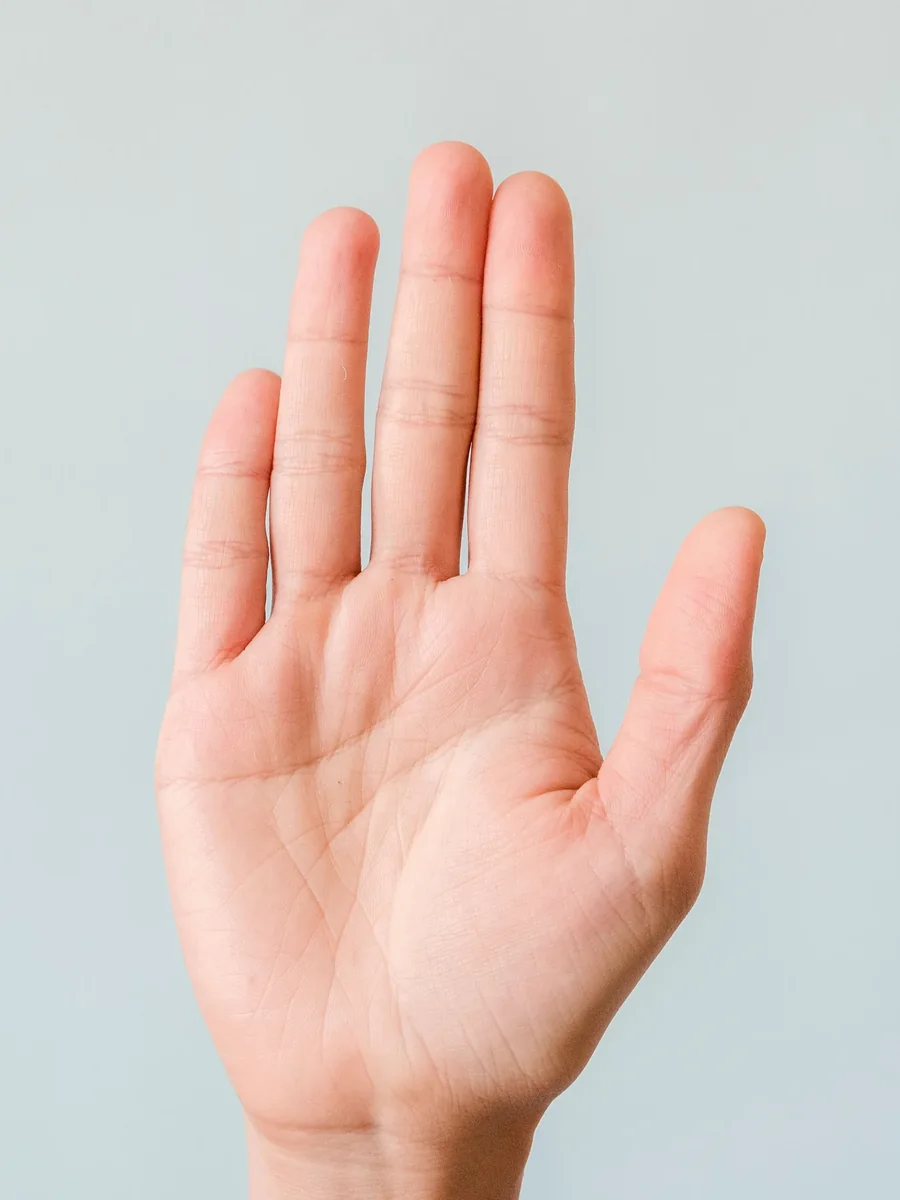
A real palm photo (Kevin Malik, Pexels), traced by the real PalmSays scanner. Your reading is made from your own photo.
Where are the travel lines on your palm?
Look at the outer edge of your palm, low down, above the wrist. Can you see short lines running in from the side?
- Hold your hand up in bright light, palm facing you, and tilt it so the little-finger edge catches the light.
- Look at the fleshy outer edge, between the end of your head line and your wrist. That pad is the mount of the Moon.
- Look for short lines running in from the edge, and for fine lines that leave your life line and bend towards that pad.
- Then check the wrist: some lines rise from the first wrist crease up into the outer palm.
On this page
- What are travel lines on the palm?
- Travel line types and what the books read in them
- Is there a foreign travel line in palmistry?
- Can travel lines predict when you will travel?
- Are travel lines real or just creases?
- What does no travel line mean?
- Travel lines in the left and right hand, for women and men
- Can a phone photo show travel lines?
- Myths about travel lines
- Questions people ask
- Sources
What are travel lines on the palm?
Travel lines are short lines on the outer edge of the palm, low on the mount of the Moon, and fine lines that leave the life line and bend towards that pad. In Hindi they are यात्रा रेखा (yatra rekha), and the one people search for as the foreign travel line is विदेश यात्रा रेखा (videsh yatra rekha).
The mount of the Moon is the soft pad on the little-finger side of the palm, above the wrist. Cheiro (1916) finds travel lines in two places: little lines on that mount, and fine lines that leave the life line and lean over towards it. The Indian books add a third: a line that rises from the wrist into the outer palm.
The PalmSays scanner traces the four major lines, not travel lines, so the photo at the top shows none. Look for them on your own hand with the steps above, in bright light from one side.
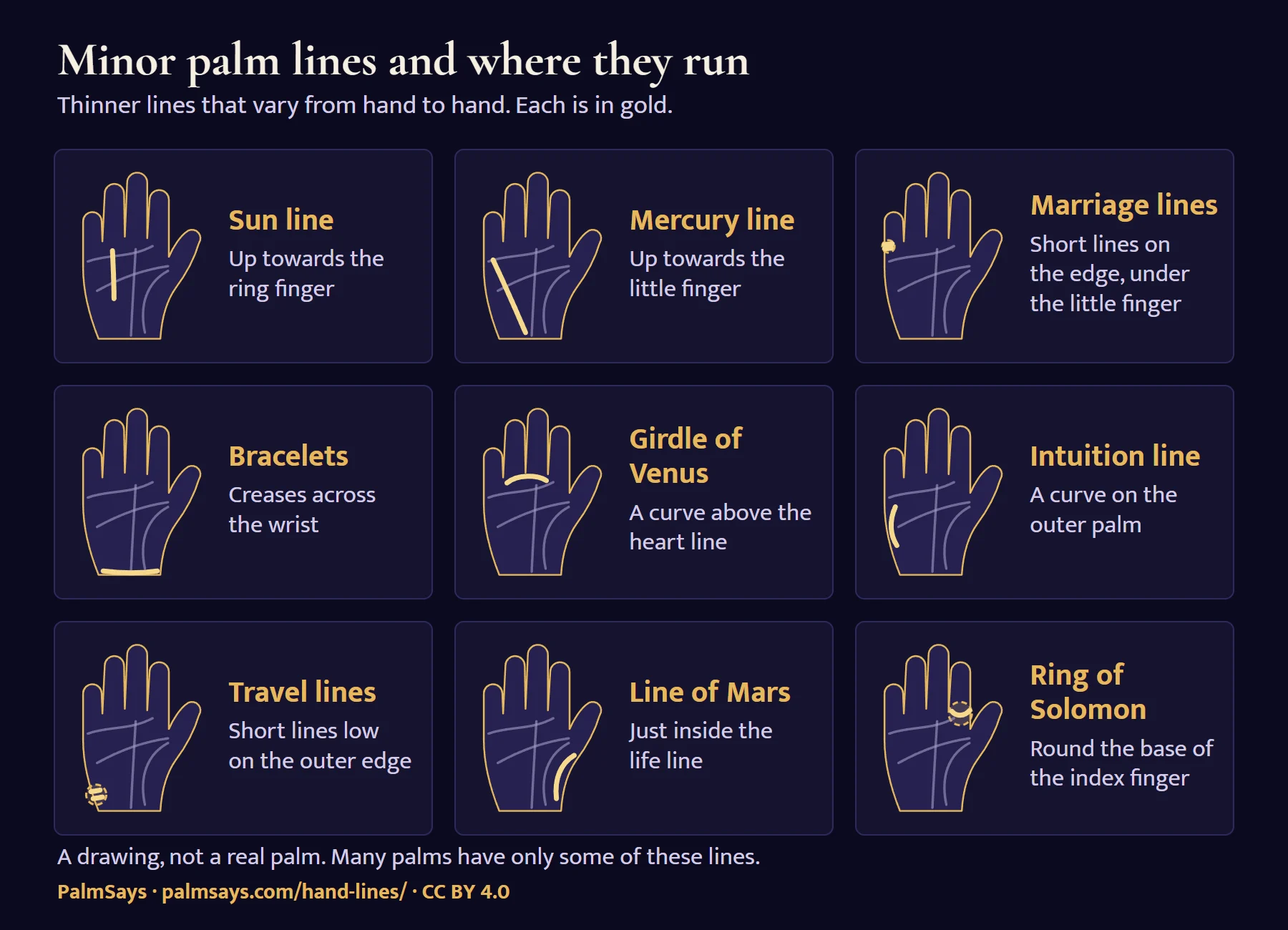
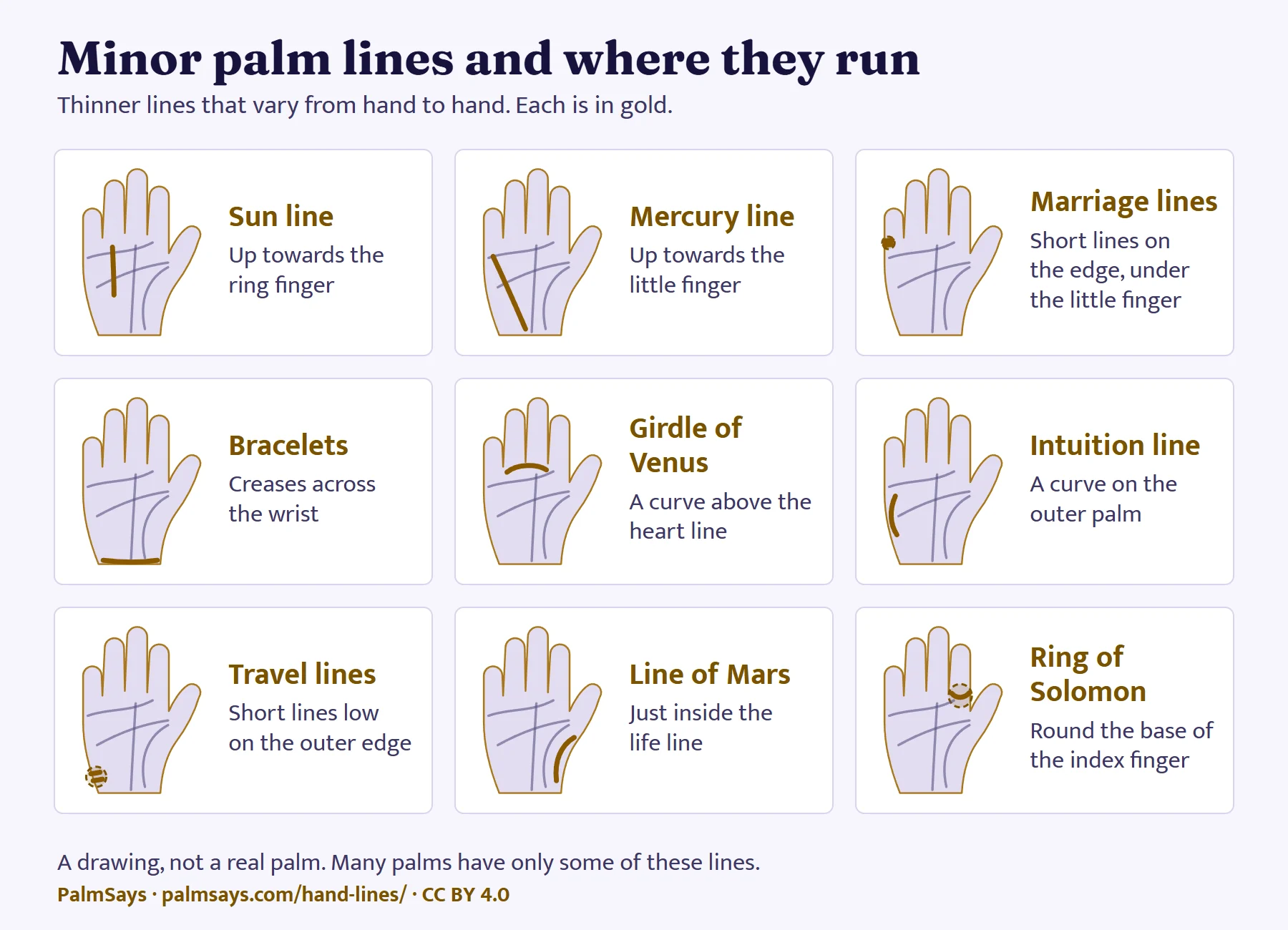
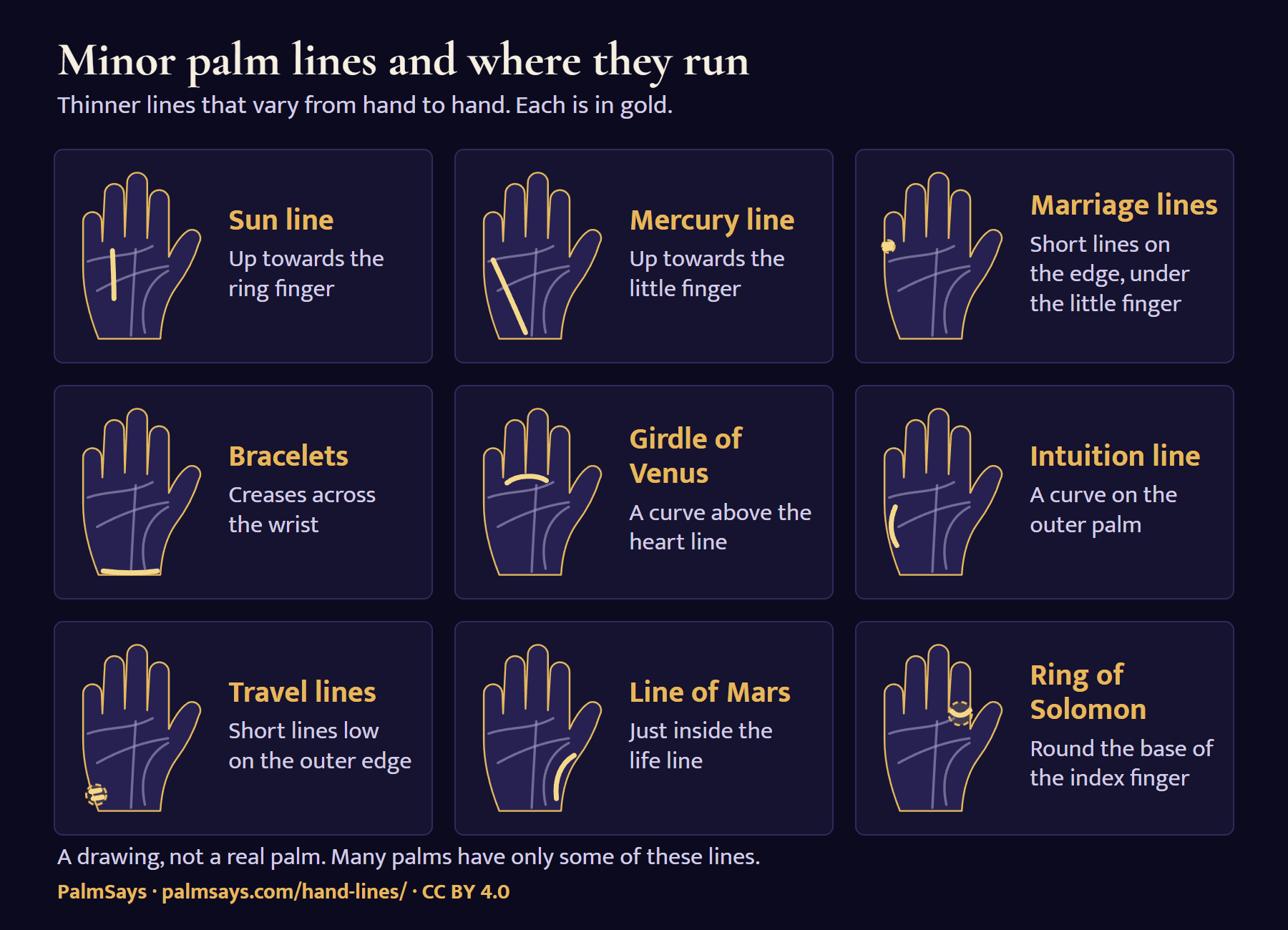
Travel lines are read for a restless, change-loving nature. No line on the hand can book a ticket or give a date.
The outer edge of the palm below the little finger is the Mount of the Moon. Tap it in the interactive palm map to see where travel lines are looked for on a hand.
Travel line types and what the books read in them
The books describe four kinds of travel line. Each row gives the reading in our own words, and the book it comes from.
| Where the line sits | What the books read | What we keep | Source |
|---|---|---|---|
| Short lines coming in from the outer edge, on the mount of the Moon | Journeys and voyages; Cheiro calls these the minor travels | A restless streak and a love of new places | Cheiro (1900, 1916); Markun (1927) |
| A fine line or branch leaving the life line towards the Moon mount | Cheiro: more important journeys; a split life line, a move from one’s native land | A wish for big change in how and where you live | Cheiro (1900, 1916) |
| A line rising from the first wrist crease into the outer palm | Cheiro: more important journeys than the edge lines; Jain: an unsettled life in many places | Restlessness and a liking for change | Cheiro (1900); Jain (1927); Dale (1895) |
| A line from the wrist to the mount of Mercury, under the little finger | Dale: life in a foreign country, held in esteem | Nothing as a forecast: it is the old “foreign line” reading | Dale (1895) |
Lines on the edge of the palm
These are the classic travel lines: short, roughly level lines that run in from the little-finger edge, low on the palm. Cheiro’s Language of the Hand (1900) calls them the lines that relate to the minor changes or travels of a person.
Markun (1927) gives the same old reading in one line: lines on the edge in the district of the Moon show voyages. The PalmSays rule set reads a full mount of the Moon as a strong imagination with a love of travel, scenery and anything new. The mount of the Moon section of the mounts guide explains that pad.
A life line branch towards the Moon
Cheiro thought this the most important travel sign. When the life line divides and one branch leans over towards the mount of the Moon, he reads a life full of change, and in Language of the Hand a great change from one’s native land to another.
The app keeps the tendency: a life line that ends towards the outer palm is read as restlessness and a strong wish to travel and see new places. The forked life line card shows the shape. A life line that keeps its curve round the thumb is read the other way, as a settled pattern that keeps to familiar ground.
Lines rising from the wrist
Some palms show a line rising from the first wrist crease (the first of the bracelet lines) up into the outer palm. Cheiro calls these much more important than the edge lines, and Benham (1900) says they rise from the first bracelet and are read as part of it.
Chhotelal Jain’s Hindi book (1927, p. 29) reads a line from the wrist (मणिबंध, manibandh) into the mount of the Moon as an unsettled life, lived in many places. That is the nearest the books we use come to the popular “foreign settlement line”.
The old “foreign country” line
Mrs Dale’s Indian Palmistry (1895) gives the clearest foreign reading. A clear, straight line from the bracelets to the mount of the Moon presages many journeys by land and sea, and one that runs on to the mount of Mercury says a person will live in a foreign country in great esteem.
We report it because it is what many readers mean by the foreign travel line. We don’t repeat it as a forecast: a visa, a job abroad or a move depends on things no crease can show.
Is there a foreign travel line in palmistry?
Not as one fixed line. The old books read several lines for long journeys and life abroad: Cheiro the life line branch to the Moon mount, Dale the line from the wrist to the little-finger mount, and Jain the line from the wrist into the Moon mount.
What they share is a direction: towards the outer, lower palm, the pad the books link with imagination and restlessness. So the honest reading is about temperament. A person with these lines is read as someone who likes change and new places, not as someone a line has sent abroad.
Can travel lines predict when you will travel?
No. Cheiro dated journeys by where the fine lines leave the life line, and he even listed birth dates for which he thought travel by water or by land was riskier. We leave all of it out: no line gives a date, and no line can tell how a journey will go.
Cheiro also read small marks at the end of a travel line: a cross for disappointment, an island for loss, a square for protection. These marks are a few pixels wide in a phone photo, and they are forecasts about events, so we don’t repeat them. The crosses on the palm guide covers the cross in general.
Are travel lines real or just creases?
They are creases in the skin, like every palm line, and the outer edge of the palm folds a great deal when you cup or grip. Benham (1900) went further: he said the cross lines on the side of the hand had been wrongly called travel lines, and that the reading came from the restless, change-loving nature the books link with the mount of the Moon.
His own reading is the one we keep. Strong lines on that pad, he says, add to a love of change and travel, and such a person will take the chances to travel that come. Even then the travels may be in the mind: he describes a man who changed from business to books and travelled a great deal in thought while taking few real journeys.
What does no travel line mean?
Nothing bad. Many palms have no clear lines on the outer edge, and a smooth mount of the Moon is common. It does not mean you will never travel or never live abroad.
The books that read travel lines also read the whole hand: the shape, the mounts and the main lines. A missing minor line takes nothing away from them.
Travel lines in the left and right hand, for women and men
Travel lines are read the same way for everyone. What changes is which hand you look at. Tradition reads your writing hand as the life you are making and the other as what you started with, so compare both. The guide to which hand to read explains the traditions, including the Indian custom of reading a woman’s left hand and a man’s right.
Can a phone photo show travel lines?
Rarely. Travel lines are fine, they sit on the curve at the edge of the hand, and a palm photo taken straight on barely shows that edge. That is why the PalmSays app leaves them out rather than guess.
What a photo does show well is the life line and where it ends. The palm reading app reads that end, and the lines on your palm chart shows where every minor line sits. Each term on this page is also in the palmistry terms glossary.
Myths about travel lines
- MythMany travel lines mean you will live abroad.
- Reality
The old books read restlessness and a love of change in them. Whether you move abroad depends on work, money, family and choice, not on lines.
- MythYou can count your trips on your palm.
- Reality
No book we use gives a fixed count, and lines on the outer edge also come from how the hand folds. Even Benham doubted the old journey readings.
- MythNo travel line means you will never travel.
- Reality
A missing minor line is common and means nothing bad. Plenty of people with smooth palms travel the world.
Quick facts
- Hindi names
- यात्रा रेखा (yatra rekha); the “foreign travel line” is विदेश यात्रा रेखा (videsh yatra rekha)
- Other names
- Lines of travel, voyage lines, journey lines. Older books also call the lines from the wrist “travel lines”.
- Where they sit
- Low on the outer edge of the palm (the mount of the Moon), as fine branches from the life line towards that pad, or rising from the first wrist crease.
- What the tradition reads in them
- Restlessness, curiosity and a love of change and new places.
- Which hand
- Look at both. Tradition reads your writing hand as the life you are making. Which hand to read
- What the app reads
- The PalmSays app doesn’t read travel lines. It does trace the life line, and reads a life line that ends towards the outer palm as a wish to travel.
Questions people ask
What are travel lines on the palm?
Short lines on the outer edge of the palm, low on the mount of the Moon, and fine lines that leave the life line and bend towards it. Cheiro read them as journeys; we read them as a love of change.
Which line shows foreign travel in palmistry?
Cheiro read a life line that splits, one branch going to the mount of the Moon, as a big change from one’s native land. Dale reads a line from the wrist to the little-finger mount as life in a foreign country. Both are tendencies at most; no line can show a visa or a move.
Do travel lines mean I will go abroad?
No. They are read for restlessness and a wish for change. Whether you travel or settle abroad depends on work, money, family and choice, not on creases in your skin.
Can travel lines tell when I will travel?
No. Cheiro dated journeys from where they leave the life line, but no line gives a date, and we never calculate one.
Which hand shows travel lines, left or right?
Look at both. Tradition reads your writing hand as the life you are making and the other as what you started with. More in which hand to read.
Does the PalmSays app read travel lines?
No. They are too fine and sit too close to the edge of the hand for a phone photo. The app traces the life line, and reads one ending towards the outer palm as a wish to travel.
Sources (7 books and studies)
- Cheiro, Palmistry for All (1916). Part I, ch. XIV: Travels, Voyages and Accidents, p. 97.
- Cheiro, Cheiro’s Language of the Hand (1900). Part II, ch. XXV: Travel, Voyages, and Accidents, pp. 139–141.
- Cheiro, Cheiro’s Guide to the Hand (1900). Ch. XXI: Minor Signs (Travels, Voyages, and Accidents), pp. 115–116.
- William G. Benham, The Laws of Scientific Hand Reading (1900). Part I, ch. XXIV: The Mount of the Moon, pp. 299–300; Part II, ch. XIV: The Minor Lines (The Rascettes, and Lines of Travel), pp. 621–622.
- Leo Markun, What You Should Know About Palmistry (1927). The section on the Mount of the Moon.
- Mrs J. B. Dale, Indian Palmistry (1895). Lines, No. 17: Dragon lines or Bracelets; No. 54: Luna lines; the section “The Bracelets Line”.
- Chhotelal Jain, Samudrik Shastra ya Bhagya Nirnay (1927). The section on the lines of the palm: a line from the wrist (manibandh) into the mount of the Moon, p. 29. (in Hindi)
Meanings on this page are written in our own words from these books. Books whose rights are unclear are used for facts only, never quoted. How we choose sources
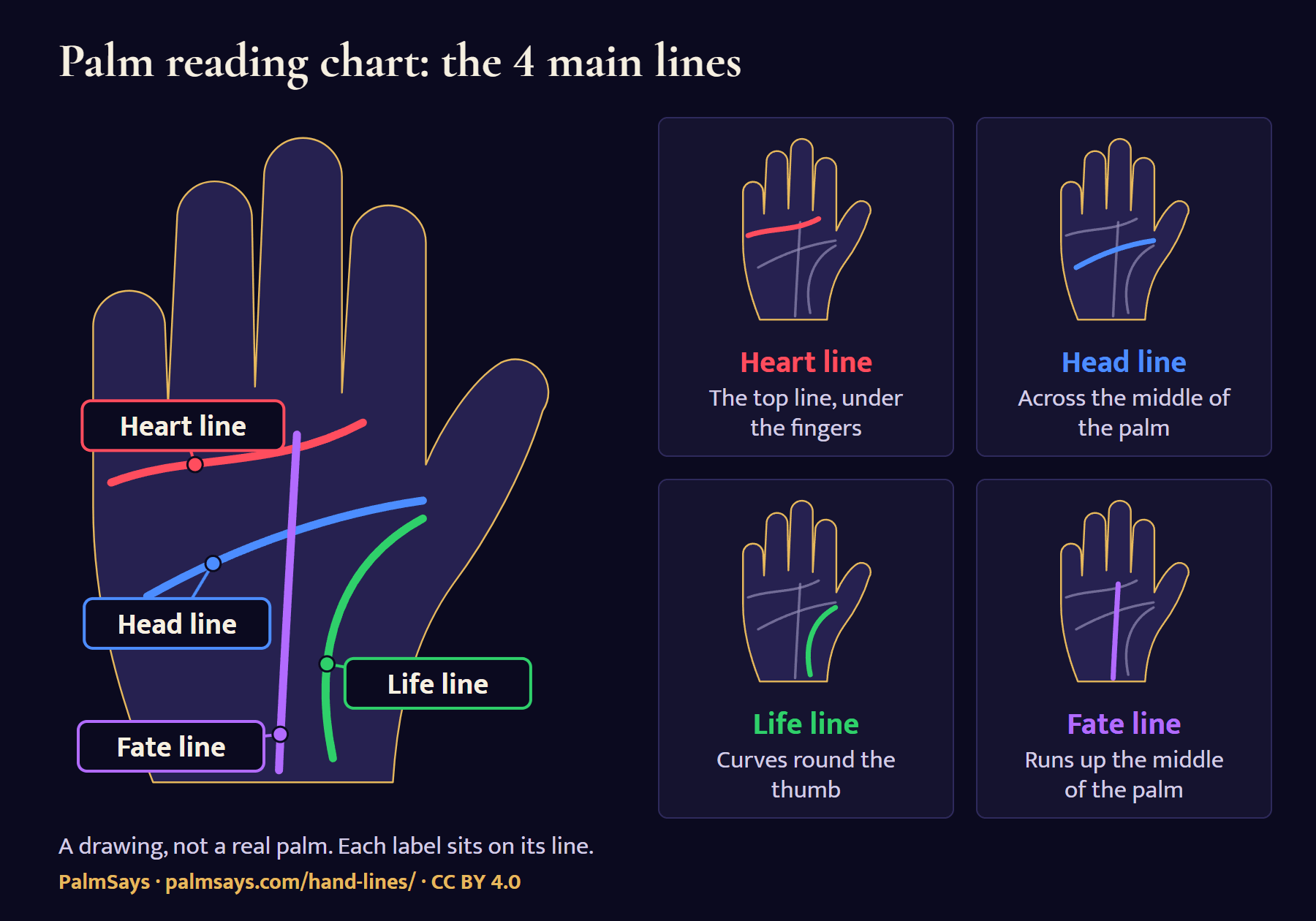
The diagrams on this page are free to reuse under CC BY 4.0 with credit to PalmSays (palmsays.com).Full-size diagram: Palm reading chart: the 4 main lines (PNG, 1800 × 1260)
See your own lines
Upload one photo of your palm. We trace your lines and show what palmistry says about each one.
- Open palm
- Good light
- Whole hand in the frame
A phone photo shows the main lines and their breaks, forks and branches. Tiny marks such as stars and crosses are too small, so an honest reading leaves them out.
Coming soon on Google Play. The Android app is not on Google Play yet. This page will get the link the day it is.
The iPhone app isn’t ready yet. You can keep using this website.
Or see what the PalmSays palm reading app reads before you install it.
Read next: Lines on your palm and what they mean