Bracelet lines on the wrist: what palmistry reads (and what it doesn’t)
No, bracelet lines don’t show how long you will live. Some old books gave each wrist line 25 to 30 years; Benham found no proof and Cheiro called them of little importance. They are read for steadiness, never lifespan.
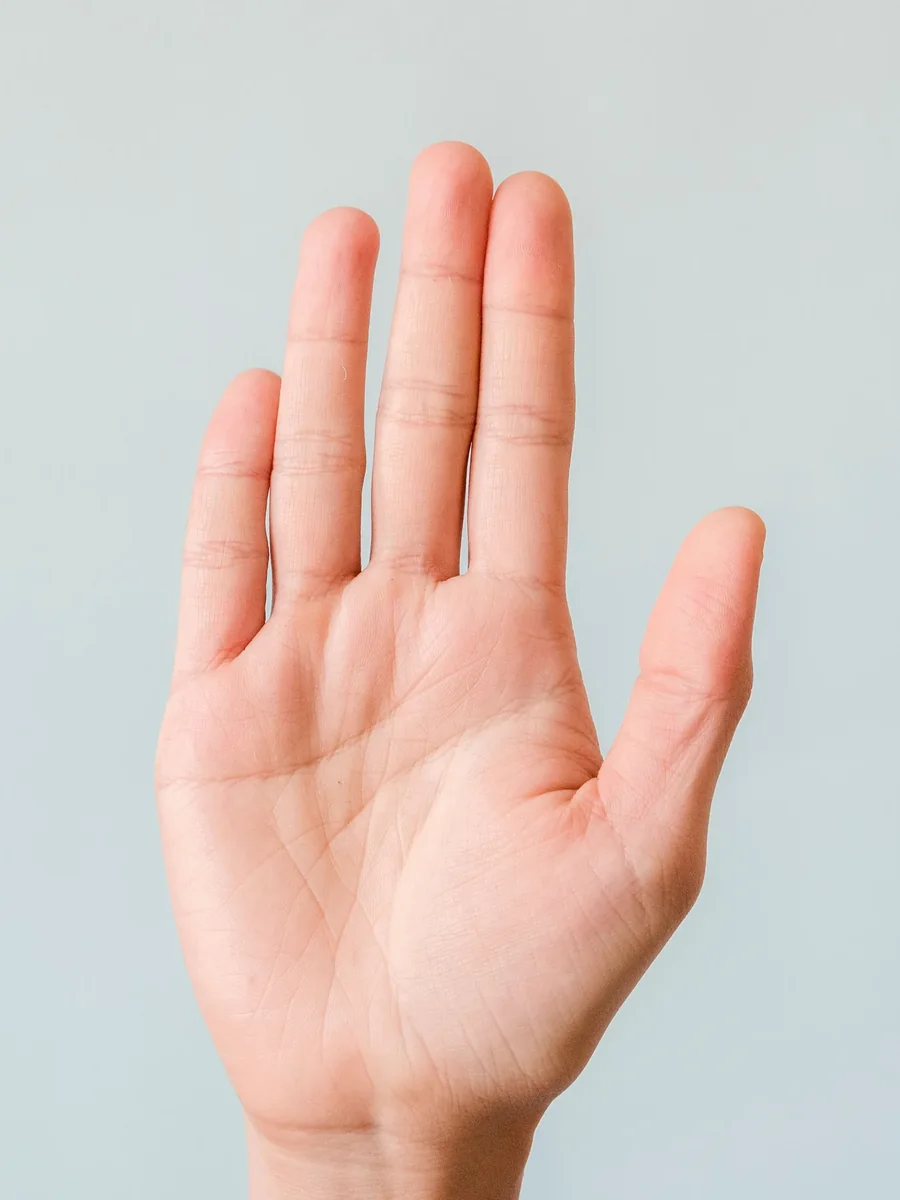
A real palm photo (Kevin Malik, Pexels), traced by the real PalmSays scanner. Your reading is made from your own photo.
Where are the bracelet lines on your wrist?
Turn your hand over and bend it back a little. How many creases cross the inside of your wrist?
- Hold your hand palm up in good light and bend the wrist back slightly.
- Look just below the base of your palm: the creases that run across the wrist are the bracelets.
- The one nearest the palm is the first bracelet (the rascette). Most books read only that one.
- Count them if you like, but don’t read anything into the number: the creases deepen and fade as the wrist bends.
On this page
- Do bracelet lines show how long you will live?
- What are bracelet lines in palmistry?
- What do bracelet lines mean?
- How many bracelet lines do most people have?
- What is a royal bracelet?
- Bracelet lines in the left and right hand, for women and men
- Can a phone photo show bracelet lines?
- Myths about bracelet lines
- Questions people ask
- Sources
Do bracelet lines show how long you will live?
No. Bracelet lines are not read as lifespan here, and the most careful of the old books refused to read them that way too. The creases on your wrist are where the wrist bends, and their number says nothing about your years.
- What you see
- You have one, two or three creases across your wrist, and you have read that each one is worth 25 years.
- What the tradition says
- Some 19th-century books did say that each bracelet gave 25 to 30 years of life. Benham (1900) looked for proof, found none and never used them for longevity. Cheiro called the bracelets of little importance.
- What it can’t tell you
- Wrist lines can’t tell your lifespan or your health. For health, talk to a doctor. The number of creases also changes with how far you bend your wrist.
The claim has a clear history. Edward Heron-Allen’s Manual of Cheirosophy (1885) says each bracelet is “said to be the indication of twenty-five to thirty years of life”, and that a well-braceleted wrist will still ensure a long life when the life line is short. Katharine St. Hill (1893) gives some thirty years a line, Albert Raphael (1901) about 27, and Henry Frith (1895) nearly thirty, to be checked against the life line.
An Indian book makes the same kind of claim. Chhotelal Jain’s Hindi Samudrik Shastra (1927) reads the number of wrist lines (प्रकोष्ठ रेखा, prakoshth rekha) as a number of years, from four lines down to two. We don’t repeat his figures.
The other side is just as old. Leo Markun (1927) reports that the bracelets are “sometimes said to show the number of years the subject will live”, as one reading among several he doubts. William Benham (1900) says he looked for confirmation of the thirty-years-a-bracelet tradition, found none, and never used the bracelets to judge how long anyone lives. Cheiro said they were of very little importance in reading the hand.
Bracelet lines are not a count of years. Even the old books disagreed, and the most careful of them dropped the claim.
What are bracelet lines in palmistry?
Bracelet lines are the creases that run across the inside of the wrist, just below the palm. In Hindi they are मणिबंध (manibandh). Palmistry books also call them rascettes, the bracelets of life, or, after an old Greek name, the bracelets of health, wealth and happiness.
Benham says there are sometimes three and may be only one, and that only the first, the one nearest the palm, is worth reading. The old books also name a four-line “royal bracelet”. Heron-Allen calls the whole wrist area the rascette and the lines across it the bracelets.
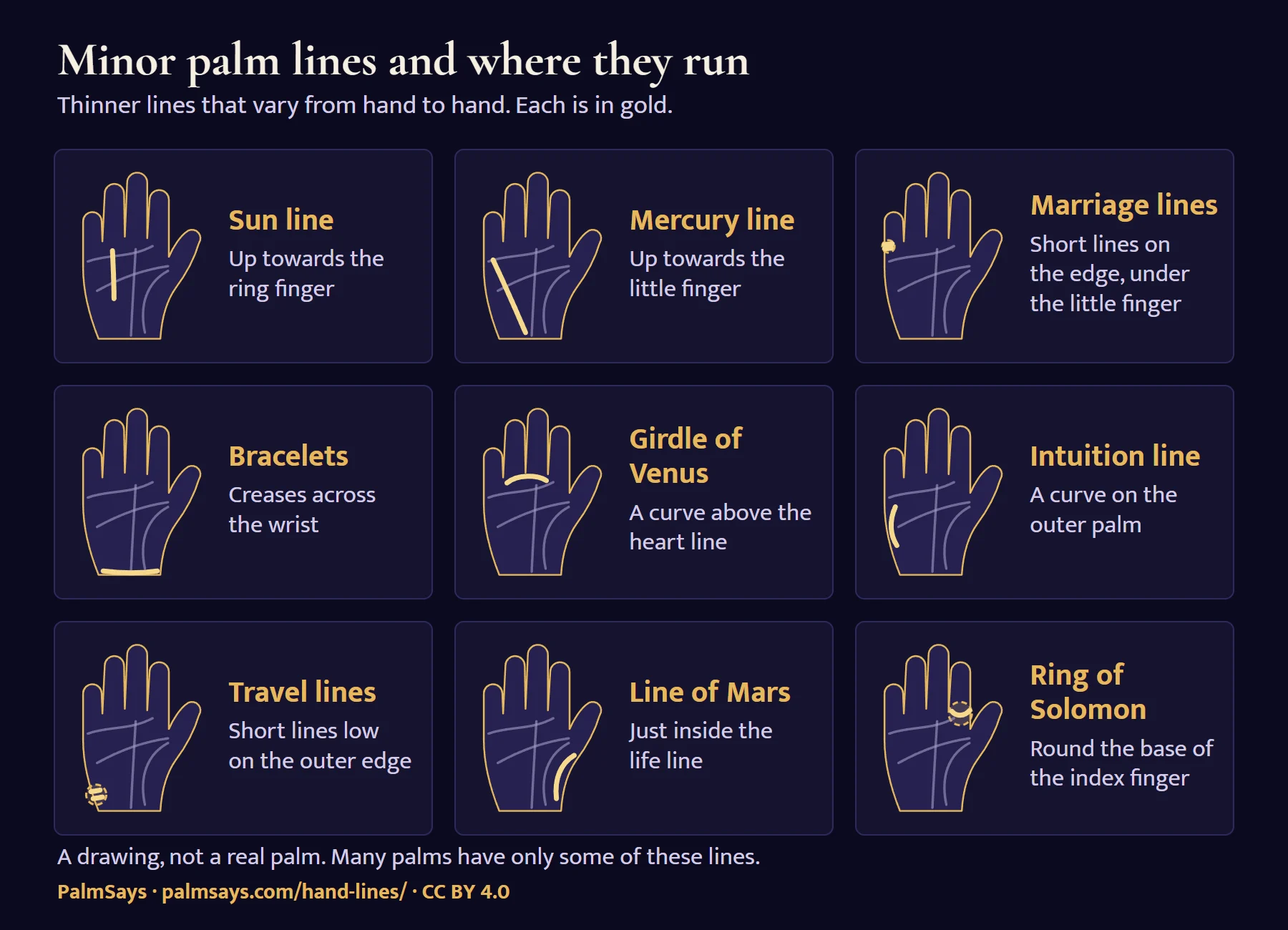
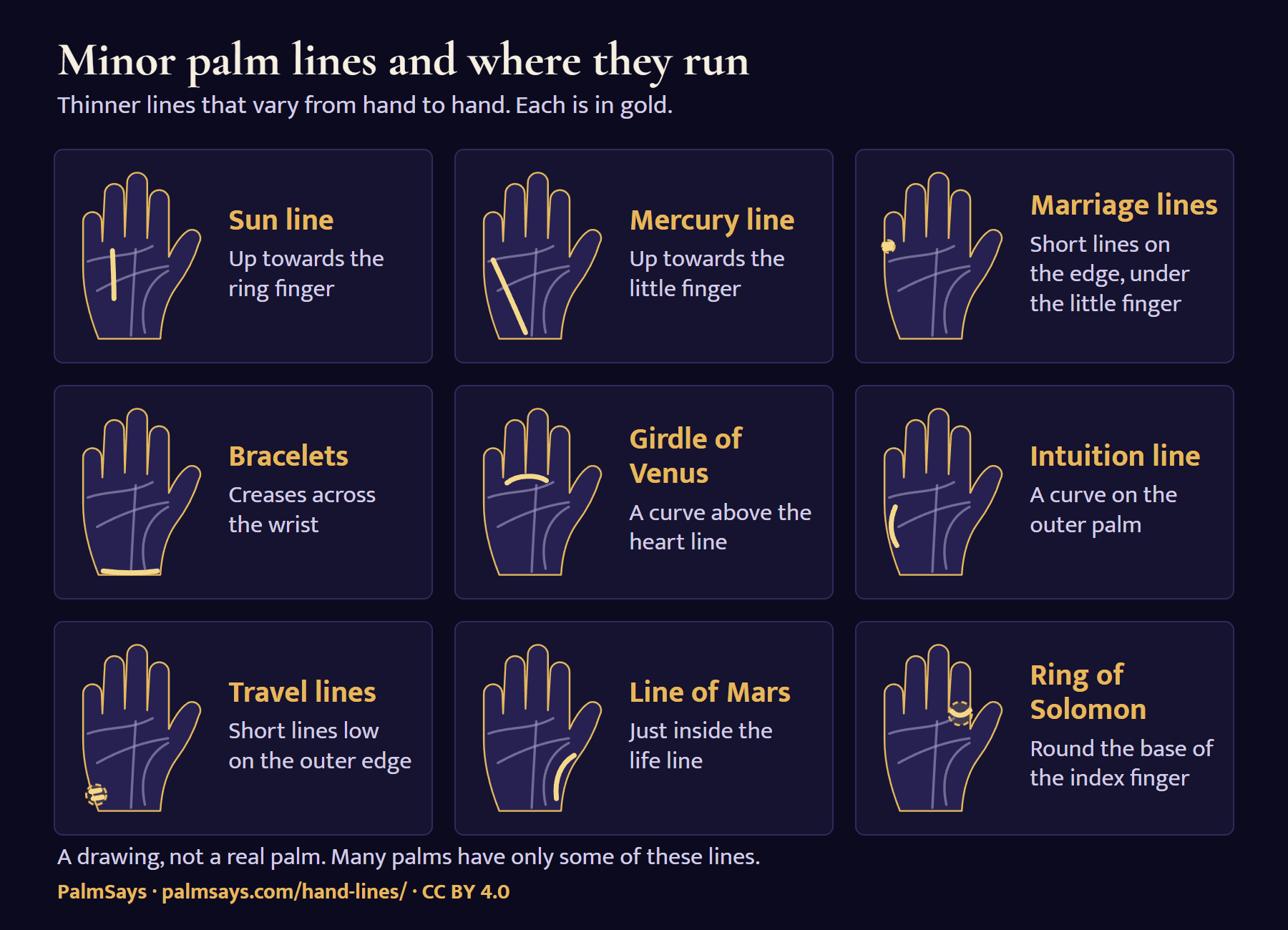
The PalmSays scanner traces the four major lines, and a palm photo usually crops the wrist, so the photo at the top shows no bracelets. The chart below shows where they sit.
What do bracelet lines mean?
The careful readings are short. Cheiro’s Language of the Hand (1900) says that well and clearly marked bracelets go with a strong, healthy constitution, and Benham reads a deep first bracelet as one more sign of a strong constitution beside a deep life line. Those are physical readings; we keep only the part about temperament, a steady, even nature, because palm and wrist lines are not a health test.
| Form | What the books read | What we keep | Source |
|---|---|---|---|
| Clear, even lines | A calm disposition (St. Hill); good composure of body (Dale) | A steady, even temperament | St. Hill (1893); Dale (1895) |
| Chained first line | A life of hard work, with success at last | Persistence | Heron-Allen (1885); St. Hill (1893) |
| Lines rising towards the palm | High-minded ideas and noble views of life | High ideals | St. Hill (1893); Frith (1895) |
| Short branches rising from the first bracelet | A rising tendency, ambitious effort and a wish to improve | Ambition | Benham (1900) |
| A line from the wrist into the mount of the Moon | Journeys; a life in many places | A restless, change-loving streak | Cheiro (1900); Dale (1895); Jain (1927) |
| An arch in the first bracelet | Health and childbearing | Nothing: it is a medical claim | Cheiro (1900, 1916); Benham (1900) |
| The number of lines | Years of life | Nothing: it is a lifespan claim | Heron-Allen (1885); Jain (1927) |
Clear, even bracelets
Clear, even lines across the wrist are the form the books read most kindly. Mrs Dale’s Indian Palmistry (1895) reads two or three lines forming a straight, continuous tract as good composure of body, and three as health, wealth and prosperity.
Cheiro was dry about that promise. He wrote that the three bracelets are seldom found together, because life rarely brings health, wealth and happiness at once. We keep only the calm, even temperament St. Hill reads in them.
Chained or broken bracelets
A chained first line is read as a life of hard work with good results in the end (Heron-Allen, St. Hill). Badly marked, broken lines are read in the old books as extravagance or trouble. We keep the first as persistence and leave the second out: a broken crease on the wrist is not a judgement of anyone.
An arched first bracelet
When the first bracelet rises into the palm in an arch, Cheiro and Benham read a delicate constitution, and Cheiro tells a story of Greek priests who would not let a woman with this sign marry. These are claims about health and childbearing, and no crease can show either. We name them only to refuse them.
Lines rising from the bracelets
Some lines rise from the first bracelet up into the palm. Benham reads short branches as ambition and a wish to improve. Long ones that reach the outer palm are the old travel lines: Cheiro read them as important journeys, and Jain’s Hindi book as a life lived in many places. The travel lines on the palm guide covers them.
How many bracelet lines do most people have?
There is no fixed number. Benham saw anything from one to three, and the old books also describe four. No book we use counts them across many people, and we know of no study that does, so we give no percentages.
What does change the count is how you hold your wrist. Bend it back and more creases show; keep it straight and some fade. That alone is a good reason not to read anything into the number.
What is a royal bracelet?
A “royal bracelet” is the old name for four clear wrist lines. St. Hill (1893) and Raphael (1901) promise its owner every good thing the world offers. No line can promise that, and four creases are simply four places where your wrist folds.
Bracelet lines in the left and right hand, for women and men
Bracelet lines are read the same way for everyone. The old readings that singled out women’s wrists were about childbearing, and we don’t repeat them. Tradition reads your writing hand as the life you are making and the other as what you started with, so you can compare both wrists if you like. The guide to which hand to read explains the traditions.
Can a phone photo show bracelet lines?
Only if you take a photo of the wrist itself. A palm photo for a reading usually crops just below the palm, so the PalmSays app doesn’t read the bracelets. It traces the four major lines, and its meanings come from a fixed rule set built from the palmistry books. The lines on your palm chart shows every minor line, and the bracelets have their own entry in the palmistry terms glossary.
Myths about bracelet lines
- MythEach bracelet line adds 25 years to your life.
- Reality
Some 19th-century books said so. Benham looked for proof and found none, and Markun reported it as one belief among several. No crease on your wrist counts years.
- MythOnly one bracelet line means a short life.
- Reality
One line does not mean a short life. Wrist creases vary from person to person and with how far the wrist bends.
- MythAn arched wrist line means you can’t have children.
- Reality
That old reading is a medical claim no crease can make. For any question about health or fertility, talk to a doctor.
Quick facts
- Hindi names
- मणिबंध (manibandh); Jain’s Hindi book calls the wrist lines प्रकोष्ठ रेखा (prakoshth rekha)
- Other names
- Rascettes, wrist lines, the bracelets of life, the bracelets of health, wealth and happiness. Dale’s Indian Palmistry calls them the Dragon lines.
- Where they sit
- Across the inside of the wrist, just below the palm. The one nearest the palm is the first bracelet, or rascette.
- What they are not
- A count of years. Wrist creases are where the wrist bends; their number is never read as lifespan.
- What the tradition reads in them
- At most, a steady, even constitution and temperament when they are clear and even.
- What the app reads
- The PalmSays app doesn’t read the bracelets. A palm photo usually crops the wrist.
Questions people ask
Do bracelet lines show how long you will live?
No. Some old books gave each wrist line 25 to 30 years, and an Indian book gave years by the number of lines. Benham (1900) found no proof and never used them for lifespan. We don’t either.
What do three bracelet lines mean?
The Greek name for them was the bracelets of health, wealth and happiness. Cheiro joked that the three are rarely found together. Read clear, even lines as a steady temperament, and nothing more.
What does a fourth bracelet line mean?
Some books call four lines a “royal bracelet” and promise every good thing from it. No line can promise anything, and the number of wrist creases varies with how the wrist bends.
What does it mean if my first bracelet line arches into the palm?
The old books read health and childbearing into it. Palm and wrist creases are not a medical test, so we don’t repeat that. For any health question, talk to a doctor.
Do bracelet lines show travel?
The old books read lines rising from the first bracelet into the outer palm as travel lines. Read them as a restless, change-loving streak, never as a trip or a date: see travel lines on the palm.
Does the PalmSays app read bracelet lines?
No. A palm photo usually crops the wrist, and the app traces the four major lines only.
Sources (10 books and studies)
- William G. Benham, The Laws of Scientific Hand Reading (1900). Part II, ch. XIV: The Minor Lines (The Rascettes, and Lines of Travel), pp. 621–623.
- Cheiro, Palmistry for All (1916). Part I, ch. XI: The Girdle of Venus, the Ring of Saturn, and the Bracelets, p. 91.
- Cheiro, Cheiro’s Language of the Hand (1900). Part II, ch. XV: The Girdle of Venus, the Ring of Saturn, and the Three Bracelets, p. 113.
- Leo Markun, What You Should Know About Palmistry (1927). The section on the minor lines (the Bracelets or Rascia).
- Edward Heron-Allen, A Manual of Cheirosophy (1885). Section II, sub-section VII, § 3: The Rascette and Restreintes, ¶¶ 764–773, pp. 289–290.
- Katharine St. Hill, The Grammar of Palmistry (1893). The Bracelets (Rascettes), pp. 68–69.
- Henry Frith, Practical Palmistry (1895). Lines upon the Wrist.
- Albert Raphael, Cheirosophy (1901). The Bracelets or Rascettes.
- Mrs J. B. Dale, Indian Palmistry (1895). Lines, No. 17: Dragon lines or Bracelets; the section “The Bracelets Line”.
- Chhotelal Jain, Samudrik Shastra ya Bhagya Nirnay (1927). Prakoshth rekha (the wrist lines), pp. 8–9. (in Hindi)
Meanings on this page are written in our own words from these books. Books whose rights are unclear are used for facts only, never quoted. How we choose sources
See your own lines
Upload one photo of your palm. We trace your lines and show what palmistry says about each one.
- Open palm
- Good light
- Whole hand in the frame
A phone photo shows the main lines and their breaks, forks and branches. Tiny marks such as stars and crosses are too small, so an honest reading leaves them out.
Coming soon on Google Play. The Android app is not on Google Play yet. This page will get the link the day it is.
The iPhone app isn’t ready yet. You can keep using this website.
Or see what the PalmSays palm reading app reads before you install it.
Read next: Life line on your palm: what it shows (and what it doesn’t)