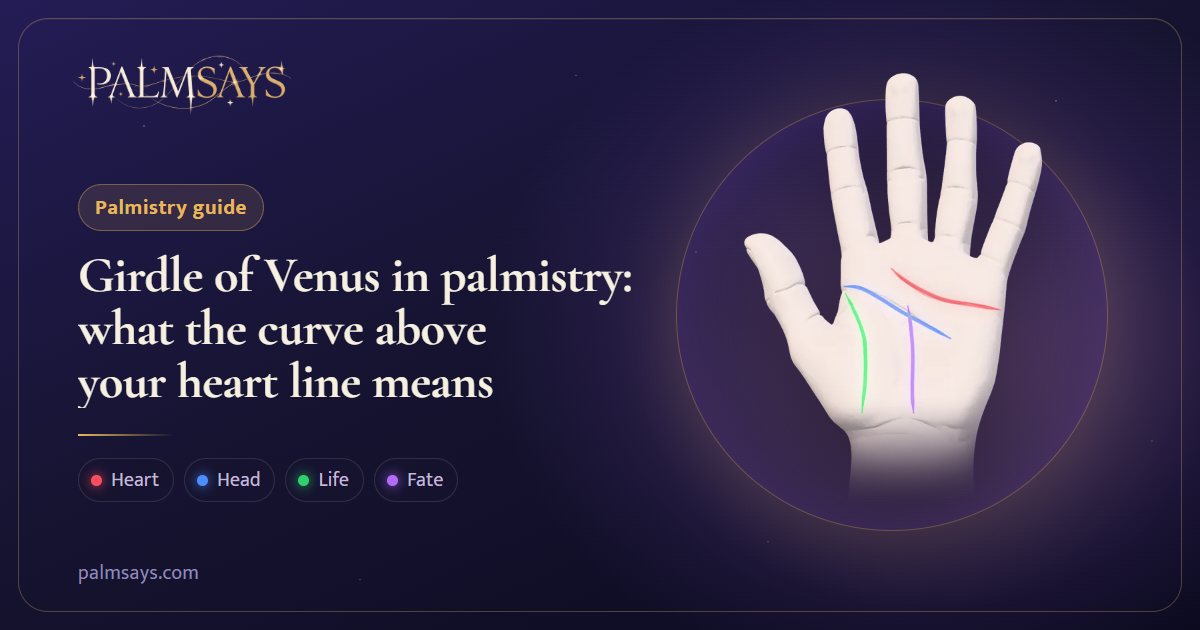
Girdle of Venus in palmistry: what the curve above your heart line means
The girdle of Venus is a curved line some palms show above the heart line, under the middle and ring fingers. Cheiro reads a sensitive, highly strung, imaginative nature. The old “lust” reading he rejected, and so do we.
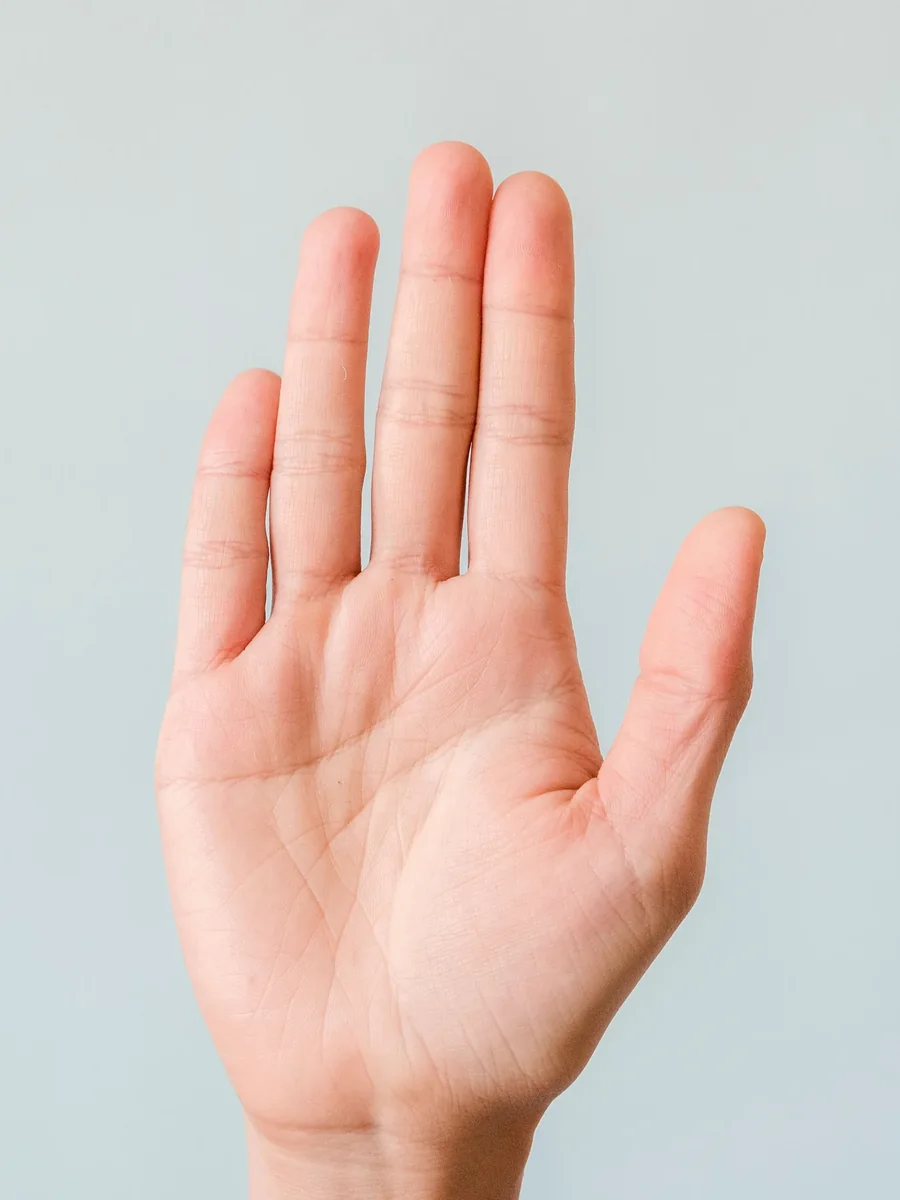
A real palm photo (Kevin Malik, Pexels), traced by the real PalmSays scanner. Your reading is made from your own photo.
Where is the girdle of Venus on your palm?
Look just above your heart line. Is there a second, curved line arching under your middle and ring fingers?
- Hold your hand up in good light, palm facing you, fingers together.
- Find your heart line, the top long line under the fingers.
- Look in the space between it and the base of your fingers for a curve that starts near the index or middle finger and ends near the ring or little finger.
- Many palms have only broken pieces of it, and many have none. Both are common.
On this page
- What is the girdle of Venus?
- What does the girdle of Venus mean?
- Girdle of Venus types and their meanings
- Is the girdle of Venus a bad sign?
- What does no girdle of Venus mean?
- Girdle of Venus vs heart line and ring of Saturn
- Girdle of Venus on both hands, for women and men
- Can a phone photo show the girdle of Venus?
- Myths about the girdle of Venus
- Questions people ask
- Sources
What is the girdle of Venus?
The girdle of Venus is a curved line some palms show above the heart line, arching under the middle and ring fingers. In Hindi it is शुक्र वलय (shukra valay). It is one of the minor lines, and many palms don’t have it.
Cheiro’s Palmistry for All (1916) describes it as a broken or sometimes unbroken half-circle rising from the base of the first finger to the base of the fourth. Benham (1900) places it a little more narrowly, rising between the index and middle fingers and ending between the ring and little fingers, and adds that it does not always keep to that path.
The PalmSays scanner traces the four major lines, not the girdle of Venus, so the photo at the top shows none. The chart below shows where the books place it, and the steps above help you find it on your own hand.
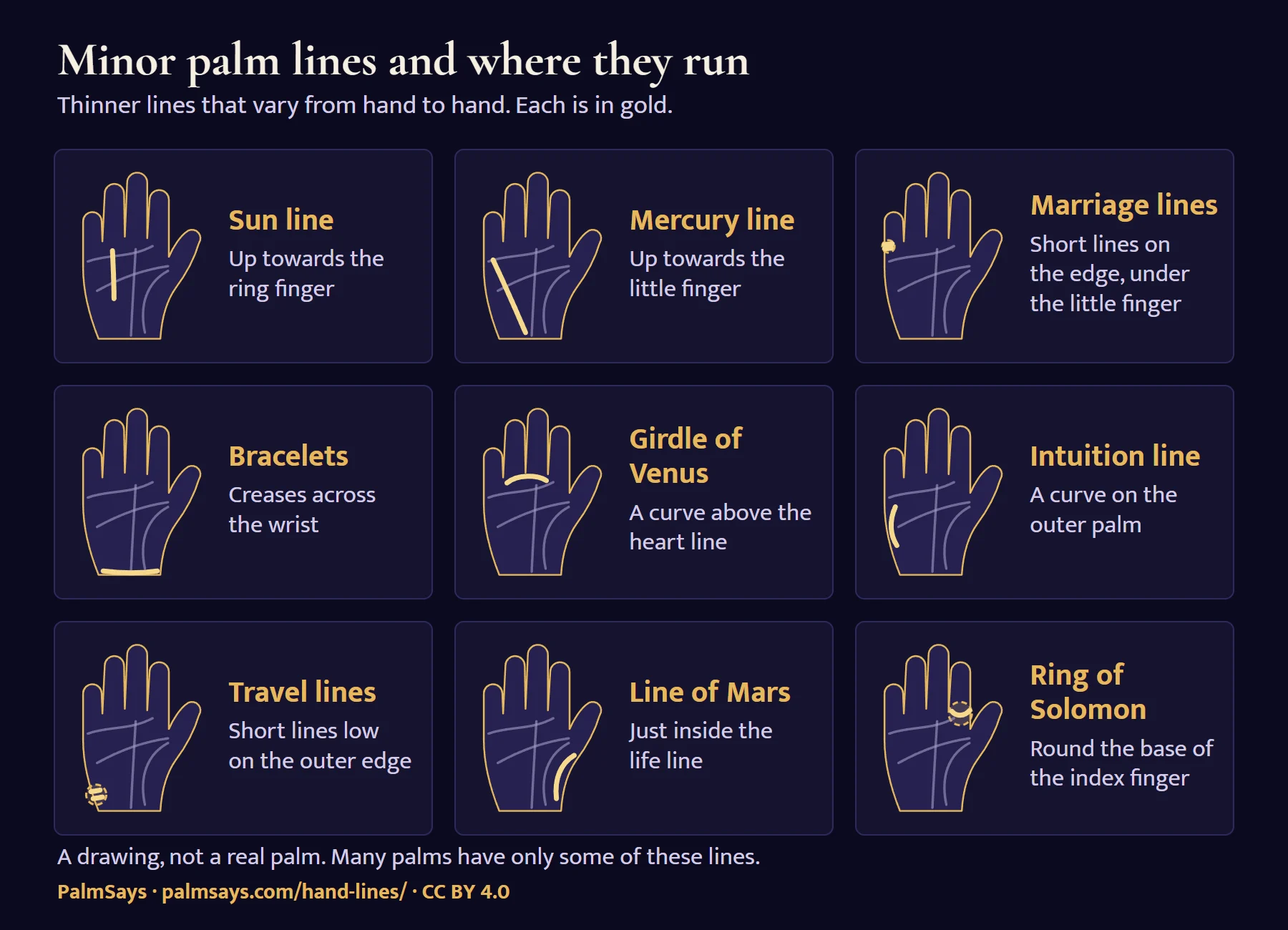
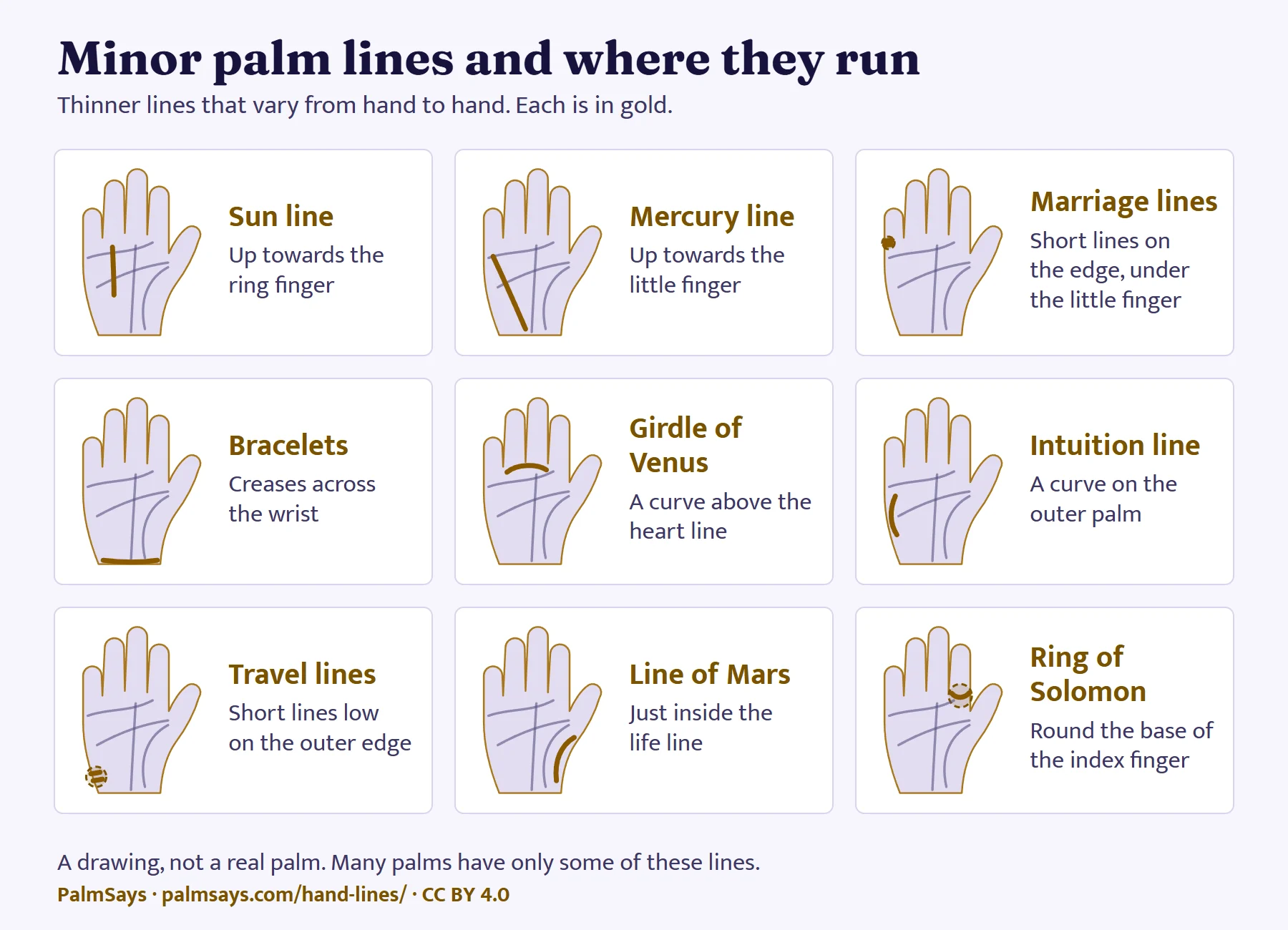
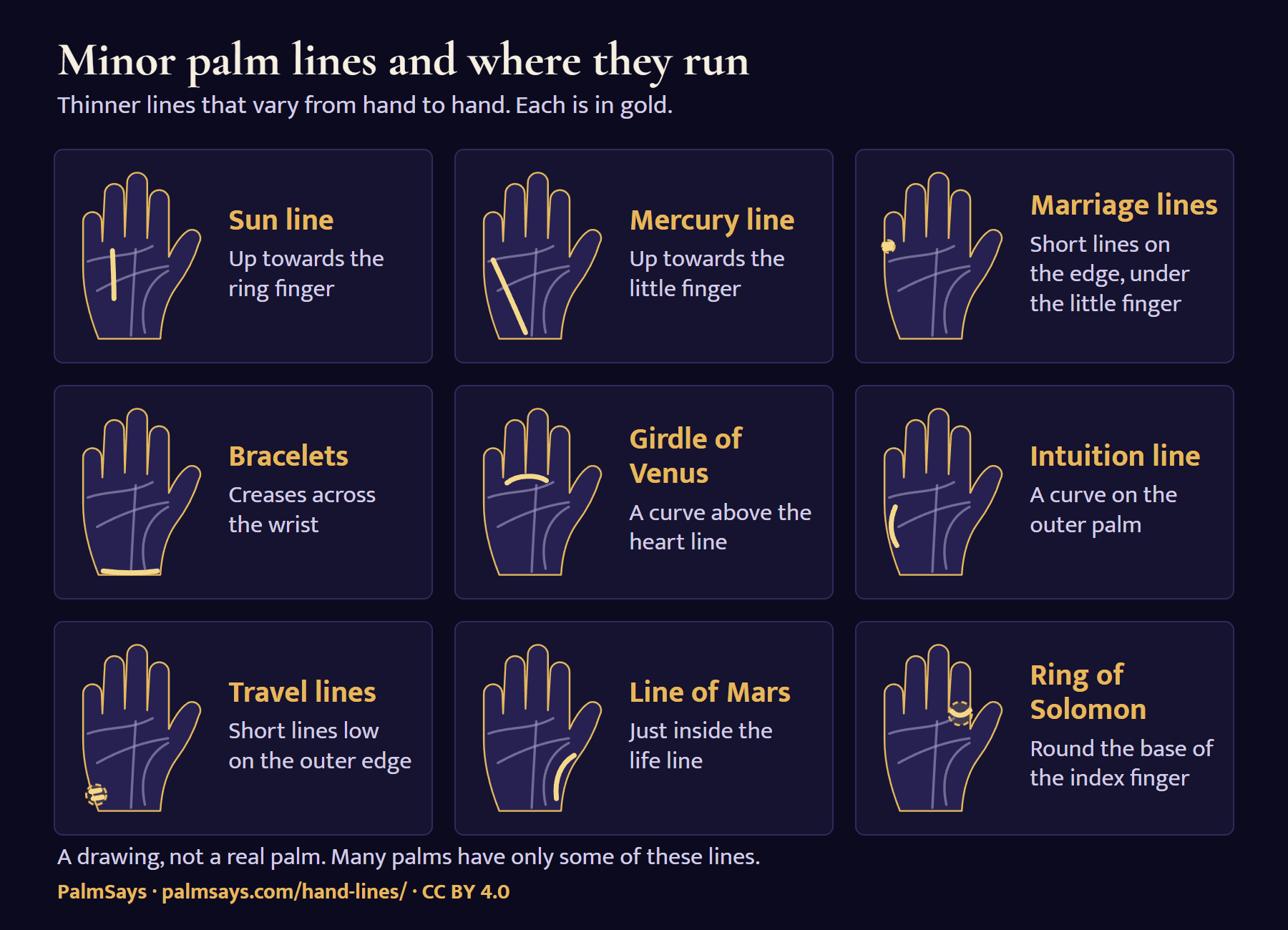
The girdle of Venus is read for sensitivity and mood, not for desire. The old “lust line” reading is the part the careful books dropped.
The girdle sits between the heart line and the fingers. If you are unsure which crease is your heart line, the heart line finder walks you through it step by step.
What does the girdle of Venus mean?
Cheiro reads it as a highly sensitive, intellectual and highly strung nature: quick to catch fire with enthusiasm, easily hurt over small things, and rarely in the same mood twice. In Cheiro’s Guide to the Hand (1900) he adds that it is usually found on the philosophic, conic and psychic hand types.
Benham (1900) tells the story of the name. Older palmists saw the line as a sister line to the heart line, so they read it as a double supply of affection and called it the girdle of Venus, the girdle of love. Over time that became a reading of excess, and Benham says many palmists gave the line up because the reading did not fit the people they met.
His own finding, after studying it, is that it nearly always goes with an intensely nervous, excitable nature. That is the part we keep: a sensitive, highly strung temperament. Benham also reads health into it, which we leave out, because palm lines are not a medical test.
Girdle of Venus types and their meanings
The books describe the line by how complete it is, how many curves there are and where it ends. Each meaning below is in our own words.
| Form | What the books read | What we keep | Source |
|---|---|---|---|
| One clear, unbroken curve | Cheiro: a highly strung nature with changeable moods | Strong feelings and quick enthusiasm | Cheiro (1900) |
| Broken into pieces | Cheiro: the same temperament, shown in moods; Benham: more nervous energy | Sensitivity that shows in changeable moods | Cheiro (1916); Benham (1900) |
| Two or three curves | Benham: the line’s qualities made stronger | The same sensitivity, more marked | Benham (1900) |
| Running off the edge into the marriage lines | Cheiro: moods that strain a marriage | Nothing as a forecast | Cheiro (1900, 1916) |
| From under the middle finger to under the little finger | Cheiro: the same qualities, darker | Nothing: his reading here judges character | Cheiro (1916) |
A clear, unbroken girdle
A single, clear curve is the form the books read most strongly. Cheiro reads a person who can rise to the highest pitch of enthusiasm over anything that catches their fancy, then sink just as fast.
He also links the unbroken form with despondency. We keep it as a temperament of highs and lows, not as a mood disorder: no palm line can show mental health.
A broken girdle of Venus
The girdle is often only a row of short pieces. Cheiro (1916) says a broken girdle has little meaning beyond showing the same highly strung temperament, and that such people feel their moods strongly.
Benham reads the broken form as more nervous energy and the deep, single form as the line’s more excessive side. Read a broken girdle as sensitivity first. A row of tiny creases under the fingers can also just be how your skin folds.
A double girdle of Venus
Benham says the girdle is often made of two or three lines, and that this makes its reading, whatever it is, doubly strong. So a double girdle is read as the same sensitive, excitable nature, more marked.
Dale’s Indian Palmistry (1895) reads a girdle with a sister line beside it as intemperance. That is a judgement of character, not a reading of temperament, and we leave it out.
Where the girdle ends
Cheiro reads a girdle that runs off the side of the hand and touches the marriage lines as moods that make a person exacting and hard to live with, and so strain a marriage. No line can foretell a marriage or how it goes, so we keep only the point about mood.
Is the girdle of Venus a bad sign?
No. It is the most misread of the minor lines, and the careful books say so themselves. Cheiro writes that he never found it to show the gross sensuality other writers gave it, and Benham found that as a rule it did not show the license the old books read in it.
Markun (1927) is blunter still. He reports Desbarrolles’ reading of immorality, then a rival view that Desbarrolles only looked at French hands, and ends with a joke that it might show a love of orchids or a fear of frogs. His point is fair: one curve can’t show how anyone lives.
Dale’s Indian Palmistry (1895) keeps the old reading, as an interest in the opposite sex, with harsh readings of the broken and doubled forms. We report that the reading exists and leave its details out, because it judges character.
What does no girdle of Venus mean?
Nothing bad. Most palms have no clear girdle of Venus, and it is not a missing part of the hand. Dale reads its absence as coldness towards the opposite sex; we don’t repeat that, because no line measures warmth.
Your heart line is the line the books read for how you feel and show affection. The girdle, when it is there, is read as adding sensitivity, never as the measure of it.
Girdle of Venus vs heart line and ring of Saturn
Three curves sit close together under the fingers, so they are easy to mix up:
- Heart line: the long line that crosses the palm under the fingers, from the little-finger edge towards the index or middle finger. It is read for your emotional style.
- Girdle of Venus: a separate curve above the heart line, arching under the middle and ring fingers. Benham calls it partly a sister line to the heart line, and says it can stand in for a missing heart line.
- Ring of Saturn: a much smaller curve round the base of the middle finger only. Cheiro gives it one of the darkest readings in his book; we don’t repeat it.
If a curve runs close beside your heart line for its whole length, it is more likely a double heart line than a girdle.
Girdle of Venus on both hands, for women and men
The girdle is read the same way for everyone. Benham says he saw it more often on women’s hands, but he gives no count. Tradition reads your writing hand as the life you are making and the other as what you started with, so a girdle on both hands is read as the same temperament, held from the start. The guide to which hand to read explains the traditions.
Can a phone photo show the girdle of Venus?
Sometimes, when it is deep and the light is good. A broken girdle is often only a few faint dashes, close to the creases at the base of the fingers, and a phone photo can lose it or invent it from shadow. The PalmSays palm reading app leaves it out for that reason.
Look at your own hand in bright light from one side, with your fingers held together. The lines on your palm chart shows every minor line, and the girdle has its own entry in the palmistry terms glossary.
Myths about the girdle of Venus
- MythThe girdle of Venus is a lust line.
- Reality
That old reading is the one Cheiro and Benham both said they did not find. The careful reading is a sensitive, highly strung nature.
- MythA girdle of Venus means an unhappy marriage.
- Reality
Cheiro linked one form with moods that strain a marriage. No line can foretell a marriage or how it will go.
- MythThe girdle of Venus is very rare and special.
- Reality
No book we use counts it. Benham says it turns up often enough to be a real minor line, often in broken pieces.
Quick facts
- Hindi name
- शुक्र वलय (shukra valay)
- Other names
- The girdle of love (Benham’s gloss of the name), the ring of Venus. It is not the ring of Saturn, a smaller curve under the middle finger only.
- Where it sits
- Above the heart line, in a curve from the base of the index or middle finger to the base of the ring or little finger. Often broken into pieces.
- What the tradition reads in it
- A sensitive, highly strung, imaginative temperament with changeable moods.
- Which hand
- Look at both. Tradition reads your writing hand as the life you are making. Which hand to read
- What the app reads
- The PalmSays app doesn’t read the girdle of Venus. Its scanner traces the four major lines, and this curve is often too faint for a phone photo.
Questions people ask
What does the girdle of Venus mean in palmistry?
Cheiro reads a sensitive, highly strung nature: enthusiastic, imaginative and changeable in mood. Older books read lust in it; Cheiro and Benham both say they did not find that, and we don’t repeat it.
Is the girdle of Venus rare?
No book we use counts it, and we know of no study that does. Benham says it occurs often enough to count as a real minor line, and it is often broken into pieces, so we don’t call it rare.
What does a broken girdle of Venus mean?
It is the most common form. Cheiro reads it as the same sensitive temperament, shown in strong moods. Benham reads the broken form as more nervous energy. Neither is a forecast.
What does a double girdle of Venus mean?
Benham reads two or three curves as the same qualities, made stronger. Dale reads a doubled girdle harshly, as a moral failing; that judges a person’s character, so we leave it out.
Is the girdle of Venus the same as a double heart line?
No. A double heart line runs close beside the heart line along its length. The girdle of Venus is a separate curve higher up, under the middle and ring fingers. Benham calls it partly a sister line to the heart line.
Does the girdle of Venus affect marriage?
Cheiro read a girdle running out to the marriage lines as moods that strain a marriage. No line can foretell a marriage or how it will go: see the marriage line, explained honestly.
Does the PalmSays app read the girdle of Venus?
No. The app traces the four major lines and leaves out any line it can’t trace rather than guess. Use the steps on this page to find it by eye.
Sources (6 books and studies)
- Cheiro, Palmistry for All (1916). Part I, ch. XI: The Girdle of Venus, the Ring of Saturn, and the Bracelets, pp. 88–90.
- Cheiro, Cheiro’s Language of the Hand (1900). Part II, ch. XV: The Girdle of Venus, the Ring of Saturn, and the Three Bracelets, p. 112.
- Cheiro, Cheiro’s Guide to the Hand (1900). Ch. XX: The Girdle of Venus, the Ring of Saturn, and the Three Bracelets, p. 111.
- William G. Benham, The Laws of Scientific Hand Reading (1900). Part II, ch. XIII: The Girdle of Venus, pp. 605–612.
- Leo Markun, What You Should Know About Palmistry (1927). The section on the minor lines (the Ring of Saturn and the Girdle of Venus).
- Mrs J. B. Dale, Indian Palmistry (1895). Lines, No. 5: Girdle of Venus; the section “Morality. The Girdle of Venus”.
Meanings on this page are written in our own words from these books. Books whose rights are unclear are used for facts only, never quoted. How we choose sources
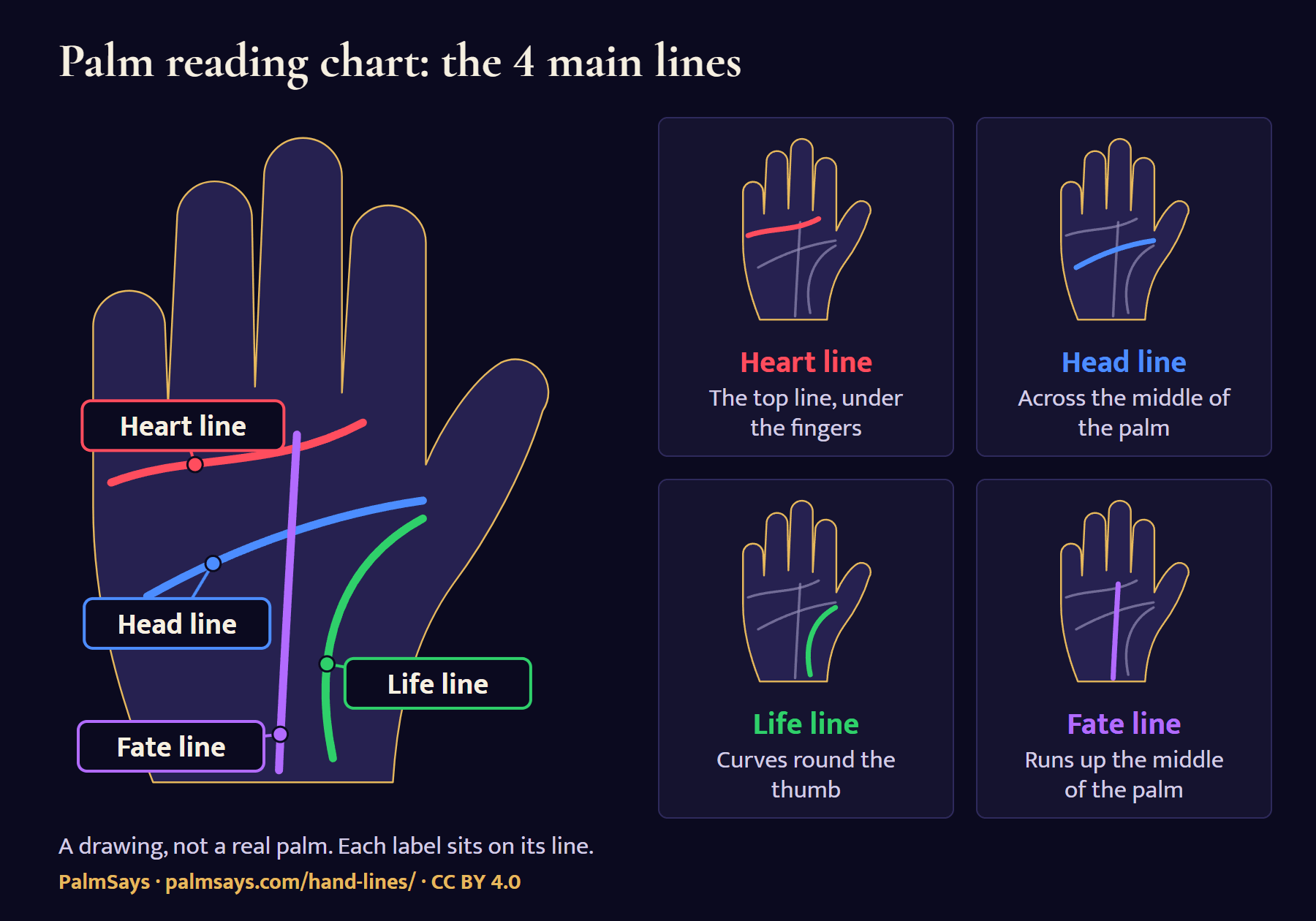
The diagrams on this page are free to reuse under CC BY 4.0 with credit to PalmSays (palmsays.com).Full-size diagram: Palm reading chart: the 4 main lines (PNG, 1800 × 1260)
See your own lines
Upload one photo of your palm. We trace your lines and show what palmistry says about each one.
- Open palm
- Good light
- Whole hand in the frame
A phone photo shows the main lines and their breaks, forks and branches. Tiny marks such as stars and crosses are too small, so an honest reading leaves them out.
Coming soon on Google Play. The Android app is not on Google Play yet. This page will get the link the day it is.
The iPhone app isn’t ready yet. You can keep using this website.
Or see what the palm reading app for Android reads before you install it.