Indian palmistry: Hast Rekha Shastra explained
Indian palmistry, or Hast Rekha Shastra, reads the lines, mounts and shape of the hand. It is often described as part of Samudrika Shastra, and its books also read small signs such as the conch and wheel.
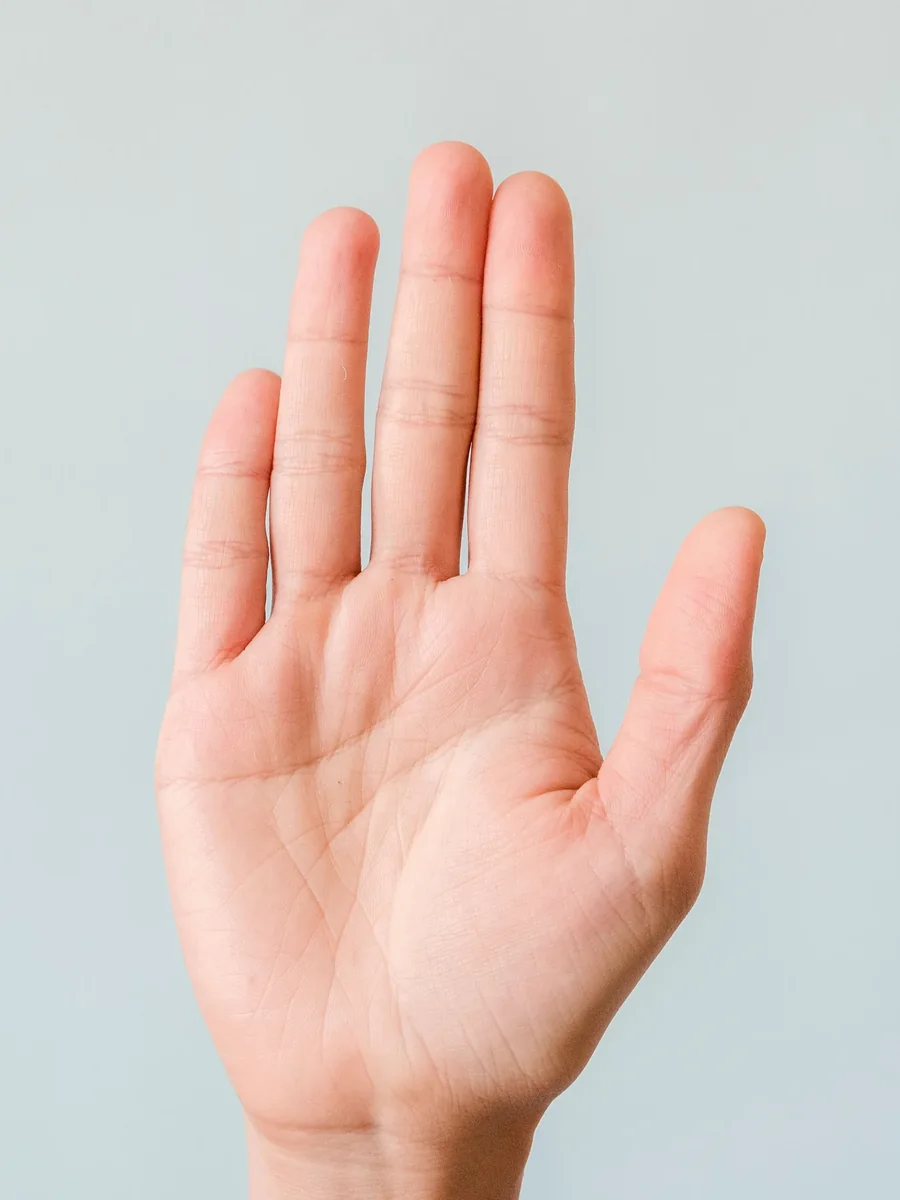
A real palm photo (Kevin Malik, Pexels), traced by the real PalmSays scanner. Your reading is made from your own photo.
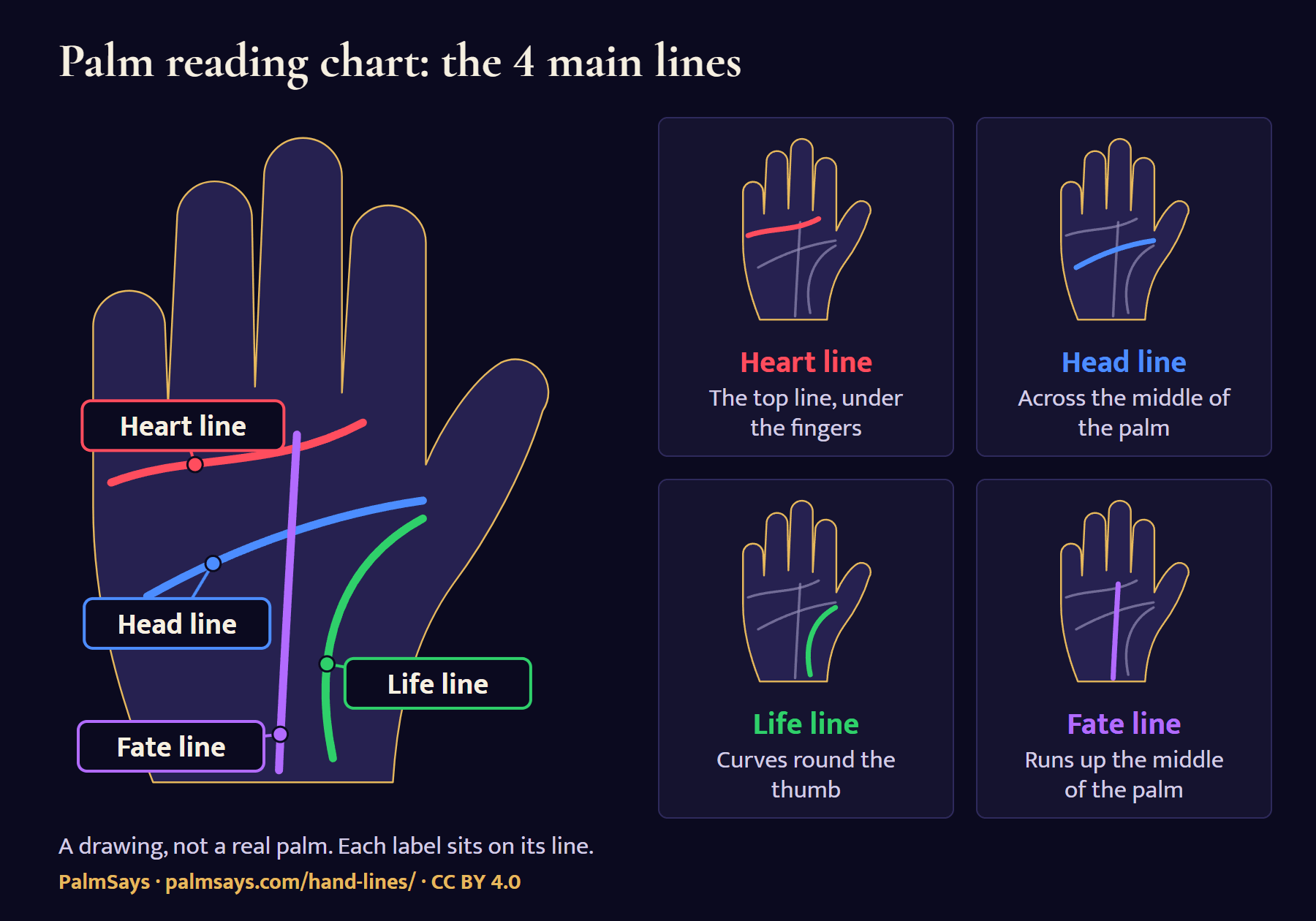
Can you find the four lines the Indian books name?
An Indian book and an English book can call the same crease by different names. Can you find all four on your hand?
- Top line, under the fingers: ayu rekha in Jain’s Hindi book, the heart line in English.
- Across the middle of the palm: matri rekha, the head line.
- Round the base of the thumb: pitri rekha, the life line.
- From the wrist up towards the middle finger: urdhva rekha, the fate line. Many palms show it faintly or not at all.
On this page
- What is Indian palmistry?
- What do Indian palmists read on the hand?
- What are the Indian names of the palm lines?
- What do the conch, wheel and barley signs mean?
- Why does Indian palmistry look at the thumb?
- Which hand does Indian palmistry read?
- How old is Indian palmistry?
- Is the book called Indian Palmistry really Indian?
- How can you try this on your own hand?
- Questions people ask
- Sources
What is Indian palmistry?
Indian palmistry is the reading of the hand as it was written down in Sanskrit and Hindi books, and in English books about India. Its Hindi name is हस्त रेखा शास्त्र (Hast Rekha Shastra), roughly “the study of the lines of the hand”.
It is often described as part of सामुद्रिक शास्त्र (Samudrika Shastra), which reads the whole body. N. Chidambaram Iyer, who translated the Brihat Samhita in 1884, calls palmistry a branch of Samudrika. The chapter he translated reads the whole body, and only a few verses are about the palm.
So a reader in this tradition may look past the palm too. One example is on our page about the mole on the palm.
What do Indian palmists read on the hand?
The Indian books we opened read four things: the long lines, the mounts, the thumb and small signs. The first two are shared with Western books. The other two get far more attention here.
- Lines. Jain’s Samudrik Shastra (1927) names four chief lines and places each by the mounts it passes. The table below gives his names.
- Mounts. The pads of the palm carry planet names: Guru (Jupiter), Shani (Saturn), Surya (Sun), Budh (Mercury), Shukra (Venus), Chandra (Moon) and Mangal (Mars). Our guide to palm mounts shows where each one sits.
- The thumb. Marks on the thumb and at its root have their own verses and sections.
- Signs. Small shapes in the skin, such as a conch or a wheel, are read as separate from the lines.
What are the Indian names of the palm lines?
Jain calls the four chief lines ayu, matri, pitri and urdhva rekha. Each name belongs to one crease, and the crease you might expect is not always the one meant.
| Where the crease runs | Common English name | Jain (1927) | Dale (1895) |
|---|---|---|---|
| Under the fingers, from below the little finger towards the index finger | Heart line | आयु रेखा (ayu rekha) | Line of the Heart, “or the line of Fortune in India” |
| Across the middle of the palm, towards the outer edge | Head line | मातृ रेखा (matri rekha) | Line of the Head and Brain |
| Curving round the thumb to the wrist | Life line | पितृ रेखा (pitri rekha) | Line of Life |
| From the wrist up to the middle finger | Fate line | ऊर्ध्व रेखा (urdhva rekha) | Line of Saturn |
The trap is आयु, the Hindi word for age or lifespan. In English books the “life line” is the curve round the thumb. In Jain, the ayu rekha is the top line under the fingers, and he calls it the chief line, saying about half of a palm reading comes from it.
So two people can say “life line” and mean different creases. Ask which one they mean. Neither name means the line measures your years: a short life line is not a short life.
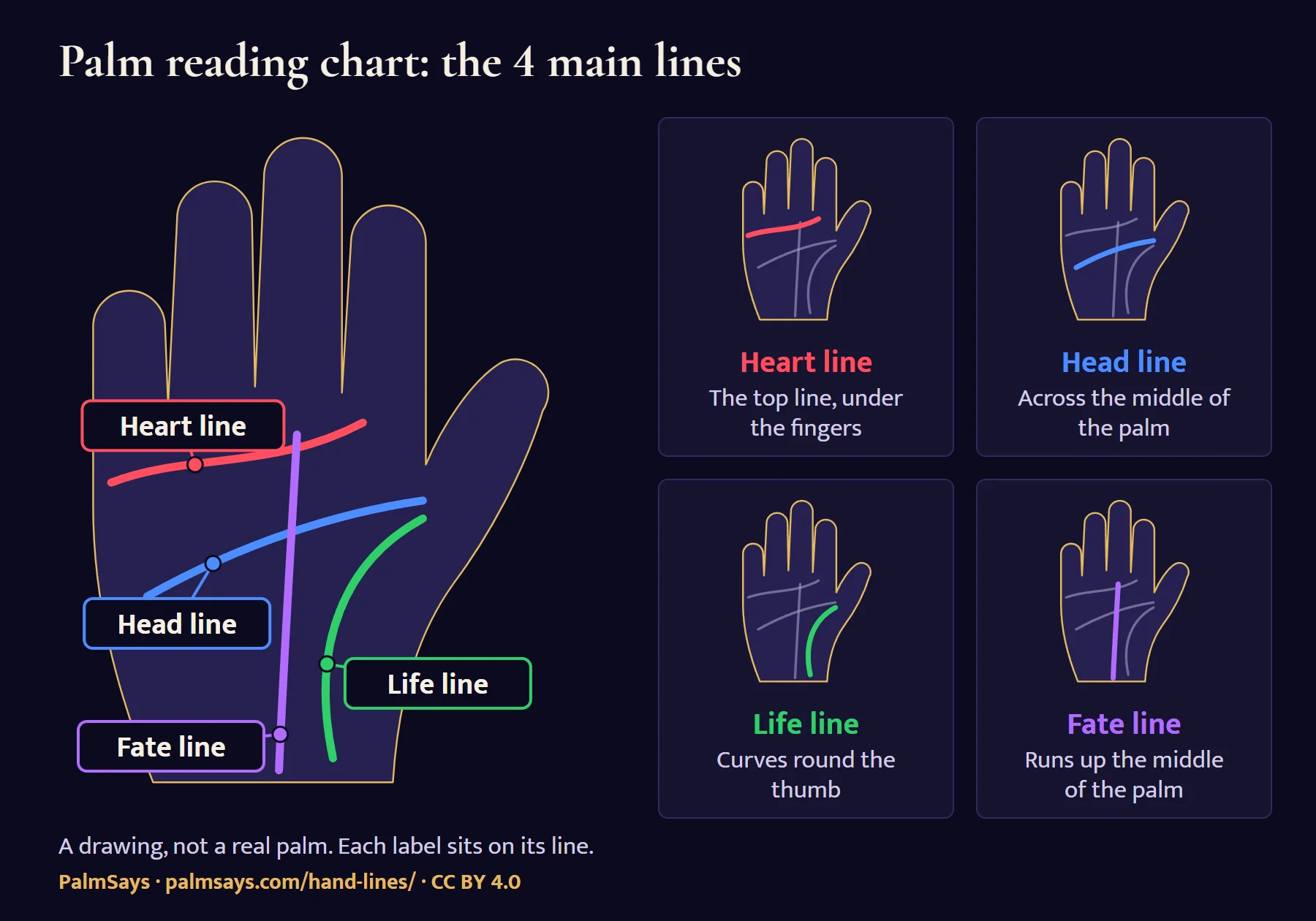
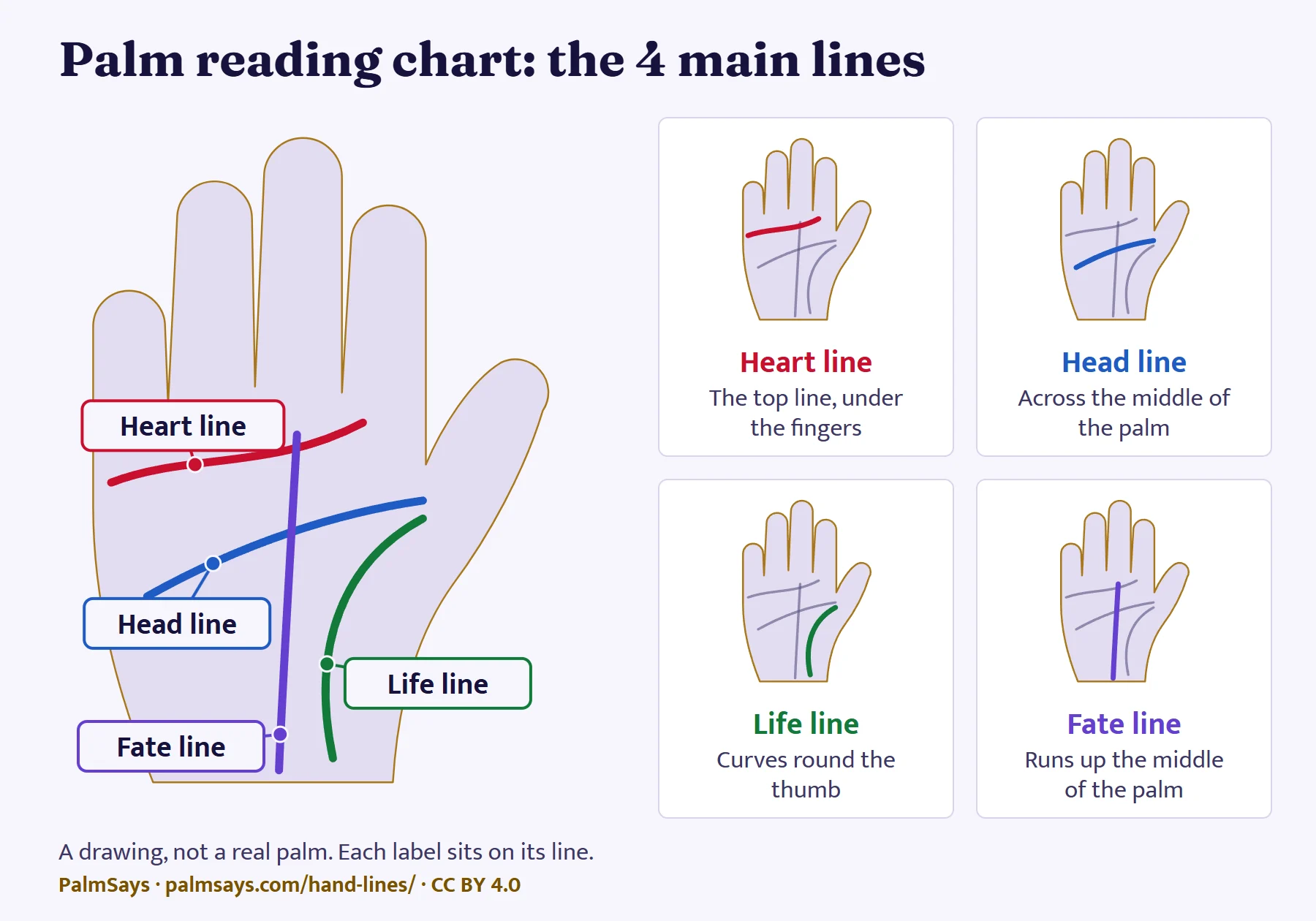
The ayu rekha in Jain’s book is the top line under the fingers, not the curve round the thumb that English books call the life line.
What do the conch, wheel and barley signs mean?
They are small shapes in the skin of the palm and fingers, and the Indian books list them at length. Jain opens his section on the palm with four of them: शंख (conch), चक्र (wheel), यव (barley grain) and पद्म (lotus).
The list is old. Verses 45 to 48 in chapter 68 of the Brihat Samhita include these shapes in the lines of the palm:
- a fish tail, a conch, an umbrella, a palanquin, an elephant, a horse and a lotus;
- a pot, a flag and an elephant driver’s hook;
- a discus, a sword, an axe, a club, a spear and a bow;
- a crocodile and a cow-shed.
These verses and Jain’s section tie the shapes to rank and riches. Those are forecasts, so we don’t repeat them. What the lists do show is how the reading works: it looks for a picture in the skin.
Dale’s Indian Palmistry (1895) reads the same kind of detail, in English terms. It lists concentric circles and a “shell form” made by the pores of the skin, and “corn or diamond loops” on the joints of the fingers. These sound like the ridge patterns of the skin, so you may find one by chance. Finding one tells you about your skin, not your future.
A phone photo can’t show marks this small, and the PalmSays scan doesn’t read them.
Why does Indian palmistry look at the thumb?
Indian books give the thumb its own marks, and two Western palmists wrote that India reads almost everything from it. They overstate the case, as the Indian books themselves show.
Cheiro (1900) says that in India “they make the thumb the center and foundation”, whatever system is used. Benham (1900) goes further, saying that many readers there build their whole work on it. Neither names an Indian book.
The books we opened show something milder. The Brihat Samhita reads shapes at the root of the thumb, and Jain has several lines on a barley mark in the thumb. But Jain also gives each long line its own section, so the thumb is one topic among several.
Which hand does Indian palmistry read?
Dale records the rule as a man’s right palm and a woman’s left. Then she adds a practical note: “take the hand in which the signs and lines are clearly shown”.
In palmistry tradition, the writing hand is read as the life you are making, for women and men alike. Our guide on which hand to read sets out each view. If you were told one hand as a child, you can look at both.
How old is Indian palmistry?
The oldest dated Indian text we could check is the Brihat Samhita, from the 6th century AD. Older dates exist, but they come from stories.
Cheiro says the most ancient records are Indian, and names no dated text. Dale’s preface cites a story of a wheel mark on the Buddha’s foot to argue the art is older still; that is a story, not a dated palm reading text.
We also found no palm reading passage we can date to the Vedas, so treat “Vedic palm reading” as a modern label. The fuller account, Greece and Europe included, is in our history of palmistry.
Is the book called Indian Palmistry really Indian?
Only partly, by its own account. Mrs Dale says she draws her main matter from two European writers, Dr J. Rothman and George Wharton, “together with some of the choicest of those of the East”. Her preface dates Wharton’s translation of Rothman to 1652.
So this old English book is a mix, and it shows. Its mounts carry Roman planet names and its wrist lines are the “Dragon lines”. Jain’s Hindi book mixes too: when he reaches the fish sign, he adds what “Western scholars” think of it.
This is why we say “the Indian books we opened” and not “ancient Indian wisdom”. By the time these books were printed, the traditions had already met. For a side by side view, read our post on Indian, Chinese and Western palmistry.
Did you know?
- The word for lifespan names the heart line. In Jain’s Samudrik Shastra (1927), the ayu rekha is the top line under the fingers, not the curve round the thumb.
- Two Hindi books of 1927 share much of their text. Jain’s Samudrik Shastra and Vishwakarma’s Bhagya Pariksha name different authors. We compared the scanned texts, and about half of the distinct lines we checked match exactly, scanning errors and all.
- An old book called Indian Palmistry names European sources first. Dale’s preface of 1895 credits Rothman and Wharton before “those of the East”.
How can you try this on your own hand?
You need one minute, good light and your palm facing you.
- Find the four creases in the table, using the English names if they come easier. Then say the Hindi name of each.
- Look at the base of your thumb and the joints of your fingers. Can you see a small barley shape?
- Compare your two hands. Which one shows the lines more clearly?
For the wider method, see how to read palm lines. The PalmSays scan traces your heart, head, life and fate lines from a photo, and its meanings come from named books.
Ready to test what you know? Try the palm reading quiz.
Quick facts
- Other names
- हस्त रेखा शास्त्र (Hast Rekha Shastra), hast rekha, Indian hand reading.
- Wider tradition
- सामुद्रिक शास्त्र (Samudrika Shastra), the reading of the whole body. Palm reading is often described as a part of it.
- What the books read
- Lines, mounts, the thumb, and small signs such as the conch, wheel, barley grain and lotus.
- Oldest dated text we checked
- Varahamihira’s Brihat Samhita, 6th century AD, chapter 68.
- Which hand
- Dale (1895) records the eastern rule of a man’s right palm and a woman’s left, then says to read the clearer hand.
- What it can’t do
- Foresee events, health or how long you live. Is palmistry real?
Questions people ask
What is Hast Rekha Shastra?
It is the Indian name for palm reading: the reading of the lines, mounts and shape of the hand. It is a tradition for reflection, not a forecast.
Is Hast Rekha the same as Samudrika Shastra?
No. Samudrika Shastra reads the whole body, and palm reading is often described as a part of it. Iyer’s 1884 translation of the Brihat Samhita calls palmistry a branch of Samudrika.
What is the ayu rekha in palmistry?
In Jain’s Hindi book of 1927 it is the top line under the fingers, the line English books call the heart line. The name does not mean any line measures how long a person lives.
Is there a Vedic palm reading?
We found no palm reading passage we can date to the Vedas. The oldest dated Indian text we could check is the Brihat Samhita, from the 6th century AD. Treat “Vedic” as a modern label.
Which hand is read in Indian palmistry?
Dale’s book of 1895 records a man’s right palm and a woman’s left as the rule in the East, then says to read the hand where the lines show clearly. Our guide on which hand to read compares the views.
How is Indian palmistry different from Western palmistry?
The clearest difference is the attention to small signs and the thumb. The printed books overlap a lot, though. The post on Indian, Chinese and Western palmistry compares them.
Sources (6 books and studies)
- Varahamihira (1884). The Brihat Samhita of Varaha Mihira, translated by N. Chidambaram Iyer. Chapter 68, On the Features of Man, verses 43–48; translator’s introduction, on Samudrika (Madura: South Indian Press).
- Mrs J. B. Dale, Indian Palmistry (1895). Preface; References to Hand (the entries on concentric circles, shell form and corn or diamond loops); The Hand to Examine; the line of the Heart.
- Chhotelal Jain, Samudrik Shastra ya Bhagya Nirnay (1927). The opening section on the four chief lines; the section on signs of the palm (facts only, in our words). (in Hindi)
- Mangalprasad Vishwakarma (1927). Bhagya Pariksha (Samudrik Shastra). Compared line by line with Jain 1927 (facts only, in our words).
- Cheiro, Cheiro’s Language of the Hand (1900). Part I, the chapter on the thumb (India and the thumb); opening chapter, A Defense (the claim of the oldest records).
- William G. Benham, The Laws of Scientific Hand Reading (1900). The chapter on the thumb (facts only, in our words).
Meanings on this page are written in our own words from these books. Books whose rights are unclear are used for facts only, never quoted. How we choose sources
The diagrams on this page are free to reuse under CC BY 4.0 with credit to PalmSays (palmsays.com).Full-size diagram: Palm reading chart: the 4 main lines (PNG, 1800 × 1260)
See your own lines
Upload one photo of your palm. We trace your lines and show what palmistry says about each one.
- Open palm
- Good light
- Whole hand in the frame
A phone photo shows the main lines and their breaks, forks and branches. Tiny marks such as stars and crosses are too small, so an honest reading leaves them out.
Coming soon on Google Play. The Android app is not on Google Play yet. This page will get the link the day it is.
The iPhone app isn’t ready yet. You can keep using this website.
Or see what the palm reading app for Android reads before you install it.
Read next: A short history of palmistry